Four museums that dig into the subsoil of the centre and a city that still carries the name of its founder two thousand years later. What to see, in what order and why the combined ticket pays off.
Zaragoza is one of the very few cities in the world that still carries, warped by Arabic and by the Romance tongue, the name of the emperor who founded it: Caesar Augusta became Saraqusta and from there Zaragoza. And it is not only the name. The whole city lies beneath the centre, and four museums let you go down and see it.
The combined ticket for the Caesaraugusta Route covers the four museums and works out much cheaper than separate visits. You buy it at any of them and they are all under cover.
A colony for discharging legionaries
Founded around 14 before Christ.
Caesaraugusta was founded as a colony to settle legionary veterans discharged after the Cantabrian Wars, and that origin explains its layout: a regular grid of perpendicular streets with two main axes, the cardo and the decumanus, and a forum where they crossed.
Nor was the location an accident. Here the Ebro was navigable with cargo, so the city was connected by river with the Mediterranean and at the same time sat on the knot of the roads that joined up the north-east of the peninsula. It was a port and a crossroads at once.
The wall went up later, probably in the third century, when insecurity forced the cities of the empire to fortify themselves. It had a perimeter of some three kilometres and more than a hundred towers, and the best preserved stretch is next to the Torreón de la Zuda, at the western end of the Plaza del Pilar.
The line of that wall still shapes the city: the Coso, the curving street that rings the old town, still traces it. To walk along it is to walk on top of the third-century enclosure.
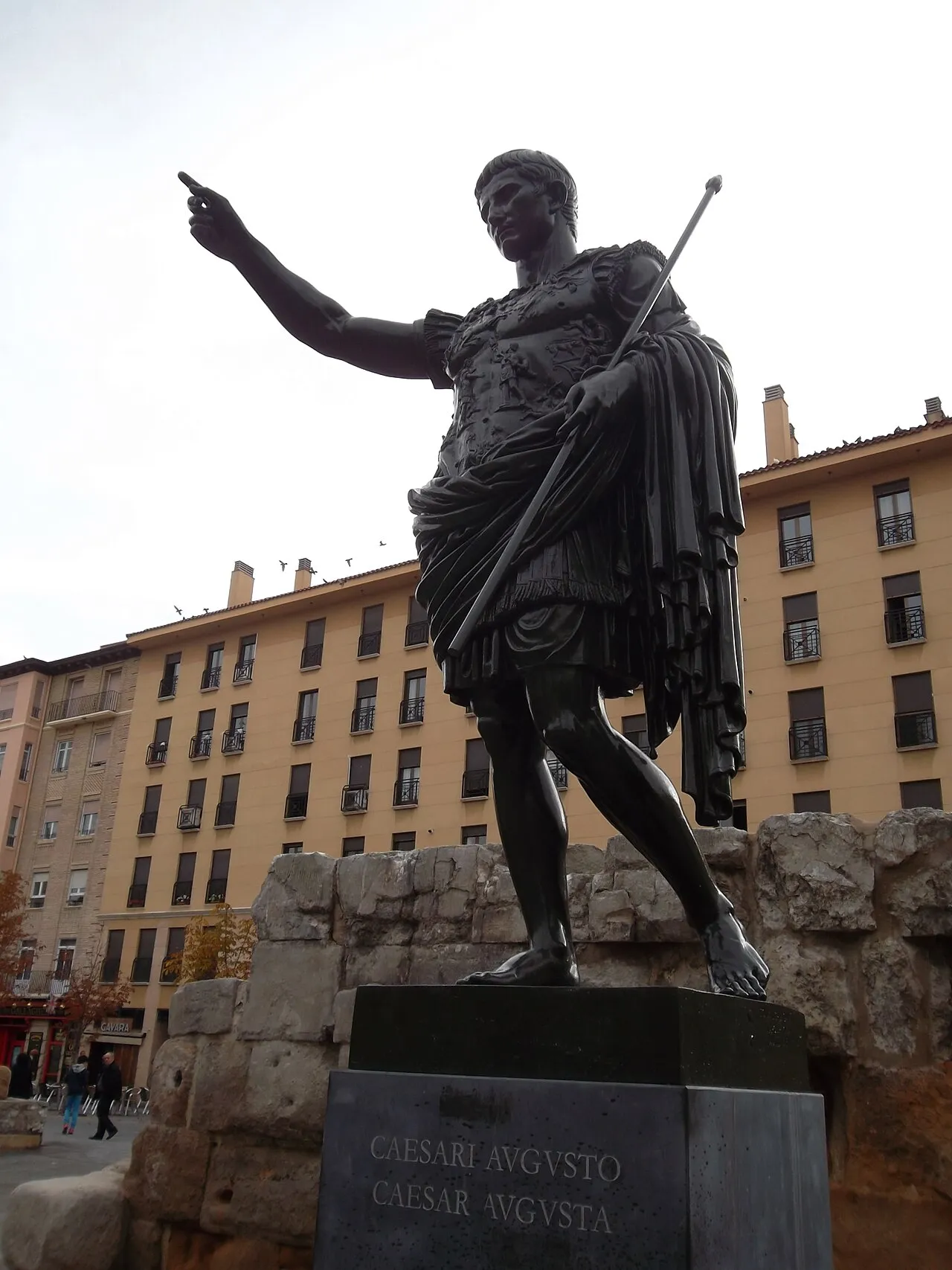
The surviving stretch lets you see the technique: a core of Roman concrete faced with ashlar, with semicircular bastions to cover the foot of the wall. The statue is a copy of the Prima Porta in the Vatican, and its raised arm is the gesture of a general addressing his troops.
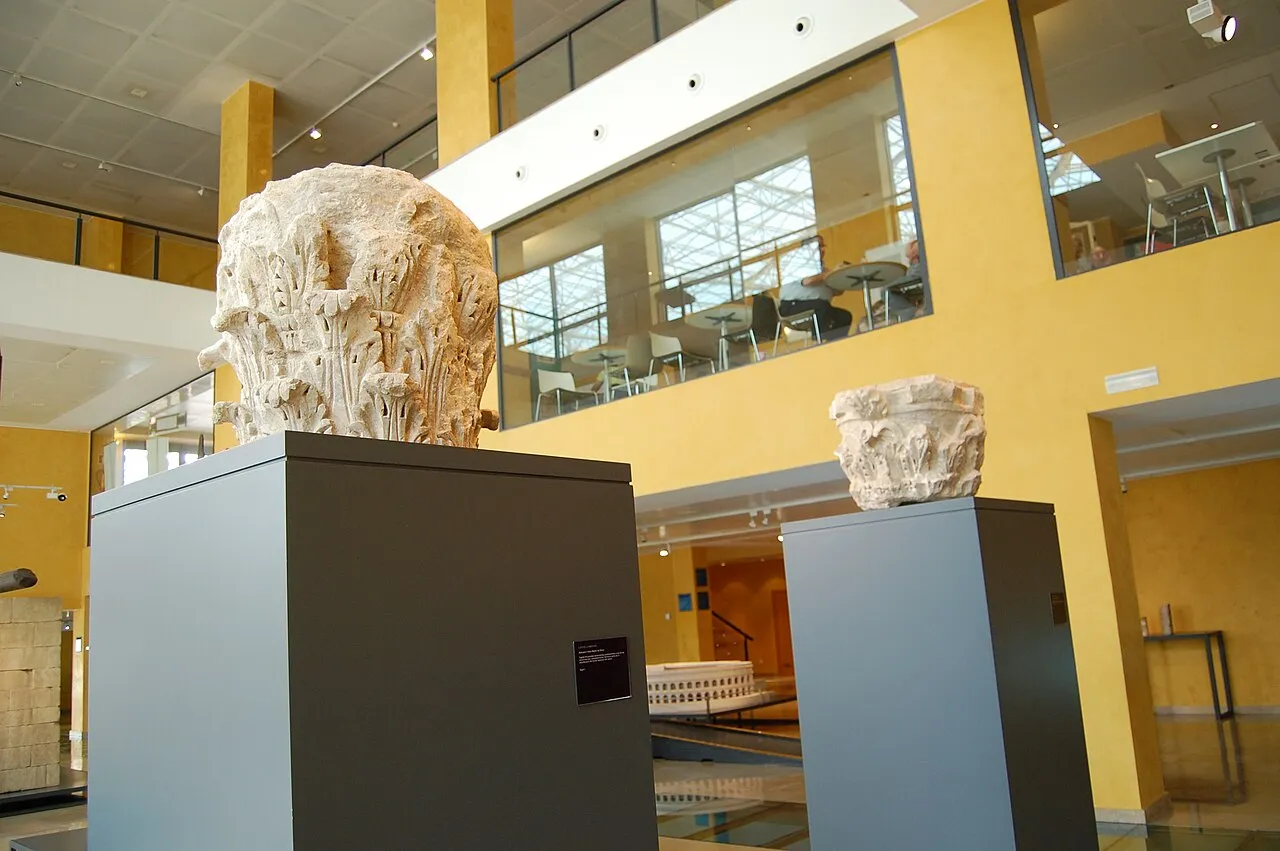
The forum was main square, court, market, local government and religious space all at once. Foundations, porticoes, water channels and a stretch of vaulted sewer you walk through have survived. Do this one first: it gives the best general context.
The largest Roman remain in the city lay under the houses of the centre for almost two thousand years without anybody knowing. It appeared in 1972 when some buildings were knocked down to build on the site, and the excavations gradually confirmed that beneath a whole block there was a complete theatre.
It was built in the first century, in the time of Tiberius, with room for some six thousand spectators, which places it among the largest in Hispania and gives the measure of what this colony was. The seating was arranged in three levels with separate access, and that division was strictly social.
The museum solution is among the best in Spain. A translucent roof protects the whole from the rain without closing it in or darkening it, and the route runs along raised walkways. The design also takes in the medieval and modern houses built on top of it over the centuries.
If you are only going to do one of the four museums, this is by far the most impressive. It includes a projection that virtually reconstructs the complete building, and in this case that device really does add something, because from the surviving tiers it is hard to imagine the original volume.
The port and the latrines
The Museum of the River Port documents something surprising: Zaragoza is three hundred kilometres from the sea and it had a port. The Ebro was navigable with cargo as far as here, and in antiquity river transport was incomparably cheaper and more efficient than transport by land.
Up it came Baetican oil, wine, salted fish, ceramics and garum from the Mediterranean ports. Part of the quay, steps down to the water and vaulted warehouses of Roman concrete you can walk through have survived. The Ebro, incidentally, gave Iberia its name: the Greeks called it the Iber.
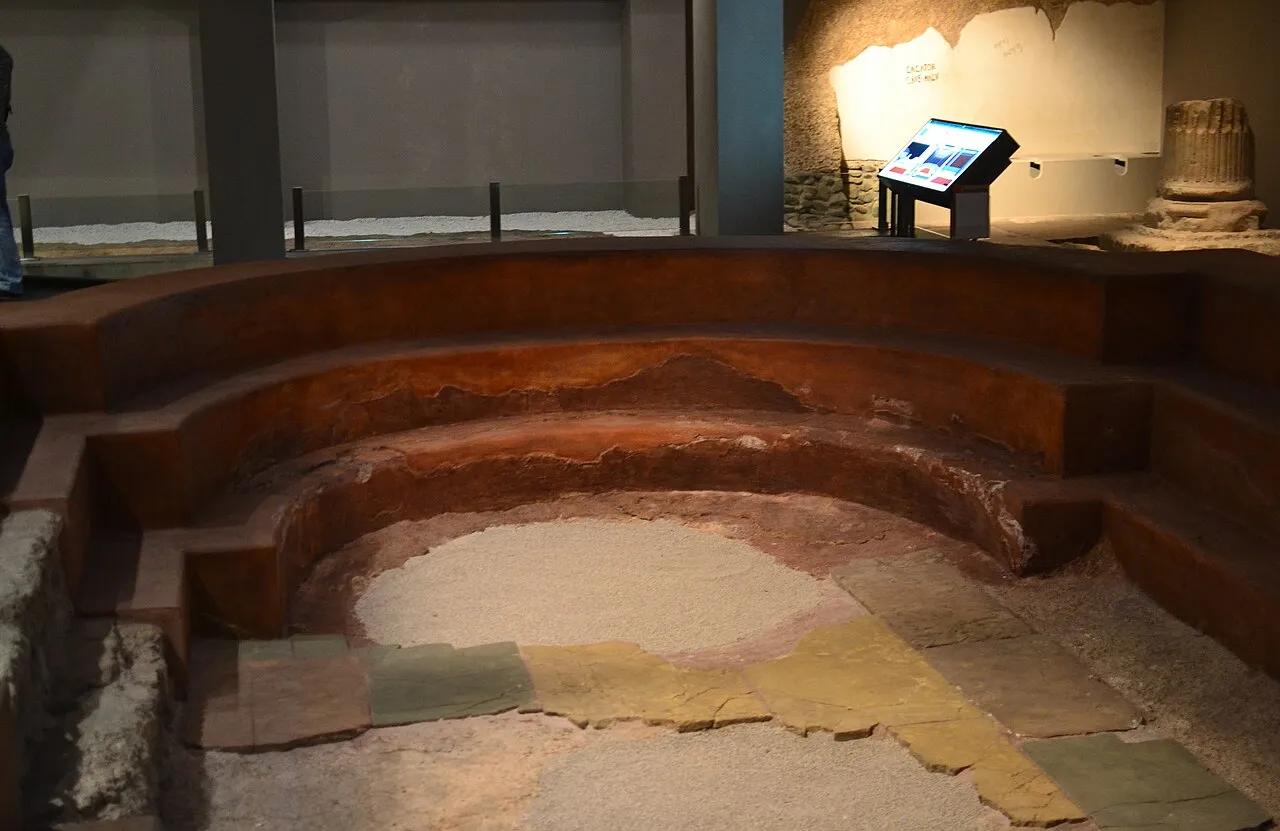
And there is the Baths museum, the most domestic. It preserves the remains of a porticoed pool and, above all, of a set of public latrines: a long room with perforated stone benches, with no partitions of any kind, where people sat in a row and talked.
Underneath ran a channel of continuous water that carried the waste away, and in front of it a smaller one of clean water for rinsing the sponge fixed to a stick that you cleaned yourself with, which was for common use. It is the thing people remember most from the whole Roman route, and with good reason.
Six thousand spectators, three levels of seating with separate access and a strict social hierarchy: the higher up, the lower the status. Women and slaves, right at the top. Forty minutes with the projection included.
Vaults of Roman concrete preserved high enough to walk underneath. The same material that made the Pantheon possible, here in its utilitarian version. Twenty-five minutes, and when you come out the Ebro is a step away.
The baths were not only about hygiene: they were where social life happened and deals were closed, with a very cheap or free entrance subsidised by magistrates after popularity. Twenty minutes, and it is worth reading the panels.
The set of four museums that excavate and display the Roman remains in the subsoil of Zaragoza: the forum, beneath the Plaza del Pilar; the river port, next to the Seo; the public baths; and the theatre, in the barrio de la Magdalena. They are visited with a combined ticket that works out much cheaper than the four separately.
Which is most worth it if I only do one?
The theatre, no argument. It is the largest Roman remain in the city, with room for some six thousand spectators, and it has the best museum solution: raised walkways under a translucent roof, with the medieval houses built on top of it taken into the route. Forty minutes with the projection.
Is it true the theatre turned up by chance?
Yes. In 1972, when some buildings in the centre were knocked down to build on the site, Roman structures appeared, and the later excavations confirmed that beneath a whole block there was a complete theatre. The works were stopped and the site became a dig. Nobody knew it was there.
Did Zaragoza really have a port?
Yes, and it is documented with remains: quay, steps down to the water and vaulted warehouses. The Ebro was navigable with cargo as far as here, and in antiquity river transport was incomparably cheaper than transport by land, which turned the city into a commercial knot between the Mediterranean and the interior.
Where does the name of the city come from?
From its founder. It was called Colonia Caesar Augusta, after the emperor Augustus, who founded it around 14 before Christ to settle legionary veterans. In Arabic it became Saraqusta and from there came Zaragoza. It is one of the very few cities in the world that still carries the name of its founder two thousand years later.
Where can you see the Roman wall?
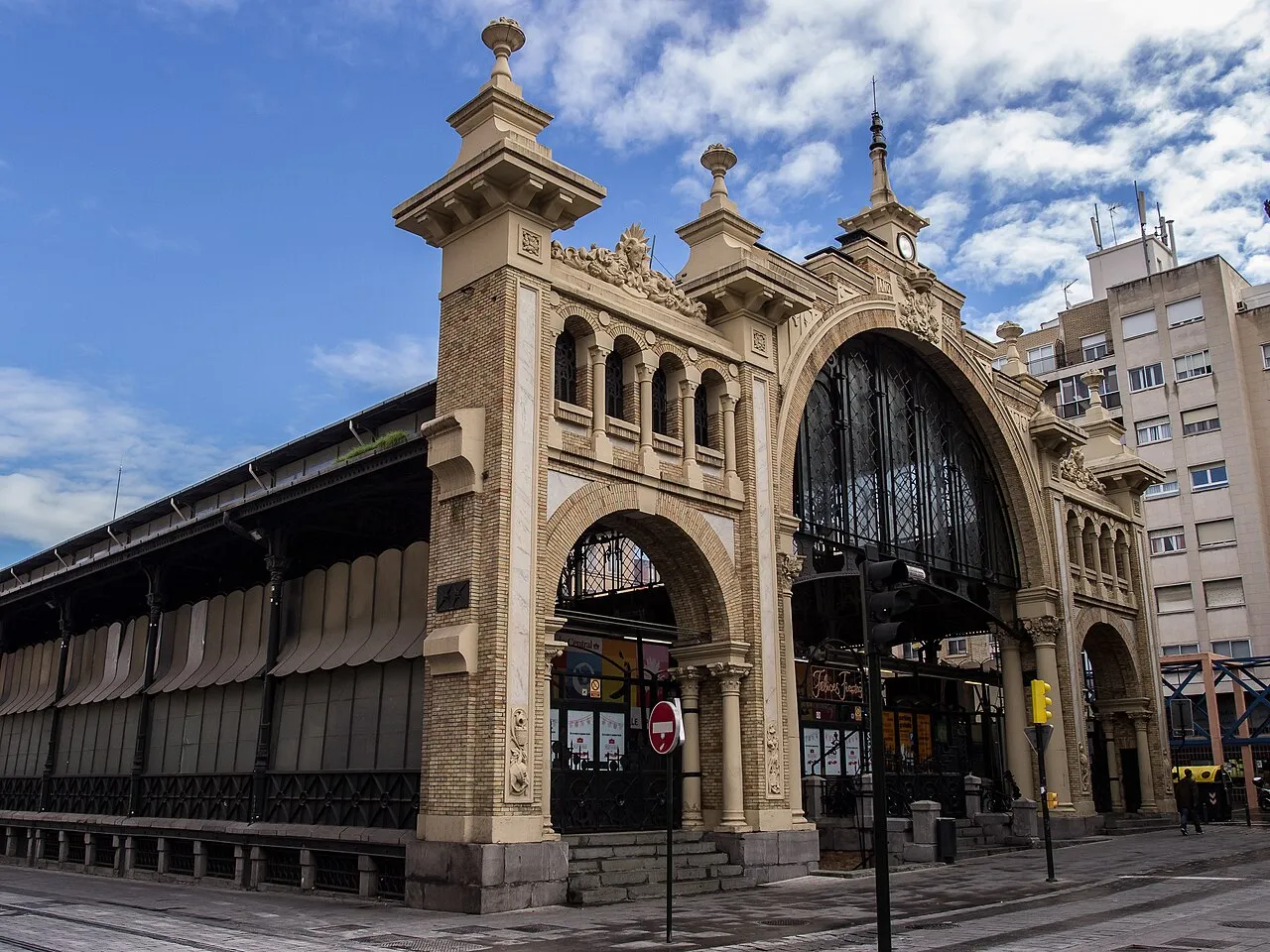
The best preserved stretch is on the avenida César Augusto, next to the Torreón de la Zuda, at the western end of the Plaza del Pilar, and you can walk round the outside of it for free. There is another visible stretch next to the Mercado Central. And the Coso, the curving street that rings the old town, still traces the complete line of the enclosure.
Practical information
The fourForum, river port, baths and theatre. The combined ticket is much cheaper than separate ones.
The orderForum first for the context, theatre after for the impact. The other two, in any order.
DurationA good half-day for all four. Forty minutes for the theatre alone.
ClosuresThey all close on Mondays. Check seasonal opening hours.
The advantageThey are all under cover: the ideal plan for a rainy day or a hot afternoon.
ExtraThe Museum of Zaragoza, on the Plaza de los Sitios, is free and completes the archaeological collection.
On the map
🎧 With Viavoy
Walk Zaragoza and listen at your own pace
Download Viavoy and walk Zaragoza offline, whenever you like.
from 2,99 €· one-off payment
City Pass · 9,99 €3 days, all the tours in Zaragoza