Puerto Banús: how you invent an Andalusian village from scratch
In 1970 there were only reed beds here. A Catalan developer, a designer from Beverly Hills and an opening with Grace of Monaco and twenty-two kilos of caviar.
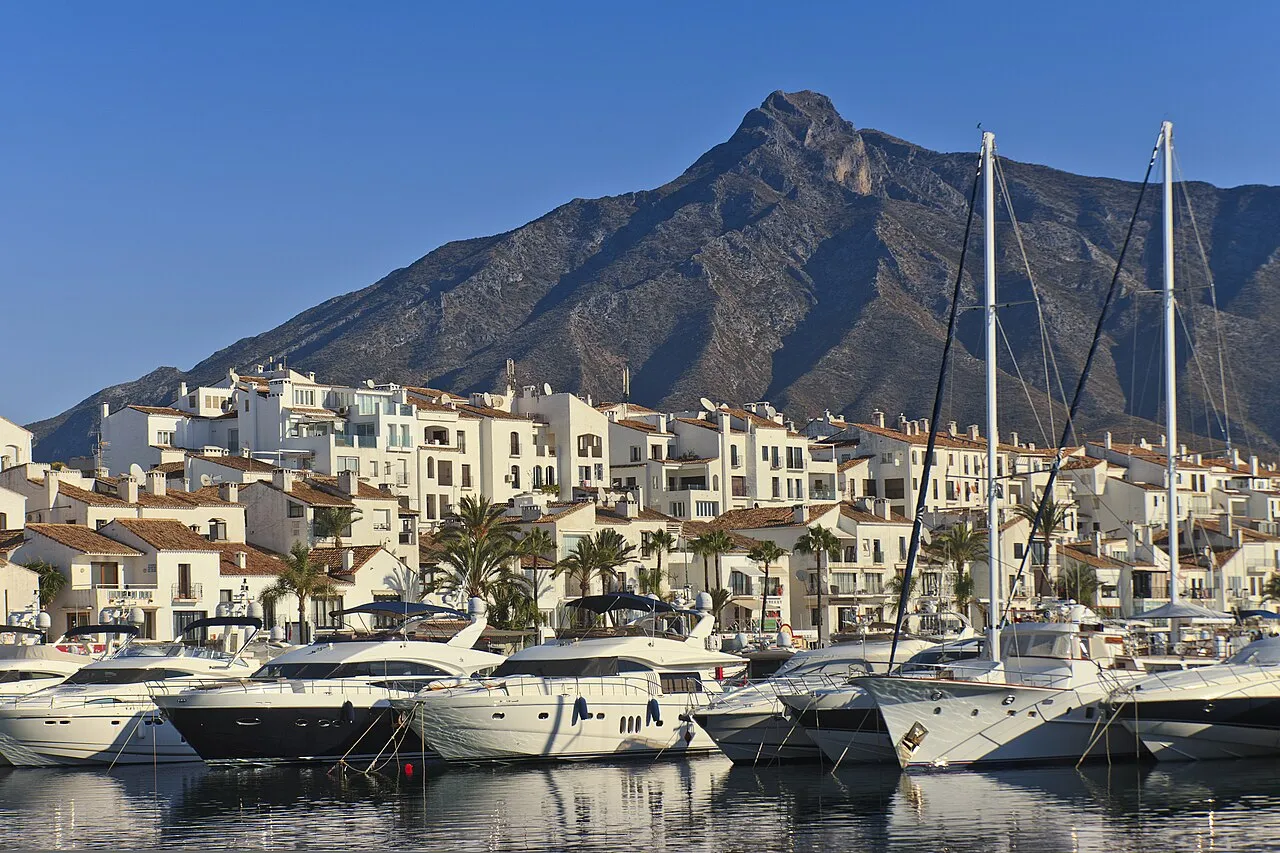
Puerto Banús is usually visited to look at yachts and shop windows, and that leaves out the most interesting thing: it is one of the most influential experiments in tourist town planning in twentieth-century Europe. A completely fake Andalusian village, built from scratch in 1970, which today is indistinguishable at first glance from a real one.
The key decision was not to build a luxury marina, but to disguise it as a village that had always been there. On a coast that was filling up with blocks of flats, that was a radical idea.
A builder of workers' housing who moved into luxury
It was built by José Banús Masdeu, a Catalan developer who had made a fortune putting up whole neighbourhoods of housing for workers in post-war Madrid: block after block, mass development and tight margins.
With that fortune he came south to build exactly the opposite. The port carries his full name — Puerto José Banús — and it is a textbook case of how the capital of Spanish residential construction in the fifties and sixties was reinvested in tourism.
The timing is no accident either. At the end of the sixties the Costa del Sol was taking off and filling up with high-rise building, with the mass sun-and-beach model that was imposing itself along the whole Spanish Mediterranean coast.
Banús bet on something else: an upmarket product, with a marina, luxury shopping and an image that did not resemble what was happening two hundred metres further along.
Whitewashed little houses with bougainvillea spilling down the walls, narrow streets and a luxury marina right beside them. All of it raised on what until 1970 was beach and reed beds, in little more than half a century.
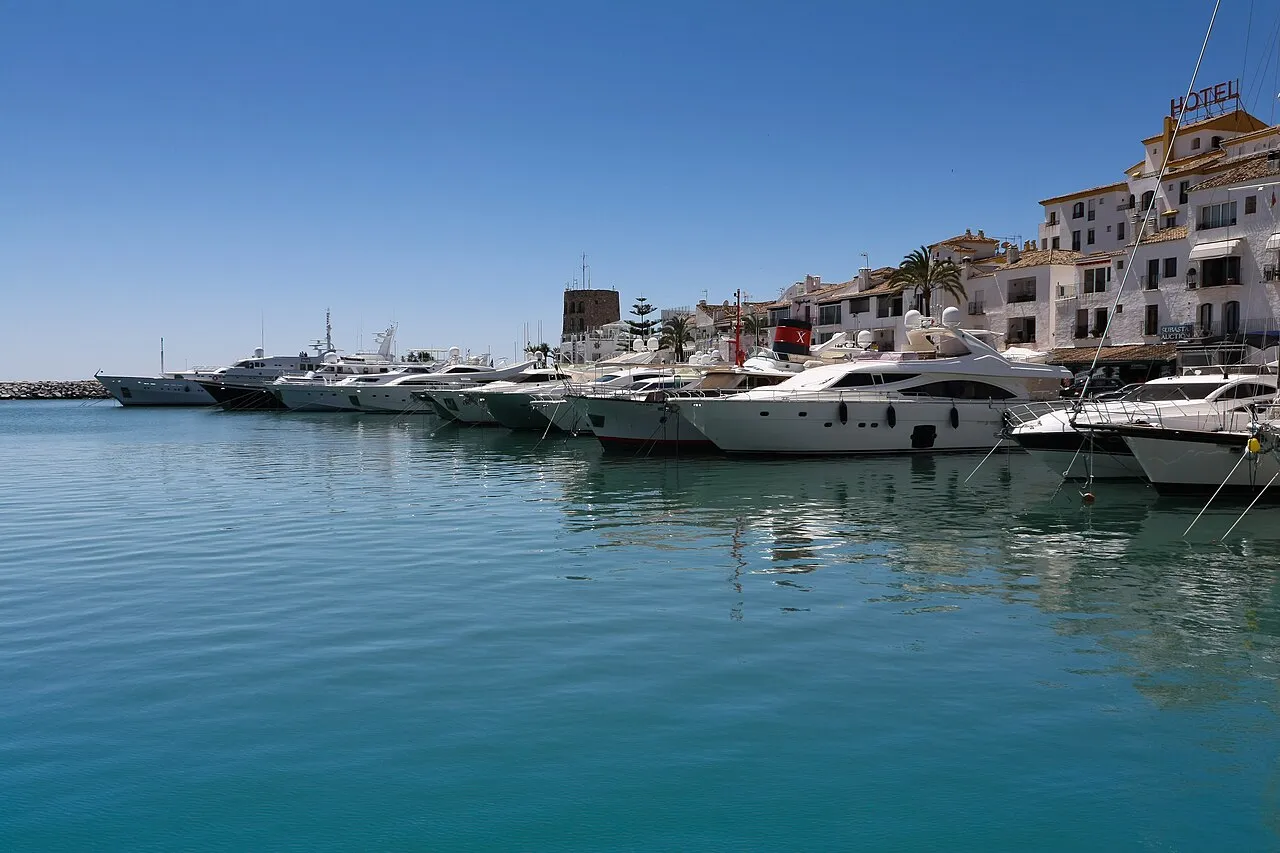
Of the port's thousand berths, only a few are here. The yachts moor stern-on to the promenade with the platform open like a drawing room: you are not paying for metres of water, you are paying for the looks.
Download the app and discover Marbella offline, whenever you like. Take the walking tour Puerto Banús and the marina glamour with a local guide in your ear.
The man responsible for the look was Noldi Schreck, a designer who arrived from working in Beverly Hills, among film sets and stars' villas. That background explains the very odd point between the real and the staged that you still sense as you walk around.
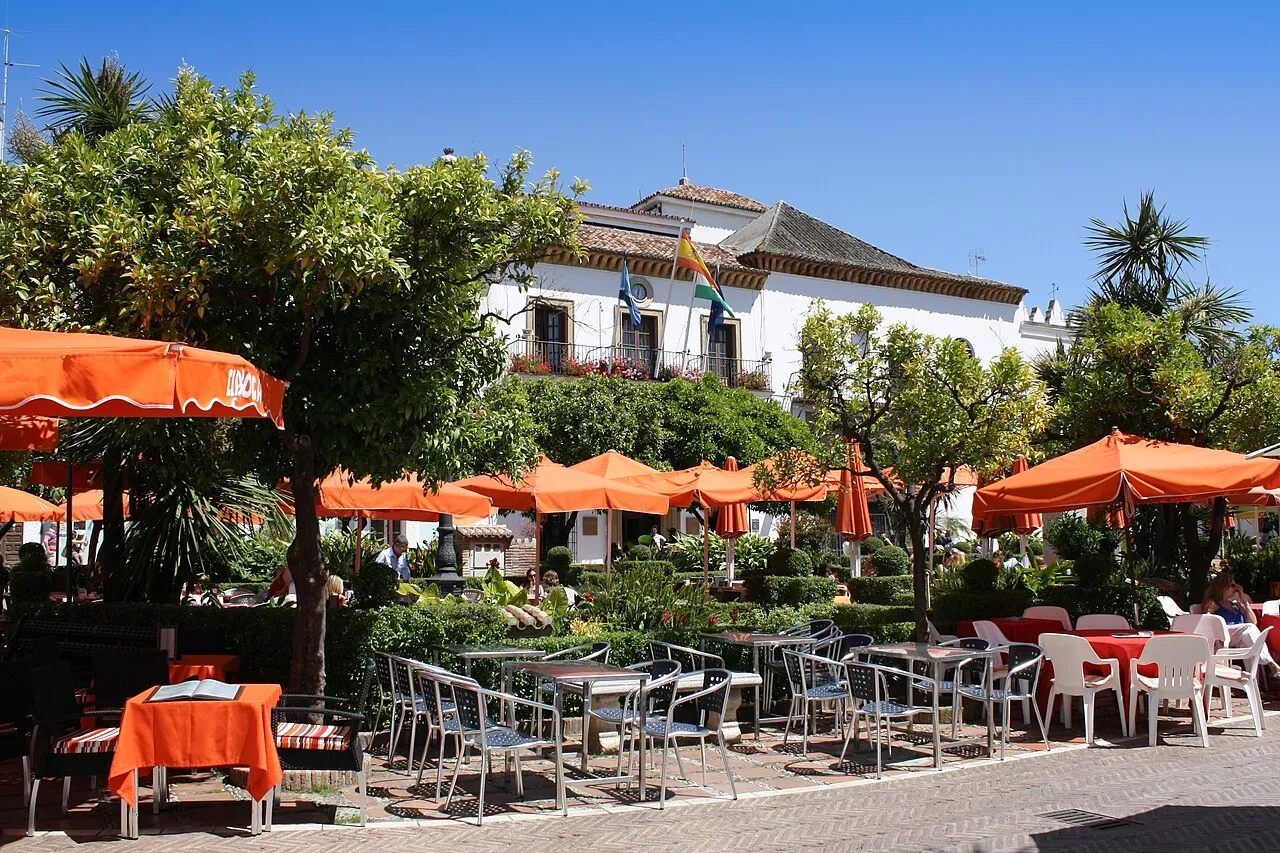
His decision was to fake an old Andalusian village of always: low whitewashed houses, narrow streets, bougainvillea, small squares. On a coast that was filling up with apartment towers, that was going against the current.
And it worked so well that it became a model. A good part of the upmarket tourist town planning of the later Mediterranean — marinas with a fake village around them — follows this formula, and its documentable origin is here.
It is worth looking at it in that key: it is not a village with a port, it is a port disguised as a village, and every element — the height of the houses, the width of the streets, the relationship with the water — is calculated to produce that impression.
The opening, the Saudis and the statue
The opening, in May 1970, was one of those that make history: the Aga Khan came, and Roman Polanski, and Prince Rainier and Princess Grace of Monaco, and three hundred waiters served twenty-two kilos of caviar to one thousand seven hundred guests. To sing, they hired a then almost unknown Julio Iglesias.
What came afterwards consolidated the model. Marbella was for years the summer capital of the Saudi royal family: King Fahd had an immense palace built right next door, with its own mosque, and came down with an enormous retinue. That transformed the local economy for decades.
And on the roundabout at the entrance stands La Victoria, the mass of bronze more than twenty metres tall that the people of Marbella call “the Russian's statue”. It was presented in 1994 as a gift from the mayor of Moscow and ended up in court, with stolen documents and doubts as to whether the piece installed was the one that had been bought.
That episode belongs to another stage: that of Jesús Gil as mayor, which led in 2006 to Operación Malaya, one of the biggest cases of planning corruption in Spain, so serious that the national government dissolved Marbella's town council.
It was signed by the Georgian Zurab Tsereteli, author of the nearly hundred-metre Peter the Great in Moscow that half the city detests. The people of Marbella look at it with a mixture of mockery and affection: it is excessive, and that is why it fits here.
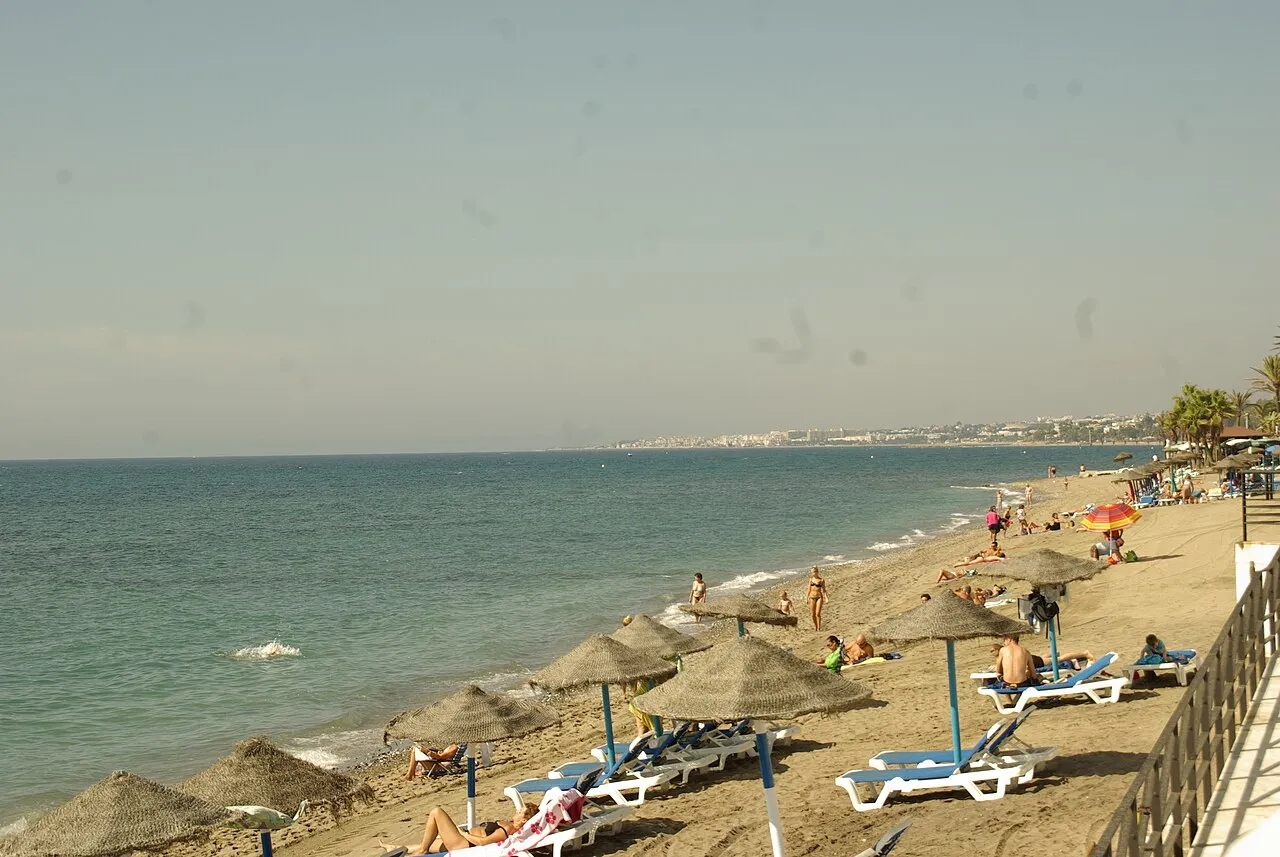
It opened in May 1970. Until then there was only beach and reed beds at this point: everything you see today — the white village, the marina, the shopping streets — was raised in little more than half a century, in the span of one life.
Who was José Banús?
A Catalan developer who had made a fortune putting up whole neighbourhoods of housing for workers in post-war Madrid, and who with that fortune came south to build exactly the opposite: a luxury marina. The full name of the place is Puerto José Banús.
Why does it look like an old village?
Because it is designed to look like one. The key decision of the project was to fake an old Andalusian village of always — low whitewashed houses, narrow streets, bougainvillea — with a luxury marina in front of it, instead of putting up high-rise blocks as was being done all along the coast.
Who designed it?
Noldi Schreck, a designer who came from working in Beverly Hills, among film sets and the villas of Hollywood stars. Hence that very odd point between the real and the staged that you still sense as you walk around, and that has turned the place into a model for half the Mediterranean coast.
What was the 1970 opening like?
A social event of the first order: the Aga Khan attended, and Roman Polanski, and Prince Rainier and Princess Grace of Monaco, and three hundred waiters served twenty-two kilos of caviar to one thousand seven hundred guests. To sing, they hired a Julio Iglesias who was then almost unknown.
What is the statue on the roundabout?
It is called La Victoria, it was signed by the Georgian sculptor Zurab Tsereteli and it was put up in 1994, presented as a gift from the mayor of Moscow. The reality was murkier: it cost public money and two plots of land, it ended up in court with stolen documents included, and there were even doubts as to whether the piece installed was the one that had been bought.
Practical information
When it was builtOpened in May 1970. Until then there was only beach and reed beds here.
WhoJosé Banús, a Catalan developer who grew rich on workers' housing in post-war Madrid.
The designNoldi Schreck, who came from Beverly Hills. Hence that air between the real and the staged.
Getting there7 km from the centre of Marbella, with a frequent city bus.
What to seeThe Muelle de Honor, the streets of the invented village and La Victoria on the roundabout.
DurationTwo hours with the beach included. It works very differently by day and by night.
On the map
🎧 With Viavoy
Walk Marbella and listen at your own pace
Download Viavoy and walk Marbella offline, whenever you like.
from 2,99 €· one-off payment
City Pass · 9,99 €3 days, all the tours in Marbella