Holy Week in Cuenca: Las Turbas and the small hours of Good Friday
What's on · Cuenca

Holy Week in Cuenca: Las Turbas and the small hours of Good Friday

Hundreds of drums and bugles blowing apart the silence of an old town hanging over two ravines. What it is, at what time, where to see it and what to expect.

7 min read · Updated for the season
🎧 On the walk Hanging Cuenca: from the Hanging Houses to the Castle

There are processions that impress through silence and processions that impress through noise. Las Turbas of Cuenca belong to the second kind: in the small hours of Good Friday, hundreds of drums and bugles sound at once, without order and without a score, while the paso advances through the narrow streets of the old town. It is not a parade, it is an organised din.

The name explains it: the turba is the mob that mocked Christ on the way to Calvary. The more noise, the better it does its job. The din is the point, not a side effect.

What Las Turbas are

The procession sets out in the small hours of Good Friday, in the dead of night, and crosses the old town with the image of Jesús Nazareno. What sets it apart is the band: hundreds of drums and bugles playing in a deliberately disordered way, with no direction and no common cadence.

That chaos is intentional and has a very old narrative logic: the turba represents the mob that mocked Christ on the way to Calvary, so the racket imitates that mockery. In terms of popular religious representation, it is one of the most effective solutions there is.

It is a tradition documented for centuries and it is declared of International Tourist Interest. For the people of Cuenca it is not a tourist spectacle but the night of the year, and that shows in how it is lived: there are whole families who have been playing in the same brotherhood for generations.

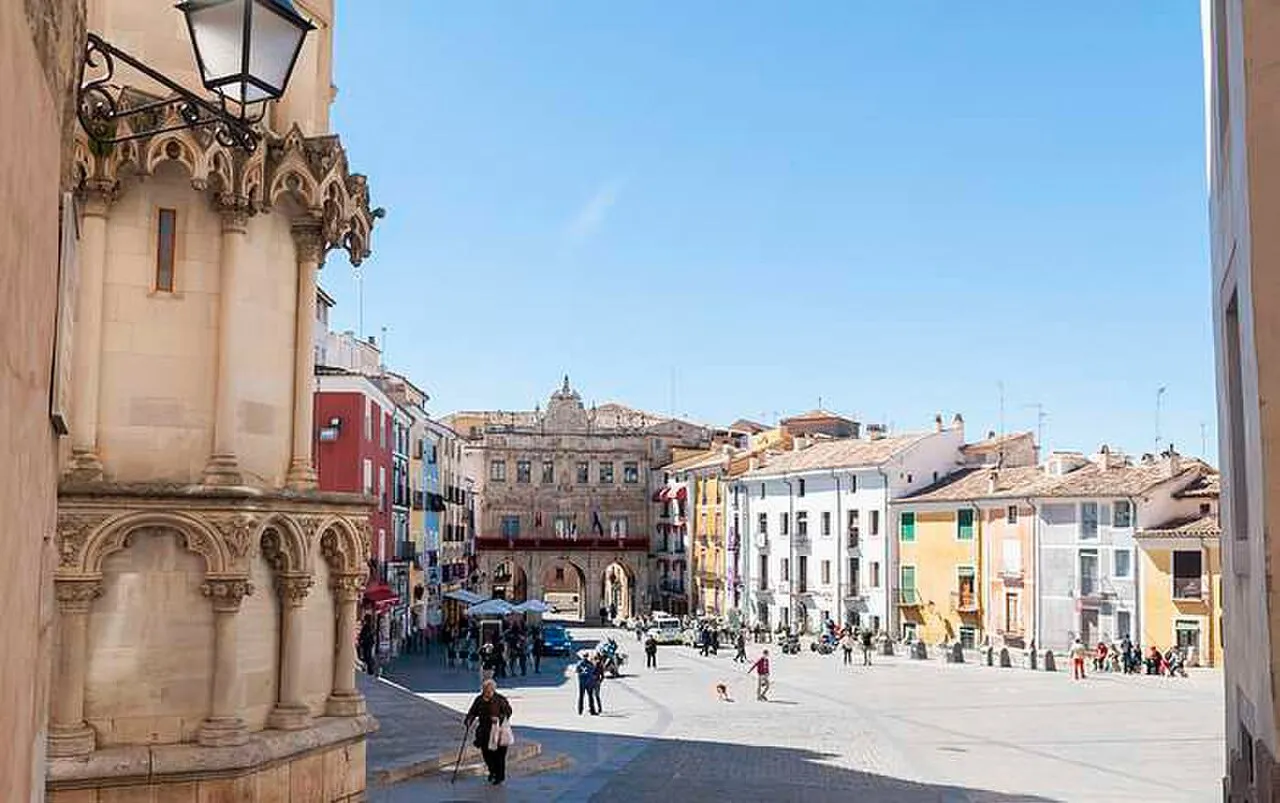
1Plaza Mayor

Plaza Mayor

📍 Heart of the old town

The point where the din reaches its peak, because the square is a triangular funnel closed in stone and the sound bounces back. It is also where most people gather, so if you are after the climax it is here, and if you are after a good view, better on another stretch.

🎧 With Viavoy

Explore Cuenca at your own pace

Download the app and discover Cuenca offline, whenever you like. Take the walking tour Hanging Cuenca: from the Hanging Houses to the Castle with a local guide in your ear.

Find out more about Viavoy →

How to see it

The route passes through the Plaza Mayor, which is where the sound reaches its peak: the square is a triangular funnel closed in stone and the din bounces off the façades. It is also where most people gather, so you have to arrive well in advance to get a place.

If you prefer to see it with more room, the narrow street stretches of the upper old town are a better alternative: it passes closer to you and the acoustic effect between high walls is just as powerful. The ronda de Julián Romero and the streets towards San Pedro work well.

It is cold. It is an April night in a city at a thousand metres of altitude and on rock, and the wait is long: a proper coat, not a jacket. And comfortable shoes, because you are on your feet for a long time and the whole route is uphill and cobbled.

The rest of Cuenca's Holy Week has more than twenty processions over the course of the week, several of them very beautiful and far less crowded, so anyone who does not want early starts or crushes has alternatives every day.

2Ronda de Julián Romero

Ronda de Julián Romero

📍 Upper old town

A narrow, stepped street-cum-viewpoint through which processions pass and from where you see them close up. The acoustic effect between high walls is as powerful as in the square and there are far fewer people. The sensible alternative to the centre.

Frequently asked questions

What are Las Turbas of Cuenca?

The procession of the small hours of Good Friday, in which hundreds of drums and bugles sound at once in a deliberately disordered way while the paso of Jesús Nazareno crosses the old town. It is declared of International Tourist Interest and is one of the most intense Holy Week traditions in Spain.

Why do they play in a disordered way?

Because the disorder is the point. The turba represents the mob that mocked Christ on the way to Calvary, so the racket imitates that mockery. The more noise and the more chaotic, the better it fulfils its narrative function. It is not a band playing badly: it is a band playing that way on purpose.

Where is it best to see it?

In the Plaza Mayor the sound reaches its peak, because it is a triangular funnel closed in stone where the din bounces back, but it is also where most people are and you should arrive well in advance. The narrow street stretches of the upper old town are an alternative: it passes closer to you and with considerably less of a crush.

Is it very cold?

Yes. It is an April night in a city at a thousand metres of altitude, on rock and with draughts from the two ravines, and the wait is long. You need a proper coat, not a light jacket, and comfortable shoes, because you are on your feet for a long time and the whole route is uphill and on cobbles.

Can you visit the monuments during Holy Week?

With limitations. The cathedral restricts its visiting hours because of the services, streets are closed for a good part of the day and getting around the old town becomes much harder. It is not the best week for a conventional sightseeing visit, though it is for experiencing the city at its most intense.

Are there more processions besides Las Turbas?

More than twenty over the course of the week, several of them very beautiful and far less crowded. Anyone who does not want early starts or crushes has alternatives every day, and some of the smaller processions through the narrow streets of the upper old town are, for many people of Cuenca, the best of all.

Planning the trip

Book accommodation well in advance. Cuenca is a small city and at Holy Week it fills up completely, with prices considerably higher than usual and very limited availability in the old town, which is where you should sleep so as not to depend on a car.

Bear in mind that the processions disrupt access to the monuments. The cathedral restricts its visiting hours, streets are closed for a good part of the day and getting around the old town becomes much harder. It is not the best week for a conventional sightseeing visit.

In compensation, the city is at its liveliest and spring is the best season for the gorges, with a green landscape and mild temperatures during the day. Combining processions at night and a walk through the ravine by day is an excellent plan.

And if you travel outside Holy Week, the Plaza Mayor and the streets of the old town are still the stage. Walking them knowing what happens there one night a year changes quite a lot how you look at them.

Practical information

WhenThe small hours of Good Friday, in the dead of night. The rest of the week, more than twenty processions.
What it isHundreds of drums and bugles playing in disorder. The chaos is intentional.
WhyThe turba represents the mob that mocked Christ. The noise imitates the mockery.
Where to see itPlaza Mayor for the climax; the streets of the upper old town to see it close up and with fewer people.
What to bringA proper coat: an April night at a thousand metres. And comfortable shoes, it is all slope and cobbles.
BookingWell in advance. The whole city fills up and prices rise.
On the map

🎧 With Viavoy

Walk Cuenca and listen at your own pace

Download Viavoy and walk Cuenca offline, whenever you like.

from 3,99 €· one-off payment
City Pass · 9,99 €3 days, all the tours in Cuenca
Find out more about Viavoy →
Viavoy app

Keep reading

More articles

Itineraries

Cuenca in a day: an itinerary through the old town

Art & architecture

Cuenca and abstract art: the city that adopted the avant-garde

Food & drink

Eating in Cuenca: morteruelo, ajoarriero and resoli

Nature

The Júcar and Huécar gorges: the city seen from below