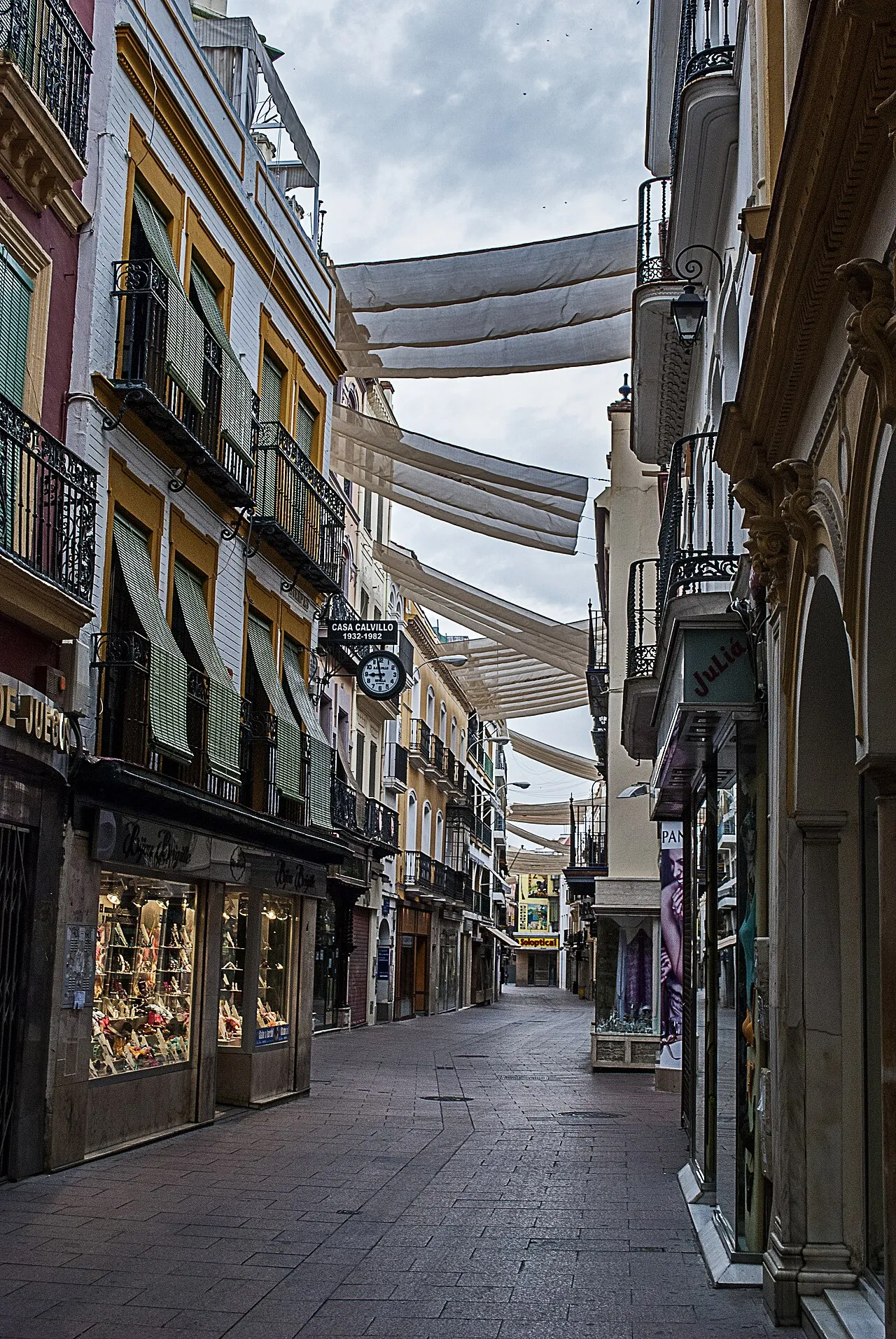
Trianeros don't say they are going to Seville: they say they are crossing over. It is an old neighbourhood joke and, like all old jokes, it says something true. Triana is separated from the rest of the city by a river that flooded it for centuries, it earned its living with trades of its own — clay, fishing, sailing — and on its own account it produced a considerable share of the flamenco heard today across half the world. All of that fits into little more than a square kilometre that you can cover in a long afternoon, and enjoy far more if you know what you are looking at.
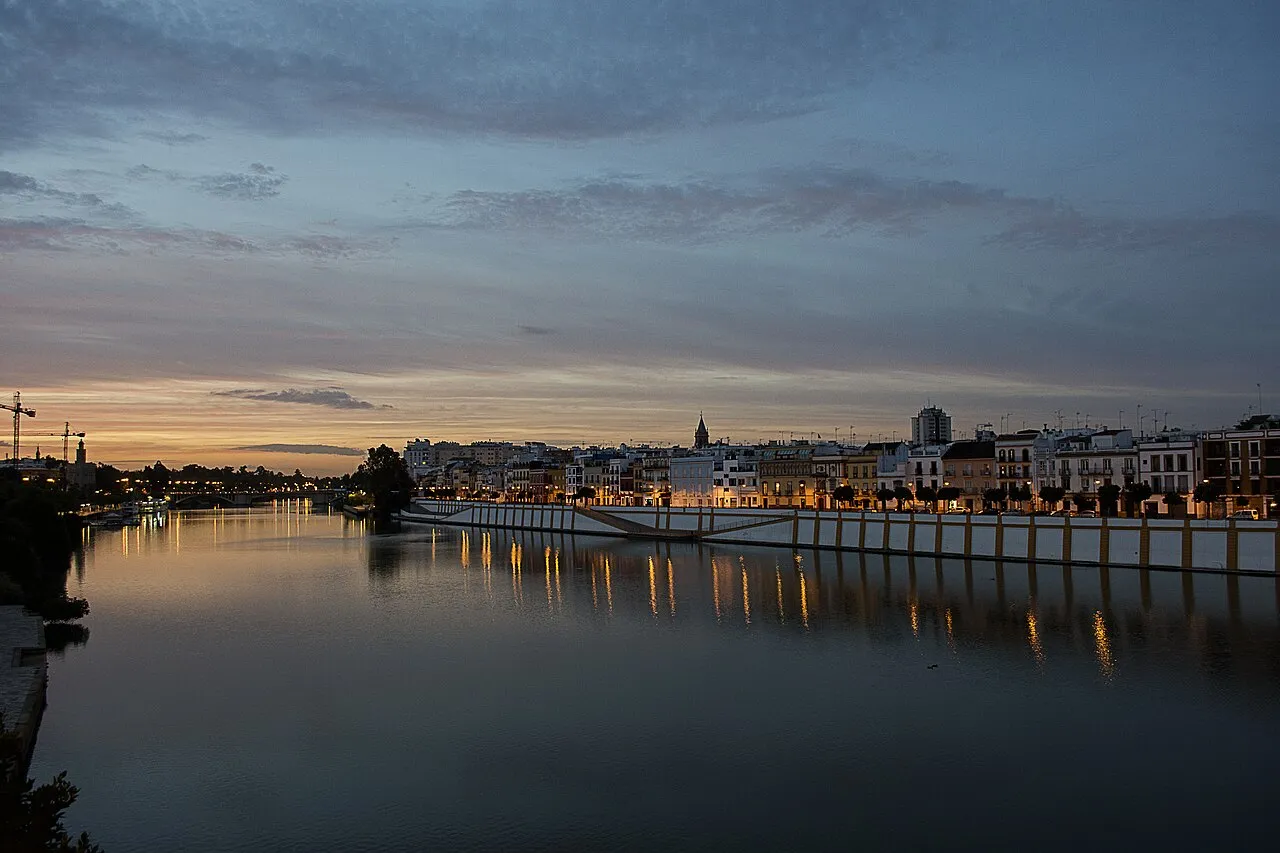
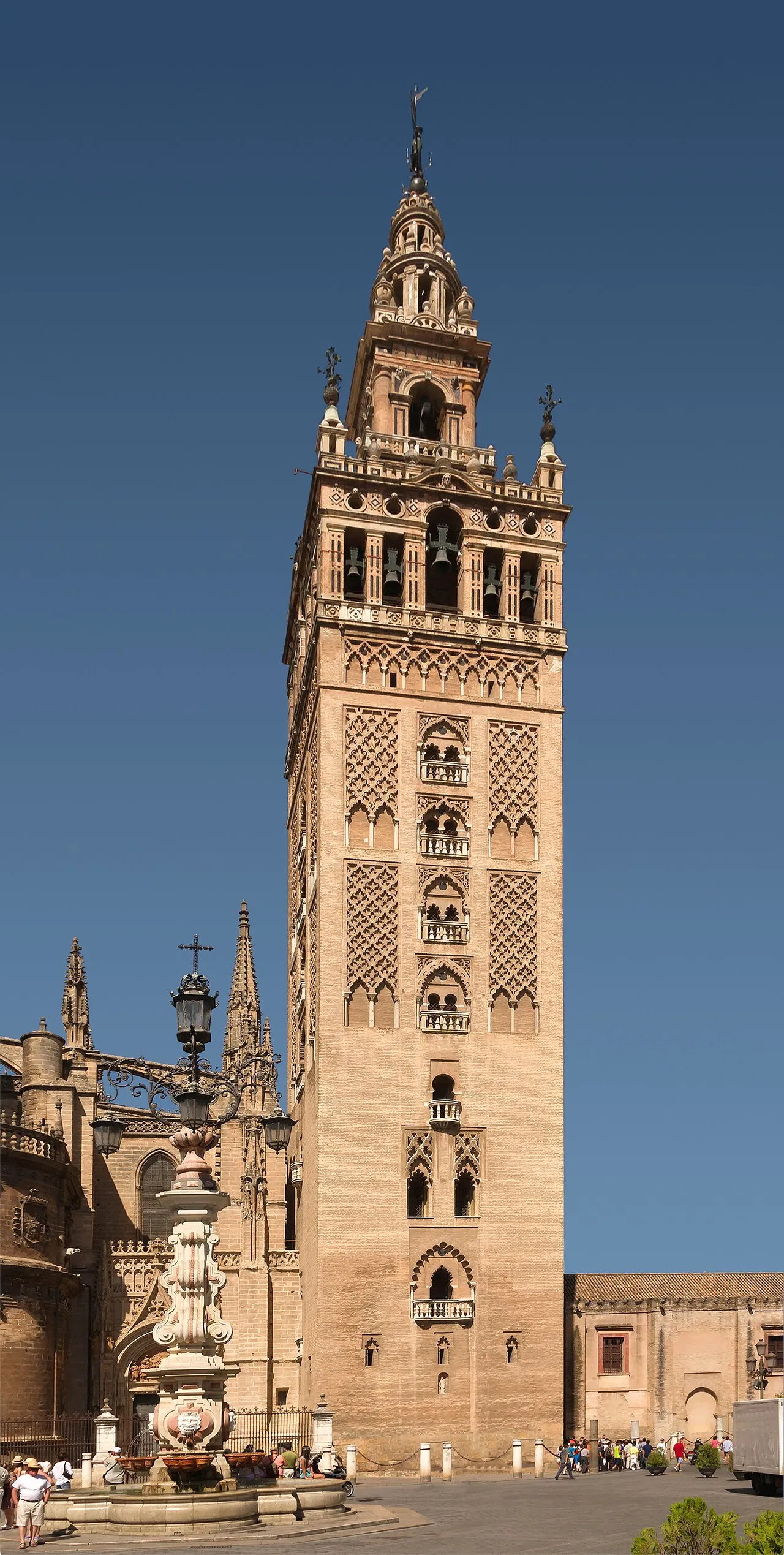
Cross over in mid-afternoon and finish on calle Betis at sunset: that is when the light falls full on the opposite bank and you see the Torre del Oro golden with the Giralda behind it. The Triana market, on the other hand, has to be seen in the morning.
Crossing the bridge: the gateway to Triana
A bridge copied from Paris and a tiled chapel that acts as a symbolic customs post.
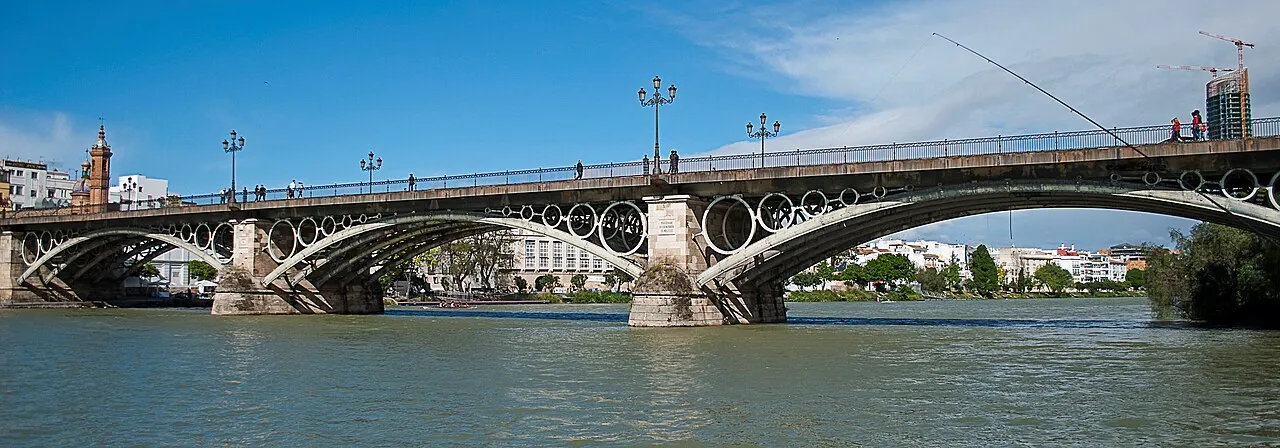
The Puente de Isabel II, which nobody in the neighbourhood calls by that name, went up between 1845 and 1852 and hides a story almost nobody expects: it was not designed from scratch but copied girder by girder from a bridge across the Seine in Paris, the Pont du Carrousel, next to the Louvre. The Parisian original was demolished almost a century ago; the Sevillian copy is still standing and in use. The model disappeared and the copy survived.
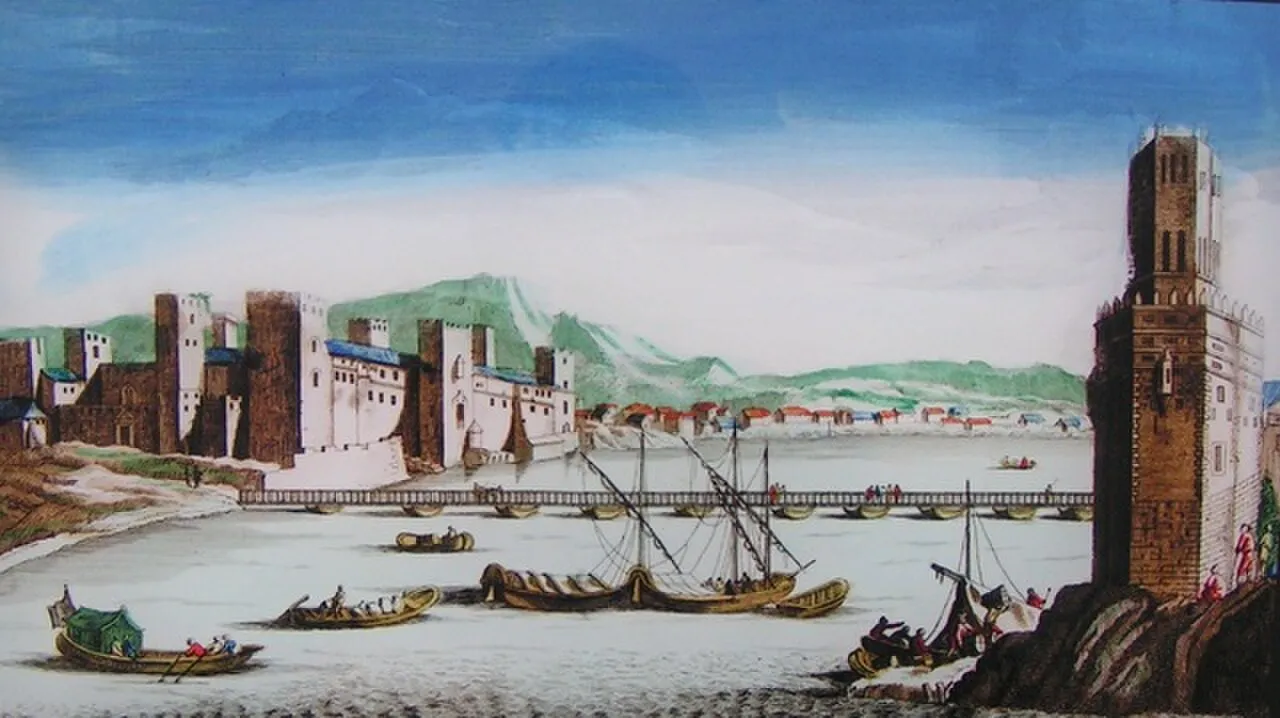
Before it, crossing here meant taking your chances on a bridge of moored boats that had been in operation since the Muslim period and that the floods swept away with regularity. That is the key to understanding the whole neighbourhood: Triana has lived fighting the water.
Cast-iron arches linked one after another, the gesture that separates the two Sevilles. It was built in the mid-nineteenth century and copies the Pont du Carrousel in Paris, now gone. Stop halfway across: from there you understand the city better than from any viewpoint, with the water below, the old town on one side and Triana on the other. It is also the best place to get an idea of why the river always ruled the life of the neighbourhood.
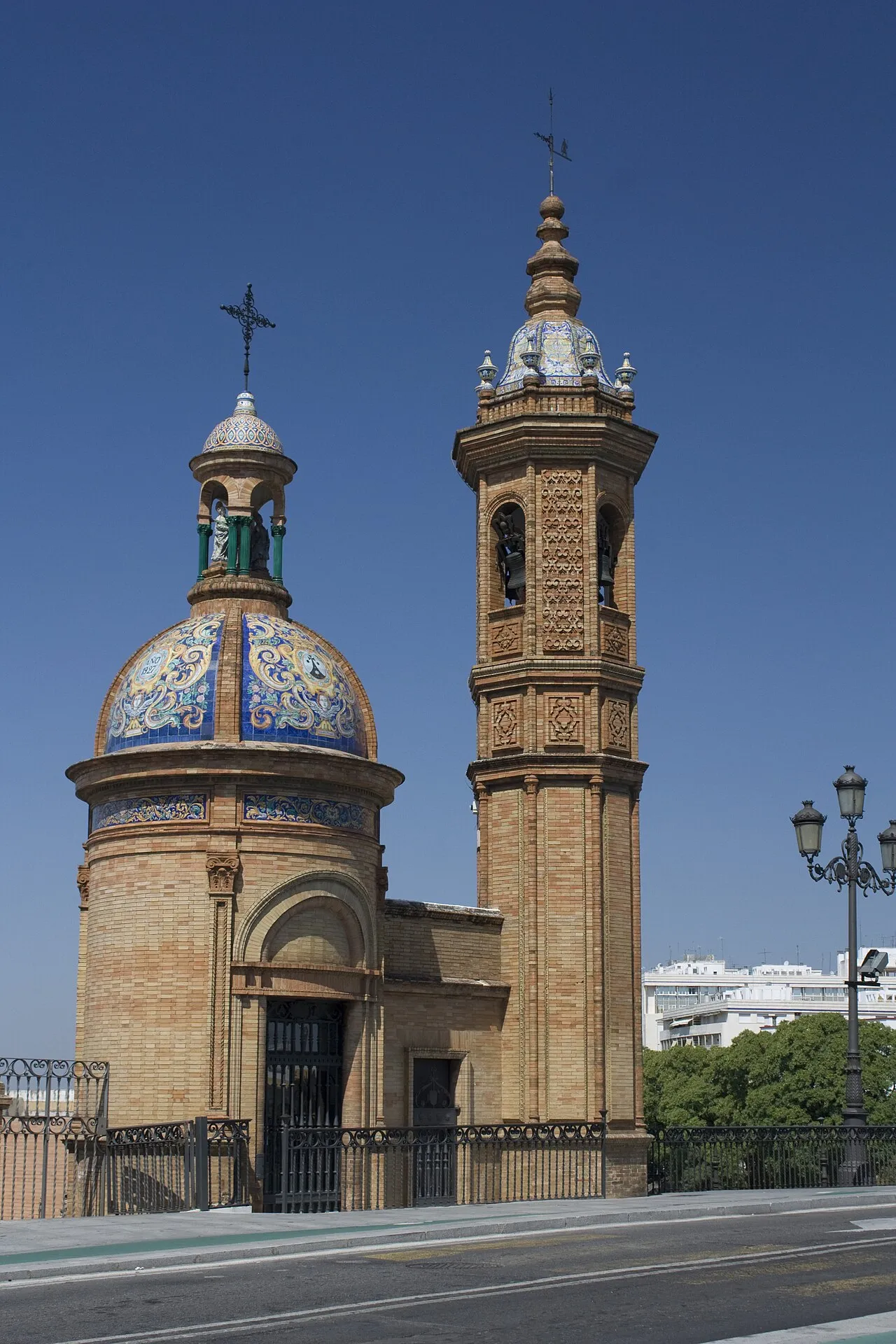
A small, dainty building covered in ceramic that gleams in the sun, almost a toy made of tiles. It is the first thing anyone crossing over sees and it works as the symbolic gateway to the neighbourhood. It was built in 1928 by Aníbal González, the same architect who designed the Plaza de España for the 1929 Exposition. Look at the dome clad in green and gold Triana ceramic and at the little octagonal bell tower: it is a miniature summary of what Triana knew how to do better than anyone.
The neighbourhood's living room, with palm trees, trams coming and going and people flowing through at all hours. The name explains everything: altozano, a small rise. When the Guadalquivir burst its banks and flooded Triana time and again, this mound stayed dry for longer, so the neighbourhood made it its safe ground and, over the years, its great meeting place. Two bronzes sum up its soul: one to the art of flamenco and the other to Juan Belmonte, the bullfighter born on this side of the river.
Download the app and discover Seville offline, whenever you like. Take the walking tour Triana: Ceramics, Flamenco, and River with a local guide in your ear.
Three centuries of the Inquisition under the fish stalls.
The Mercado de Triana stands right by the head of the bridge and is exactly what you expect of an Andalusian food market: fresh fish, ham, spices, fruit and cheerful noise. But the important thing is not what you see, it is what you are standing on.
Beneath those stalls are the remains of the Castillo de San Jorge, a fortress built to defend this end of the river which from 1481 had a far darker use: it was the seat of the Tribunal of the Inquisition in Seville for more than three centuries. Here were the chambers, the cells and the offices from which the trials were conducted. Today there is an interpretation centre in the basement, free to enter, which takes twenty minutes to visit and completely changes the way you look at the neighbourhood.
Very close by, a passage keeps the name that says it all: the Callejón de la Inquisición, the descent which, according to the neighbourhood's memory, connected the castle with the river.
📍 Plaza del Altozano, s/n · free interpretation centre
A living market above and a hard history below. The fortress defended this end of the river until 1481, when the Tribunal of the Inquisition was installed here and occupied the castle for more than three centuries. When the ground was dug up to refurbish the market, the walls, the floors and the rooms appeared, and today you can walk through them beneath the stalls. Go up afterwards to shop: the contrast between the basement and the bustle above is one of the strangest and most honest experiences in Seville.
This is where the ceramics that decorate half of Andalusia were kneaded.
For centuries Triana was the potters' neighbourhood. The clay was dug from the riverbank itself, kneaded here and fired in kilns that stood in these very streets. From here came the tiles that today dress churches, palaces and benches across half of southern Spain, including a good part of those in the Plaza de España.
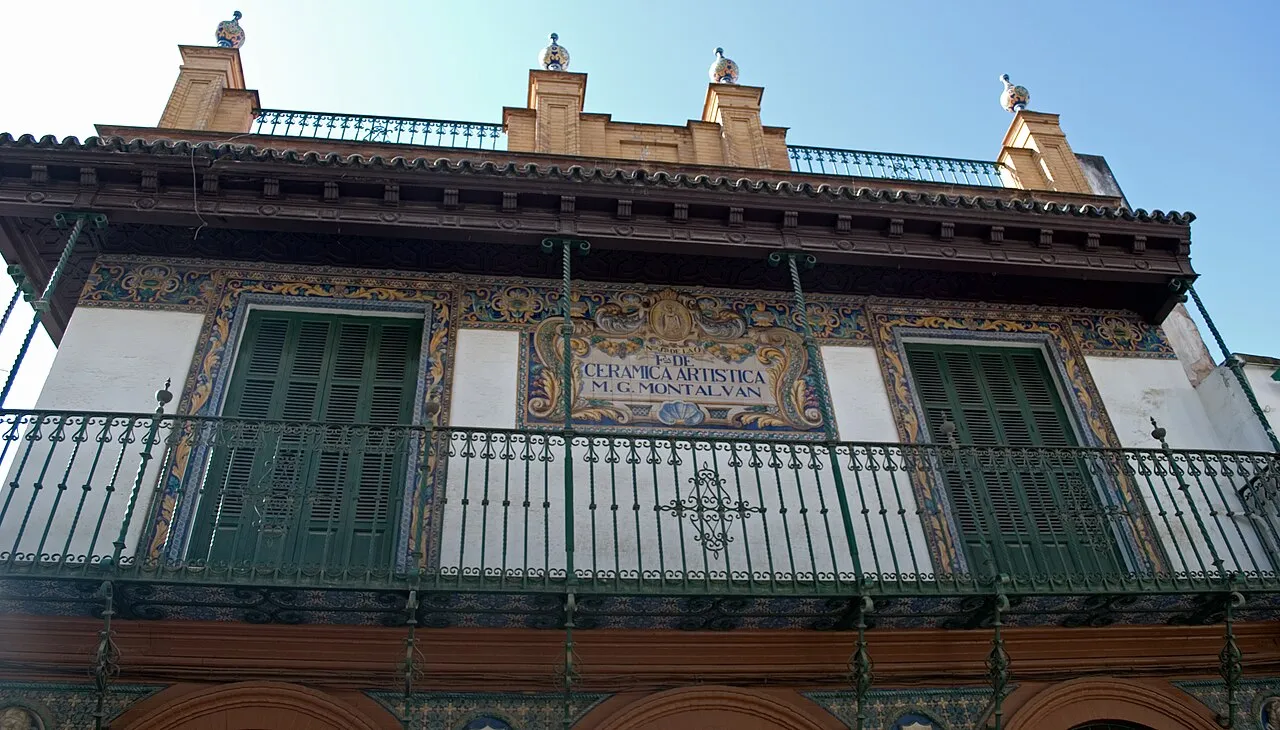
The trail lives on in the names: calle Alfarería, Pottery Street, is not called that for decoration. Behind many of those façades old workshops still remain, some still working, and every now and then you can smell clay and kiln. It is the part of the neighbourhood that has changed least and that fewest people walk through.
5
Cerámica Santa Ana
📍 Calle San Jorge, 31
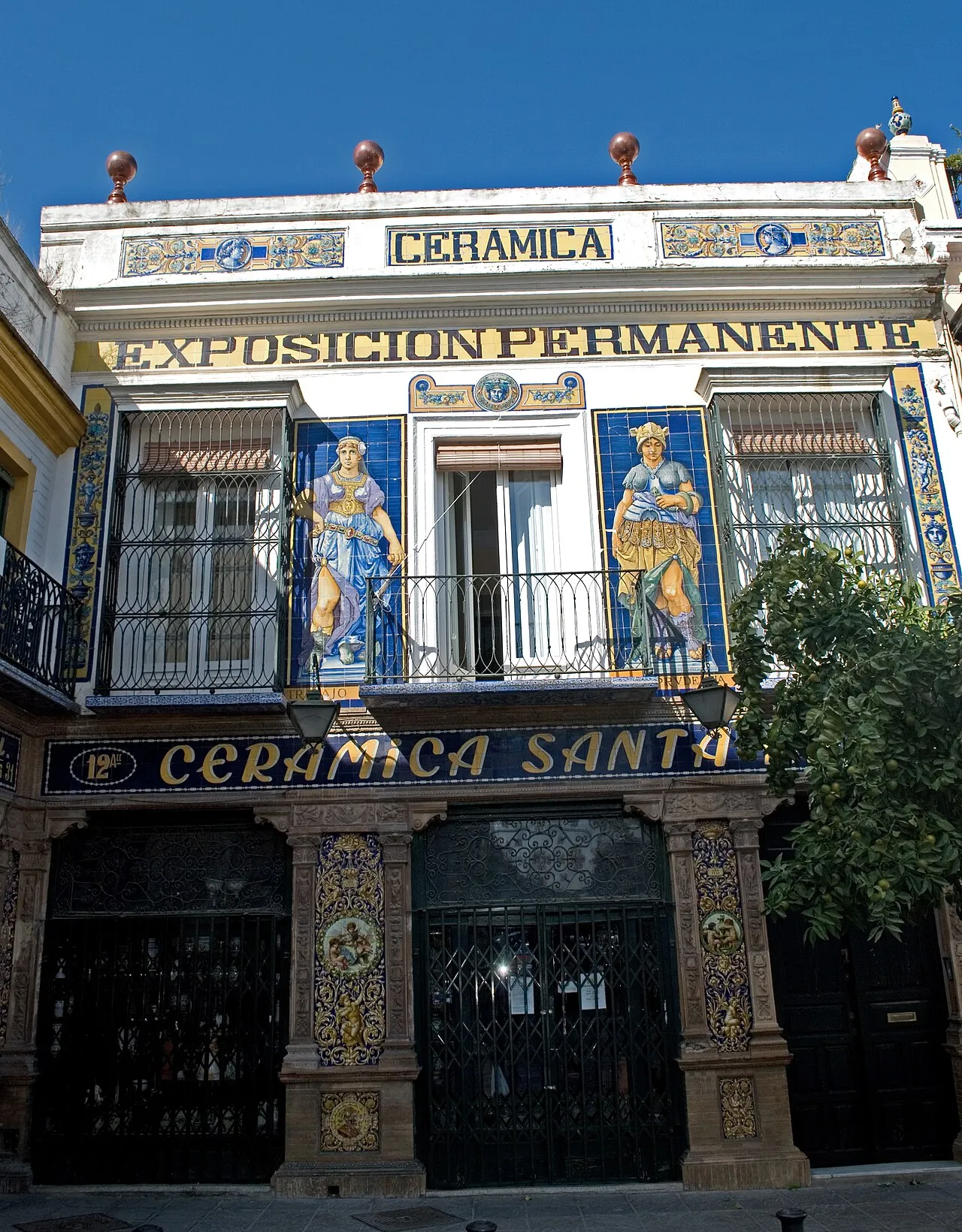
The entire façade dressed in painted tiles, with its ceramic sign: it is one of the prettiest in all Seville and deserves the stop even if you are not going to buy anything. Triana's best-known workshop-shop has roots in the neighbourhood going back to the nineteenth century. Inside there are individual hand-painted tiles with the star of Triana or Sevillian motifs, as well as bowls, plates and cups. It is the obvious place to take home something that really comes from here and not from an industrial warehouse.
Narrow, quiet lanes where hardly any cars pass and where the street names tell the story on their own. This is where the alfares stood, the kilns where Triana's clay was fired for centuries. It is the least touristy area of the neighbourhood and the one that best keeps the original scale: low houses, glimpsed courtyards, the odd workshop door standing open. Walk it unhurriedly and in mid-morning, which is when there is activity.
Pedestrianised, wide, with a pale marble surface and terraces on both sides: it is the neighbourhood's great street for strolling and shopping, and at dusk it fills with people coming out for a drink. The tram used to run along here in the old days and it was the natural way in from the bridge. Look up at the balconies — flowerpots, washing hung out, neighbourhood life holding out between the shops — because that is where you see best that Triana is still a place where people live.
A sturdy church of brick and stone with a tower reminiscent of a minaret. Trianeros call it, with all the pride in the world, the cathedral of Triana, and they have arguments: it was commissioned by Alfonso X the Wise around 1280 and it is the oldest church in Seville, the first built after the Christian conquest. The story goes that the king suffered from a serious eye complaint, entrusted himself to Saint Anne and ordered the church in thanks when he was healed. Seven centuries later it is still the neighbourhood's parish church, not a monument to visit: go in quietly.
Flamenco and devotion: the neighbourhood's two religions
Why Triana has so much to do with cante, and why the Esperanza divides the city.
Flamenco was not invented in a theatre. It was born in shared courtyards, in forges and in streets like these, among gypsy families crowded together by the river and workers in clay. Triana was one of the places where that art took shape and grew, long before tablaos and festivals existed.
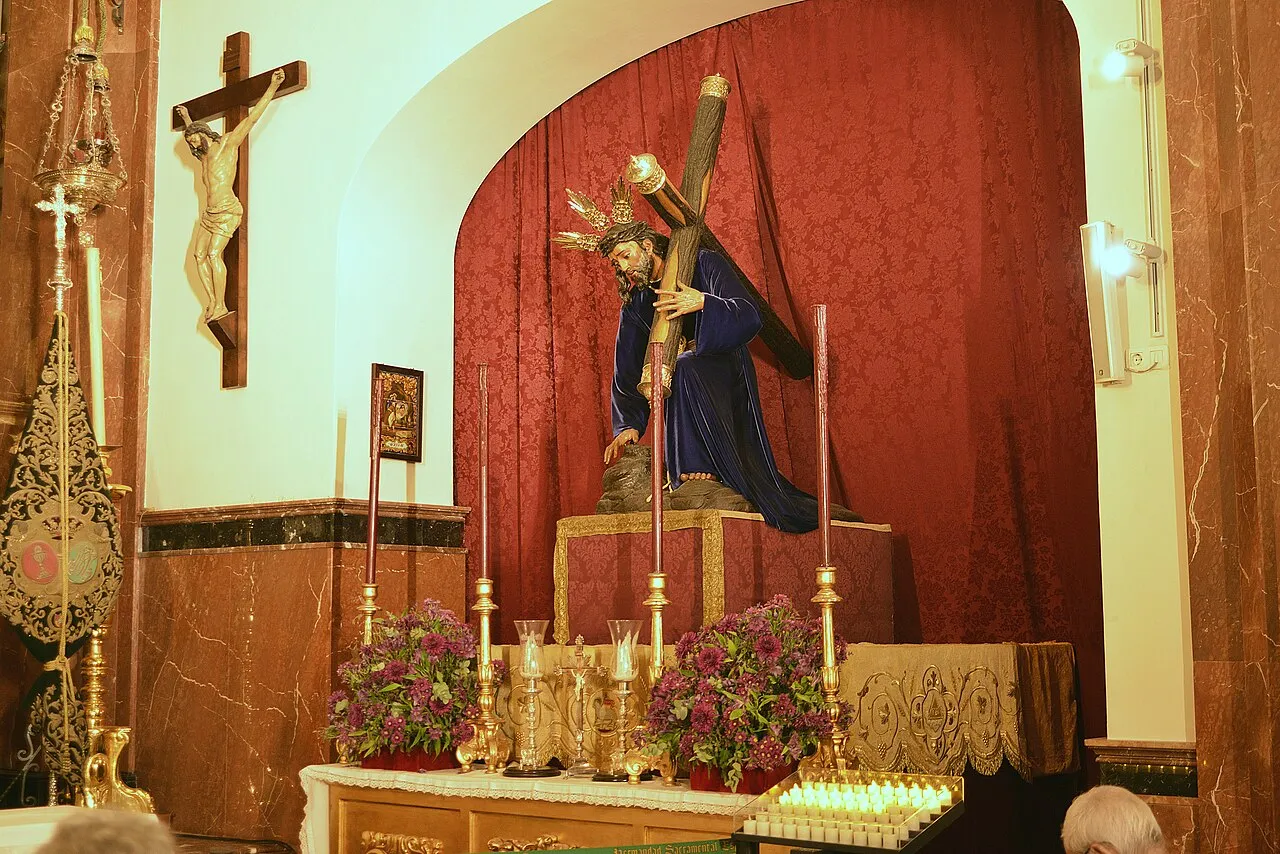
The neighbourhood's other devotion is literal. The Esperanza de Triana, who lives in the Capilla de los Marineros on calle Pureza, has an eternal rival on the other side of the river: the Macarena. Every Madrugá, the early hours of Good Friday, the two go out in procession and half of Seville splits into two halves, macarenos against trianeros, as if it were a derby of devotion. Those in the know say the rivalry is more atmosphere than reality, more about the neighbourhoods than the brotherhoods themselves. Ask a Trianero which is the best and you will see.
8
Monumento al Arte Flamenco
📍 Plaza del Altozano
A bronze put up in the early nineties to honour the art these streets helped to invent. Look at it calmly and you can read the three pillars of flamenco: the cante, the voice that laments and rejoices; the baile, the body turned into rhythm; and the toque, the guitar that holds it all together. It is not a decorative sculpture: it stands exactly where it had to stand, in the square that serves as the gateway to the neighbourhood.
One of the most Trianero streets there is: narrow, with low houses, iron grilles, flowerpots and the tile of a Virgin presiding over some corner. Halfway along the street opens the Capilla de los Marineros, home of the brotherhood of the Esperanza de Triana, one of the most loved and oldest in the city, with origins in the guilds of potters and sailors — people of the clay and people of the river — more than five centuries ago. You can go in outside service times and it costs nothing.
The obligatory ending. A row of coloured façades lined up facing the river, with the whole of Seville posing opposite: the Torre del Oro golden in the sun, the Maestranza and, behind, the Giralda. Betis, or Baetis, is what the Romans called the Guadalquivir two thousand years ago. These houses have been fighting the water for centuries: the bank was raised in the nineteenth century with a retaining wall because until then the river flooded Triana time and again, and the oldest houses still bear the mark on their ground floors.
Triana eats differently from the centre: more fish, more fried food and less posing. The area of good bars is spread between calle San Jacinto, the surroundings of the market and the lanes that run down towards the river, and unlike Santa Cruz, here most of the clientele is still from the neighbourhood.
Two recommendations about format that hold for the whole neighbourhood. First: fried fish is ordered in a paper cone or as a small portion and eaten standing up; it is not a dish for lingering over. Second: if a place has tables on calle Betis with views of the river, you are paying for the view, and it is good to know that before you sit down — the view is worth it, but you eat better one street inland.
The Mercado de Triana also works as a dining room: several stalls serve directly at the counter, and at midday it is one of the best-value options in the neighbourhood, with produce that was on the slab ten minutes earlier.
Las Golondrinas
📍 Calle Antillano Campos · potters' quarter
The neighbourhood stop par excellence, right in the area of the old potteries. Tiles up to the ceiling, waiters who have been there forever and a short menu that hasn't changed because it doesn't need to: grilled mushrooms, sirloin tips, cuttlefish. It is where the people of the neighbourhood go when they don't want to think, and it works just as well at midday as at eleven at night. They don't take bookings and you usually have to wait a while on your feet.
Yes, and not just for the views. Triana keeps a character of its own that the centre has partly lost: it is a neighbourhood where people still live, with trades that belong to it — ceramics — and with an enormous weight in the history of flamenco. Calle Betis also offers the best panorama of the city. Crossing the bridge takes five minutes from El Arenal.
What to see in Triana in an afternoon?
The Puente de Isabel II, the Capilla del Carmen and the plaza del Altozano as you enter; the Mercado de Triana with the remains of the Castillo de San Jorge beneath it; calle Alfarería and Cerámica Santa Ana in the potters' area; the Iglesia de Santa Ana, which is the oldest in Seville; calle Pureza with the Capilla de los Marineros; and calle Betis at sunset. That is about four hours with a stop to eat.
Why is Triana famous for flamenco?
Because it was one of the places where flamenco took shape, long before tablaos existed. It was born in shared courtyards, forges and streets like these, among gypsy families settled by the river and ceramics workers. The Monumento al Arte Flamenco in the Altozano, with its three figures dedicated to cante, baile and toque, stands exactly where it belongs.
What lies beneath the Mercado de Triana?
The remains of the Castillo de San Jorge, a fortress that defended this end of the river and which from 1481 was the seat of the Tribunal of the Inquisition in Seville for more than three centuries. When the ground was dug up to refurbish the market, the walls and rooms appeared, and today you walk through them beneath the stalls in an interpretation centre that is free to enter.
What is the best time for calle Betis?
Sunset, without a doubt. That is when the sun falls full on the opposite bank and you see the Torre del Oro golden with the Maestranza and the Giralda behind. At midday the street is backlit and the photo doesn't come out. If the weather is good as well, the benches along the bank fill with people waiting for exactly that.
Where to buy authentic Triana ceramics?
In the workshops on calle Alfarería and around it, and at Cerámica Santa Ana, on calle San Jorge, which has been in the neighbourhood since the nineteenth century. The difference from the souvenir shops in the centre is that here the pieces are painted by hand and many are still fired in the neighbourhood. Look for the star of Triana as the classic motif.
Practical information
Getting thereOn foot from the centre across the Puente de Isabel II: five minutes from El Arenal. The tram also reaches Plaza Nueva and from there you cross on foot.
When to goThe market, in the morning. The neighbourhood and calle Betis, from six in the evening onwards.
FreeCastillo de San Jorge, Iglesia de Santa Ana, Capilla de los Marineros and the whole riverside walk.
How longA long afternoon, about four hours including a stop to eat.
What to take homeHand-painted ceramics from the workshops on calle Alfarería or from Santa Ana, not from the souvenir shops in the centre.
With ViavoyThe route “Triana: Ceramics, Flamenco, and River” strings together the fifteen stops in this guide with narration by a local guide.
On the map
🎧 With Viavoy
Walk Seville and listen at your own pace
Download Viavoy and walk Seville offline, whenever you like.
from 2,99 €· one-off payment
City Pass · 9,99 €3 days, all the tours in Seville