1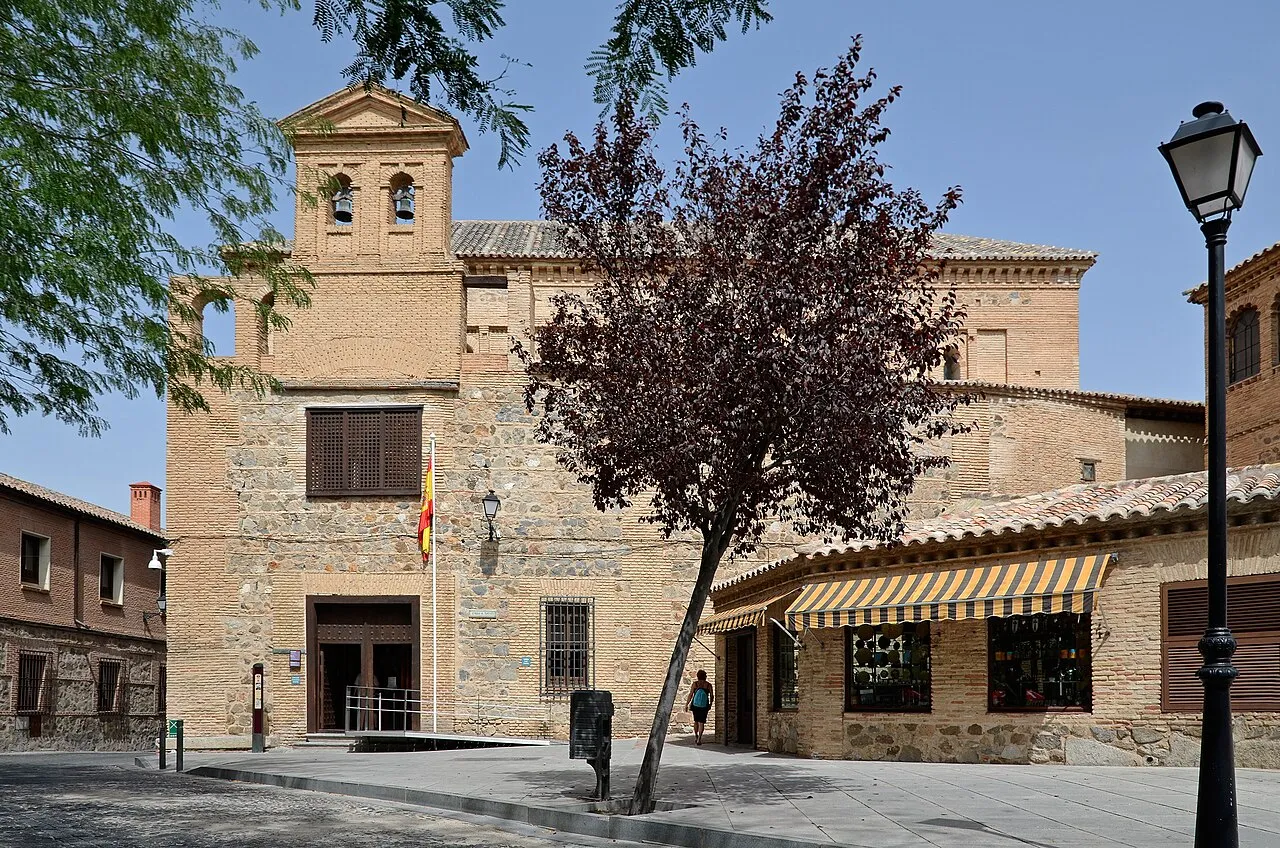
Tránsito Synagogue
📍 Calle Samuel Leví, s/n
State-owned, with entry around 3 €, a reduced rate and free time slots for EU citizens that almost nobody checks before buying. Closed on Mondays. Allow forty minutes between the hall and the museum.
Two medieval synagogues, a mosque from the year 999 and a wall where Hebrew and Arabic share the same plaster. Where coexistence stops being a phrase and can be pointed at with a finger.
🎧 On the walk Toledo of the Three CulturesThe label “city of the three cultures” is used so often that it has lost almost all its edge, and in Toledo it is worth sharpening again, because here there are specific places where you can check it. On one wall of this Jewish Quarter there are psalms in Hebrew carved next to verses in Arabic, with decoration that could be in the Alhambra, made by Muslim craftsmen for a Jewish temple under a Christian king. It is not a metaphor: it is there.
A hall without columns and a trilingual wall.
From outside it is a brick wall so plain that you can walk straight past it, and that means something too: medieval synagogues were not allowed to stand out on the exterior. You push the door and a clear hall of more than twenty metres appears without a single column, something structurally difficult and very unusual.
The ceiling is a cedar coffered ceiling with polychrome interlace, one of the best of its period on the peninsula. And along the top of the walls runs an endless band of carved plaster with whole psalms in Hebrew, interwoven with plant and geometric motifs from the Andalusi repertoire.
It was built around 1356 on the orders of Samuel ha-Levi, treasurer to King Peter I of Castile, a Jew who came to handle the finances of the kingdom. The king himself ended up ordering his arrest, had him tortured and kept his fortune. The synagogue remained standing; the man who built it did not.
Go up to the upper gallery, which was the space reserved for women. From there you read the coffered ceiling far better and you understand the proportion of the hall. Today the building houses the Museo Sefardí, devoted to the life of the Jewish communities of the peninsula up to the expulsion and afterwards, in the diaspora.
State-owned, with entry around 3 €, a reduced rate and free time slots for EU citizens that almost nobody checks before buying. Closed on Mondays. Allow forty minutes between the hall and the museum.
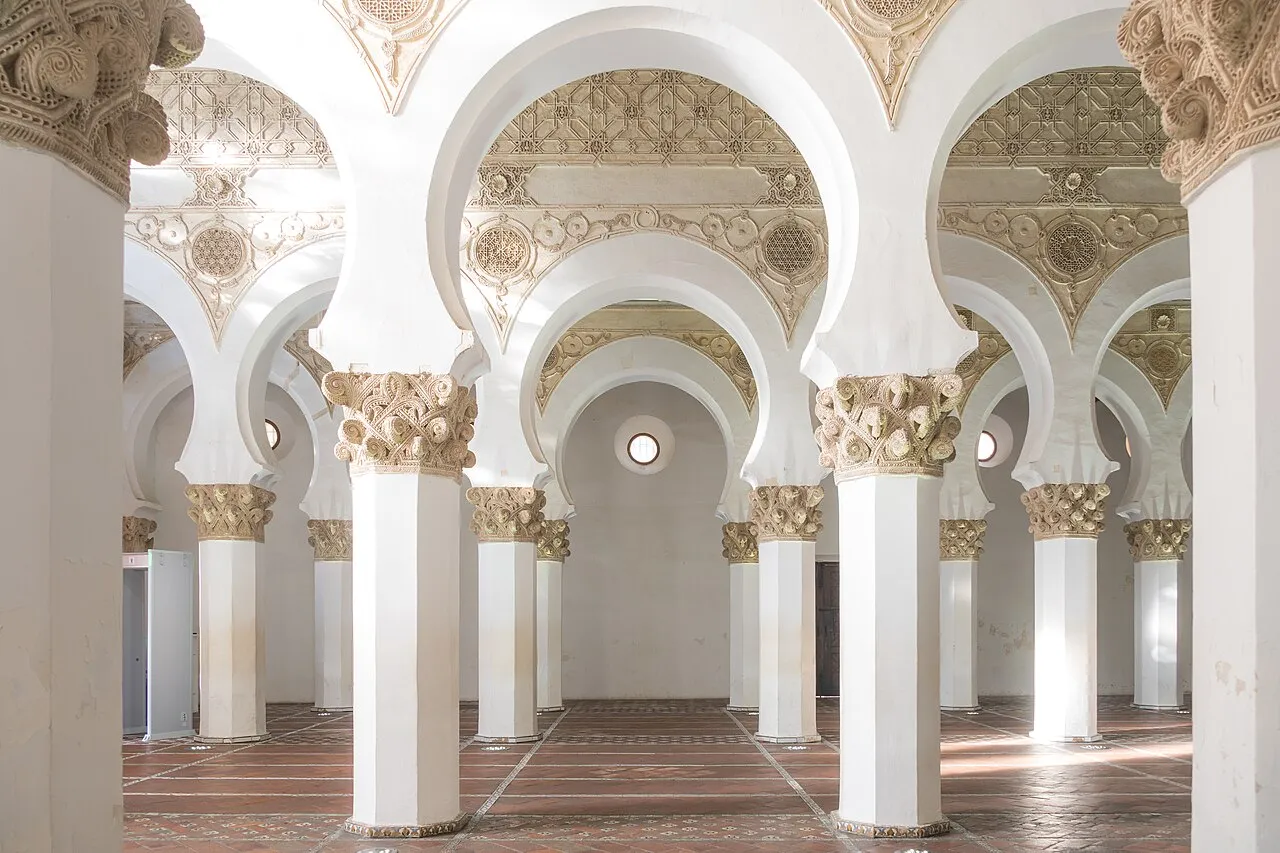
The other surviving synagogue, and one of the oldest still standing in Europe: five naves separated by horseshoe arches on whitewashed pillars, with pinecone capitals. It was built as a synagogue in the twelfth century, became a church after 1391 and keeps its Christian name.
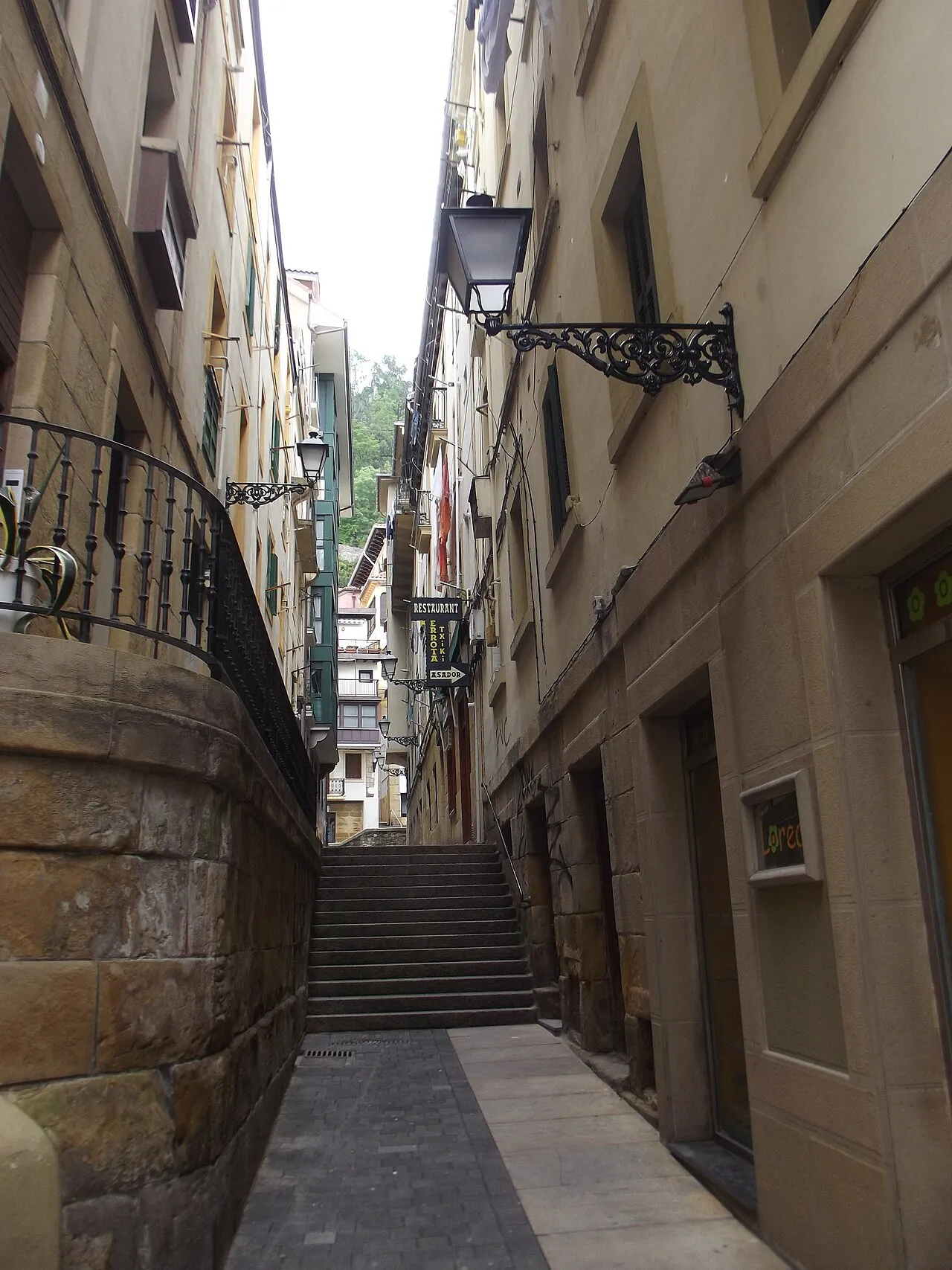
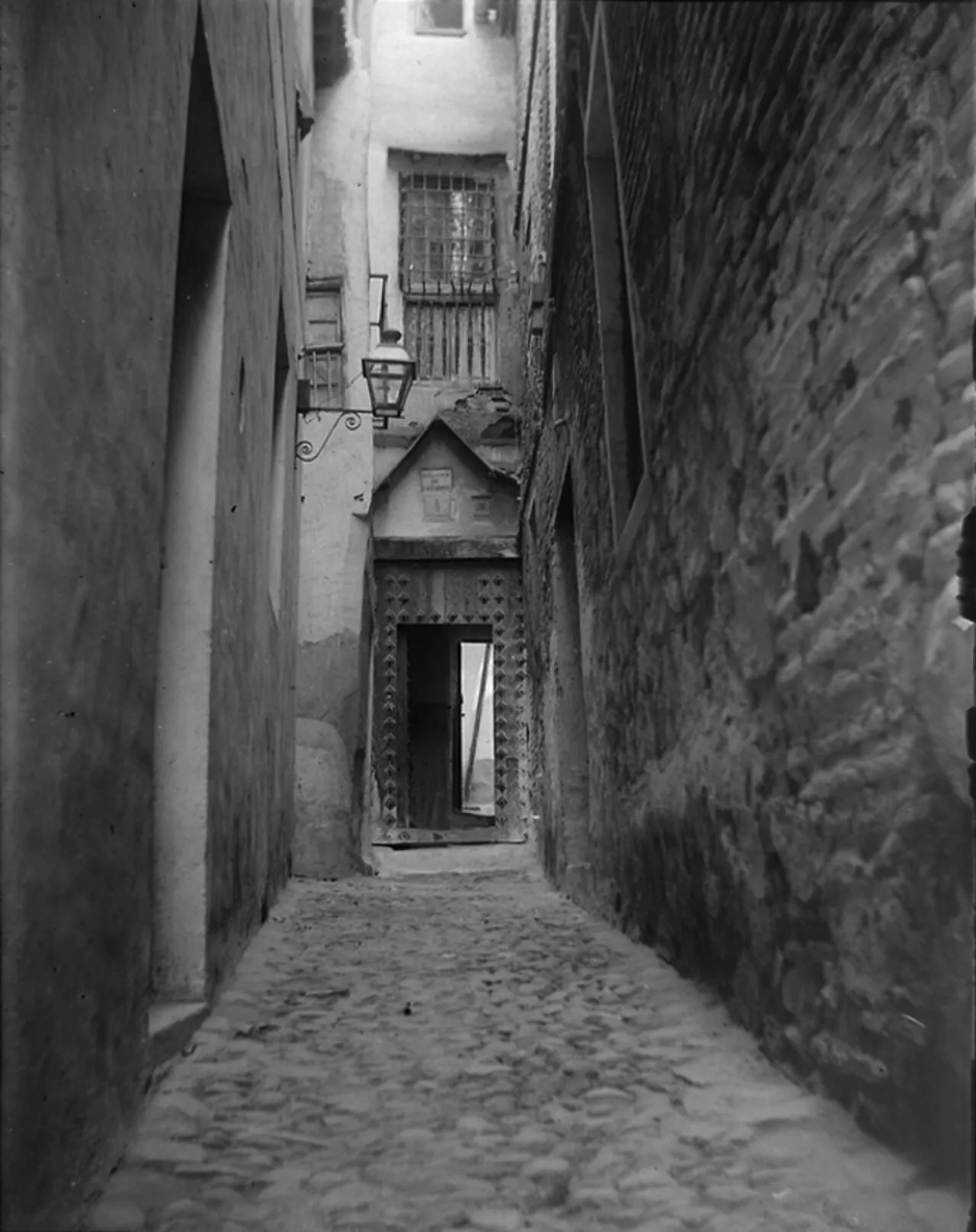
The web of alleys that surrounded the synagogues, far quieter than the cathedral axis. There are menorah markers set into the paving indicating the route of the Jewish Quarter, and once you know they are there they appear everywhere.
Download the app and discover Toledo offline, whenever you like. Take the walking tour Toledo of the Three Cultures with a local guide in your ear.
Find out more about Viavoy →In the high, northern part of the old town, somewhat off the usual circuit, stands the mosque of Cristo de la Luz, the oldest building still standing in Toledo. The date is not an estimate: an inscription on its own wall gives the year 999, and also the names of the patron and of the master builder.
It is tiny, eight metres to a side, with a square plan divided into nine bays by four columns reused from Visigothic buildings. The exceptional part is above: each of the nine bays is covered by a different ribbed vault and not one is repeated.
Those ribbed vaults whose ribs do not cross at the centre are an Andalusi invention that appears for the first time in the Mezquita of Córdoba, and here, some thirty-five years later, they unfold in nine variants in a minimal space. It is practically a catalogue of architecture.
When Toledo passed into Christian hands in 1085 the building became a chapel and a Mudéjar apse was added to it in the same Andalusi formal language. The seam between the two parts can be seen from inside, and it is the best proof that Mudéjar was not imitation but continuity of craft.
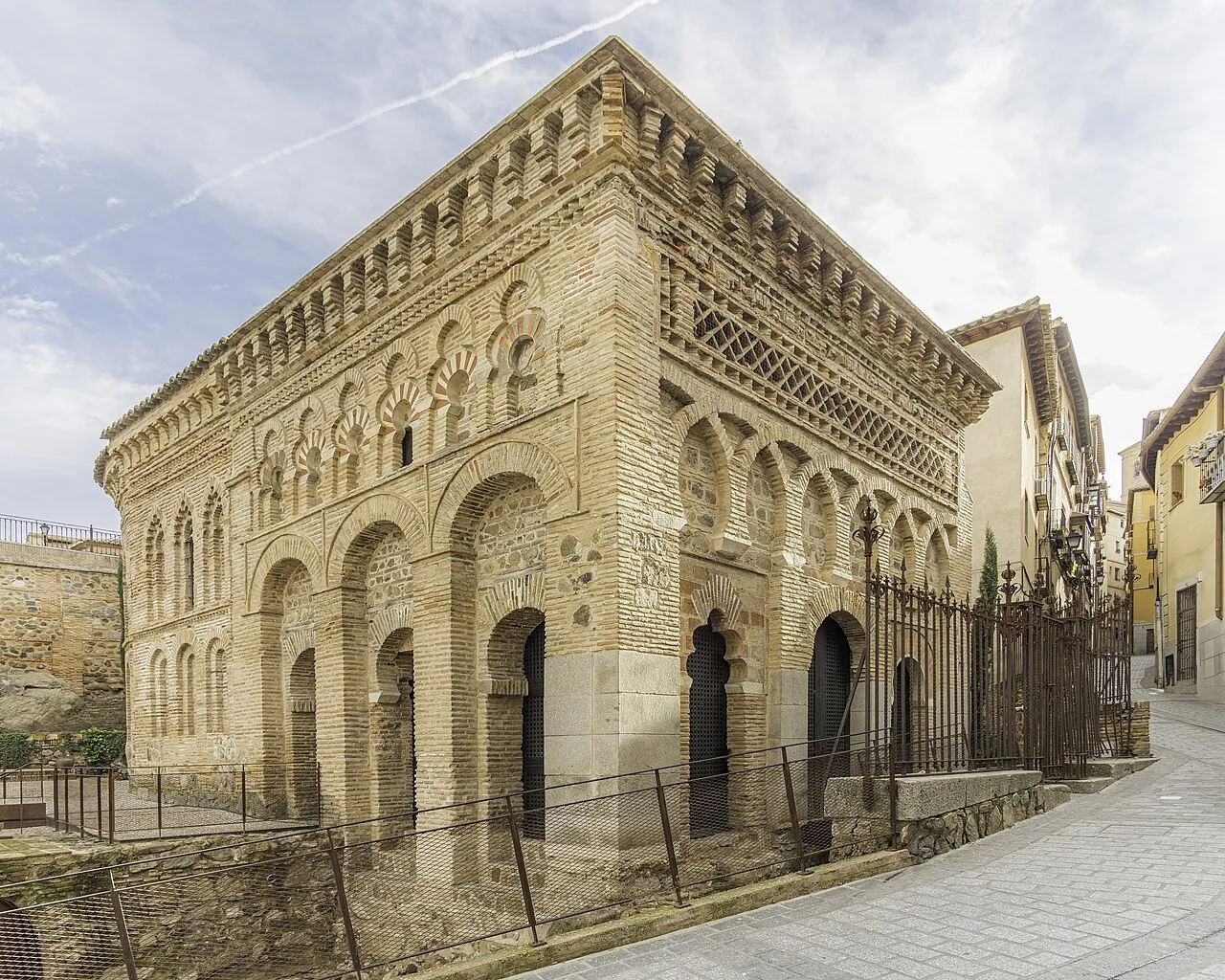
Excavating the garden outside brought up a Roman road along which one of the routes into Roman Toletum came in. Beneath the mosque is Rome, above it the Christian apse: three historical layers in twenty square metres. Entry around 3 €, included in the wristband.
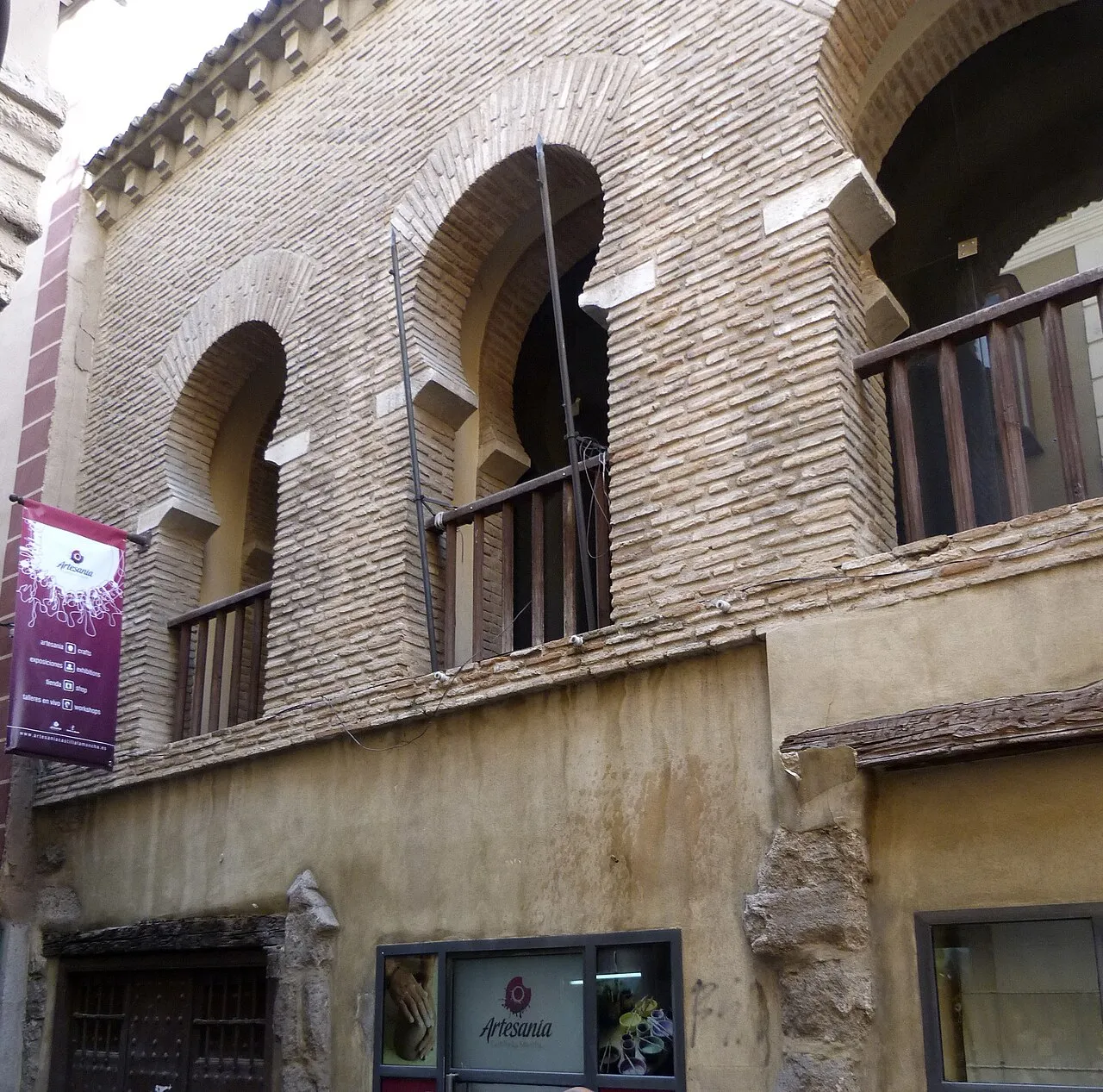
The other Andalusi remnant in the city, from the eleventh century, built over a Roman cistern and with a prayer hall on the upper floor. It is far less visited than the Cristo de la Luz and has irregular opening times, but they are worth checking.
The western end of the Jewish Quarter is occupied by San Juan de los Reyes, and its presence there is no accident. Isabella and Ferdinand ordered it built in 1476 to celebrate a victory and to serve as their burial place, and they did so by planting it on the edge of the Jewish Quarter, in a city that was about to change completely.
On its façade hang rows of iron chains which, according to tradition, belonged to Christian captives freed in the conquest of Granada. It is the same year, 1492, in which the decree expelling the Jews from all the Spanish kingdoms was signed.
That coincidence of dates is what makes it worth walking this area in order: you begin in the synagogue of a fourteenth-century royal treasurer and you end in the monastery that celebrates the end of that world. Toledo tells that story without needing any signs.
The full circuit — Santo Tomé, the Tránsito, Santa María la Blanca, San Juan de los Reyes and the Cristo de la Luz — takes a long half-day and is the least walked part of the old town. Start early and finish at the viewpoint looking out over the Tagus.
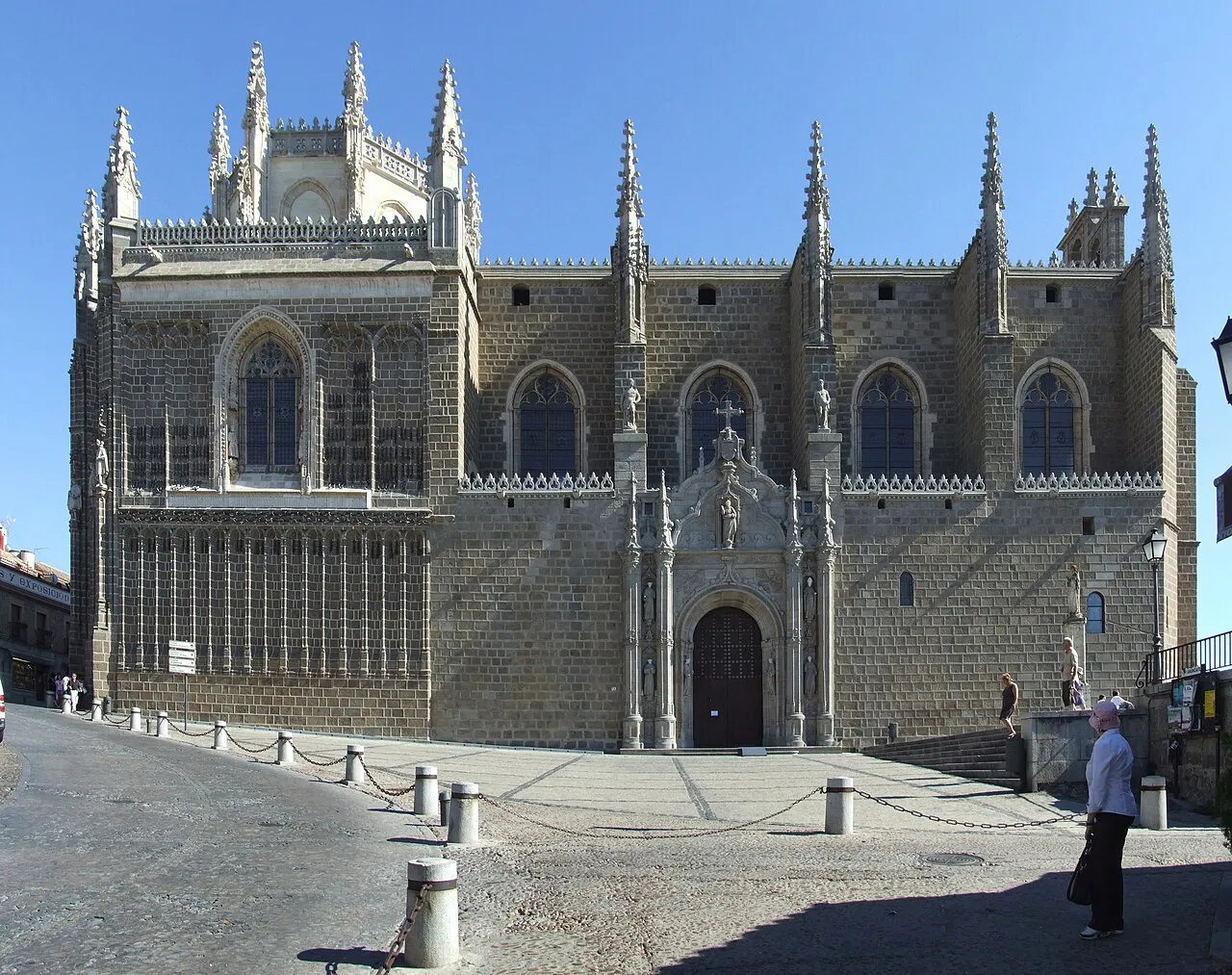
Isabelline Gothic by Juan Guas, with a two-storey cloister pierced like lace, impossible gargoyles and a Mudéjar coffered ceiling in the upper gallery that almost nobody goes up to see. Isabella ended up buried in Granada, so the royal tomb was left empty for ever.
Two surviving medieval synagogues — the Tránsito and Santa María la Blanca, both open to visitors —, the web of alleys of the quarter and menorah markers set into the paving that indicate the route. Of the ten synagogues that once existed, only those two survived, and only because they were converted into churches.
Santa María la Blanca, from the twelfth century, considered one of the oldest synagogues still standing in Europe. Its interior is five naves separated by horseshoe arches on whitewashed pillars, with pinecone capitals. It keeps its Christian name because it became a church after the attack of 1391.
For centuries they lived side by side in the same city, with a real exchange of trades, languages and knowledge, and the School of Translators is the best-known proof. But it was neither idyllic nor permanent: there was a devastating attack on the Jewish Quarter in 1391 and the expulsion came in 1492. What is exceptional is not that it was a paradise, but that it worked for so long.
The mosque of Cristo de la Luz, dated by its own inscription to the year 999, which also gives the names of the patron and the master builder. It is the oldest building standing in Toledo. Beneath its garden a Roman road also came to light, so in twenty square metres there are three historical layers on top of one another.
A long half-day for the full circuit: Santo Tomé, the Sinagoga del Tránsito with the Museo Sefardí, Santa María la Blanca and San Juan de los Reyes. The Cristo de la Luz is out of the way, in the high northern part, and is best left for arrival or departure from the city.
Santa María la Blanca, San Juan de los Reyes and the Cristo de la Luz are in the wristband circuit, which pays off from the third visit on. The Sinagoga del Tránsito is not, because it is state-owned and has its own system of reduced rates and free time slots. Santo Tomé is also paid for separately.
Download Viavoy and walk Toledo offline, whenever you like.