The convents of Salamanca: Columbus, capitals and a covered ceiling
Three convents ten minutes from the Plaza Mayor, in the least walked part of the old town. Where Columbus found his support, where the strangest capitals in Spain are and what was hidden under a Baroque ceiling.
The east of the old town is the convent quarter and it receives a tiny fraction of the visitors who go to the university buildings, despite being ten minutes away and holding three exceptional buildings. In one of them part of the destiny of America was decided, another keeps the strangest capitals to be seen in Spain, and the third hid a Mudéjar coffered ceiling for three hundred years.
The three visits fit into one morning and none of them is expensive. Santa Clara can only be entered on a guided visit with slots at fixed times, so it is worth checking the timetable before organising the rest.
San Esteban: Columbus and Vitoria
A thirty-metre front and two episodes that matter.
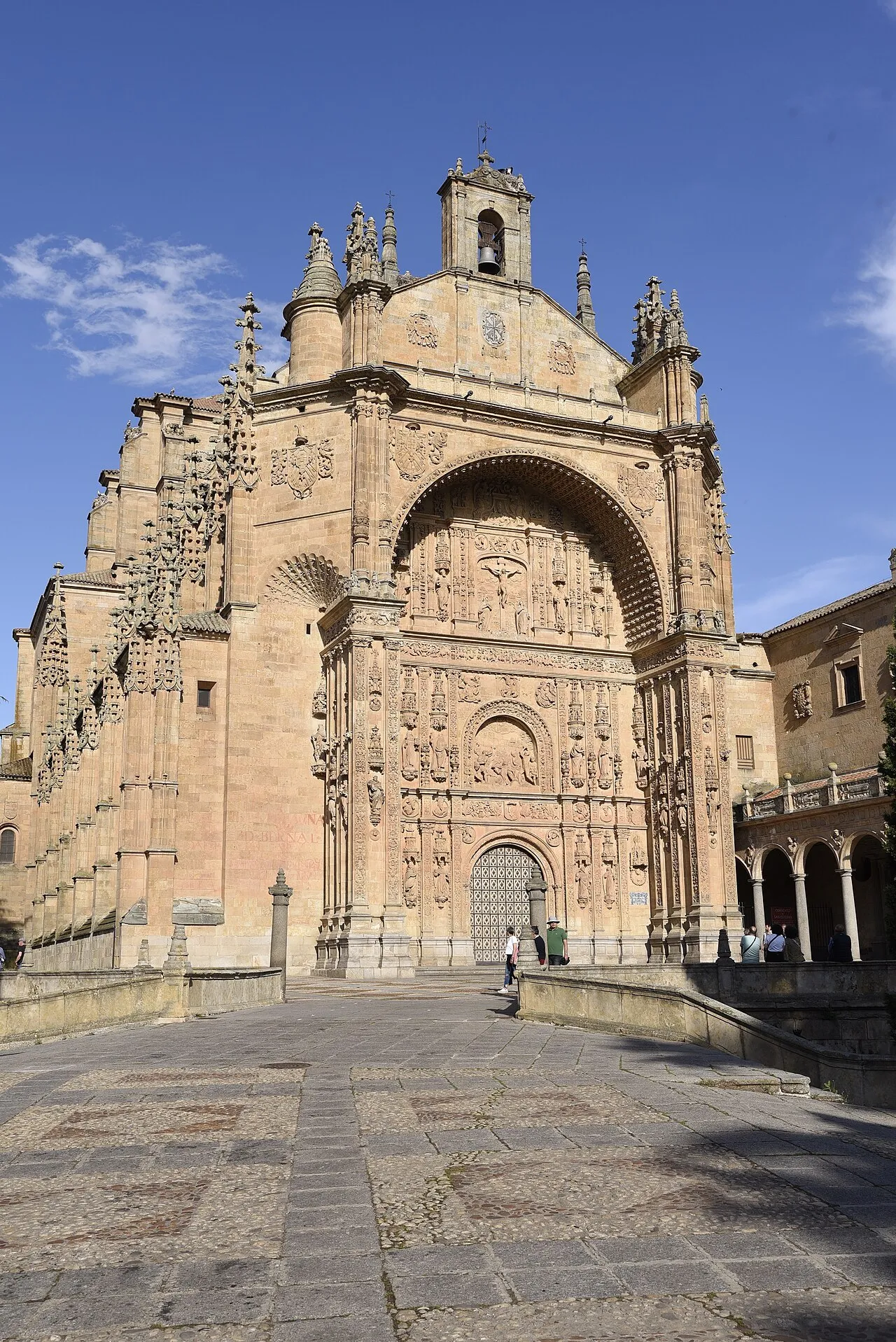
The doorway is a stone altarpiece thirty metres high framed by a triumphal arch, with a large relief of the martyrdom of Saint Stephen in the centre and the whole surface covered in figures, medallions and grotesques. It is one of the three or four peaks of the Spanish Plateresque.
Two relevant things happened inside. The first: when the committee of experts convened in Salamanca rejected Columbus's project, in this Dominican convent he found the support of Fray Diego de Deza, who put him up and pressed his case at court until the voyage was funded.
It is worth saying that the experts were right. They did not reject the plan because they thought the Earth was flat — any university man knew otherwise — but because Columbus had miscalculated the circumference of the Earth and his estimated distance was far too short. He reached America because there was a continent in the way that nobody expected.
The second: Francisco de Vitoria lived and taught here, and argued that the peoples of America were the legitimate owners of their lands and had sovereignty of their own, and that discovering an inhabited territory gave no title of conquest. Those theses lie at the origin of modern international law.
Its Kings' Cloister has Gothic arcading below and Renaissance arcading above, and from it you reach the Soto staircase, a cantilevered stone stair that holds itself up with no central support. Entry around 4 €, and forty minutes for the visit.
Fray Diego de Deza, a Dominican theologian and later archbishop, was the one who defended the project at court once it had already been dismissed. Without that support the voyage would probably never have been funded, and the paradox is complete: those who were wrong about the arithmetic were the ones who backed it.
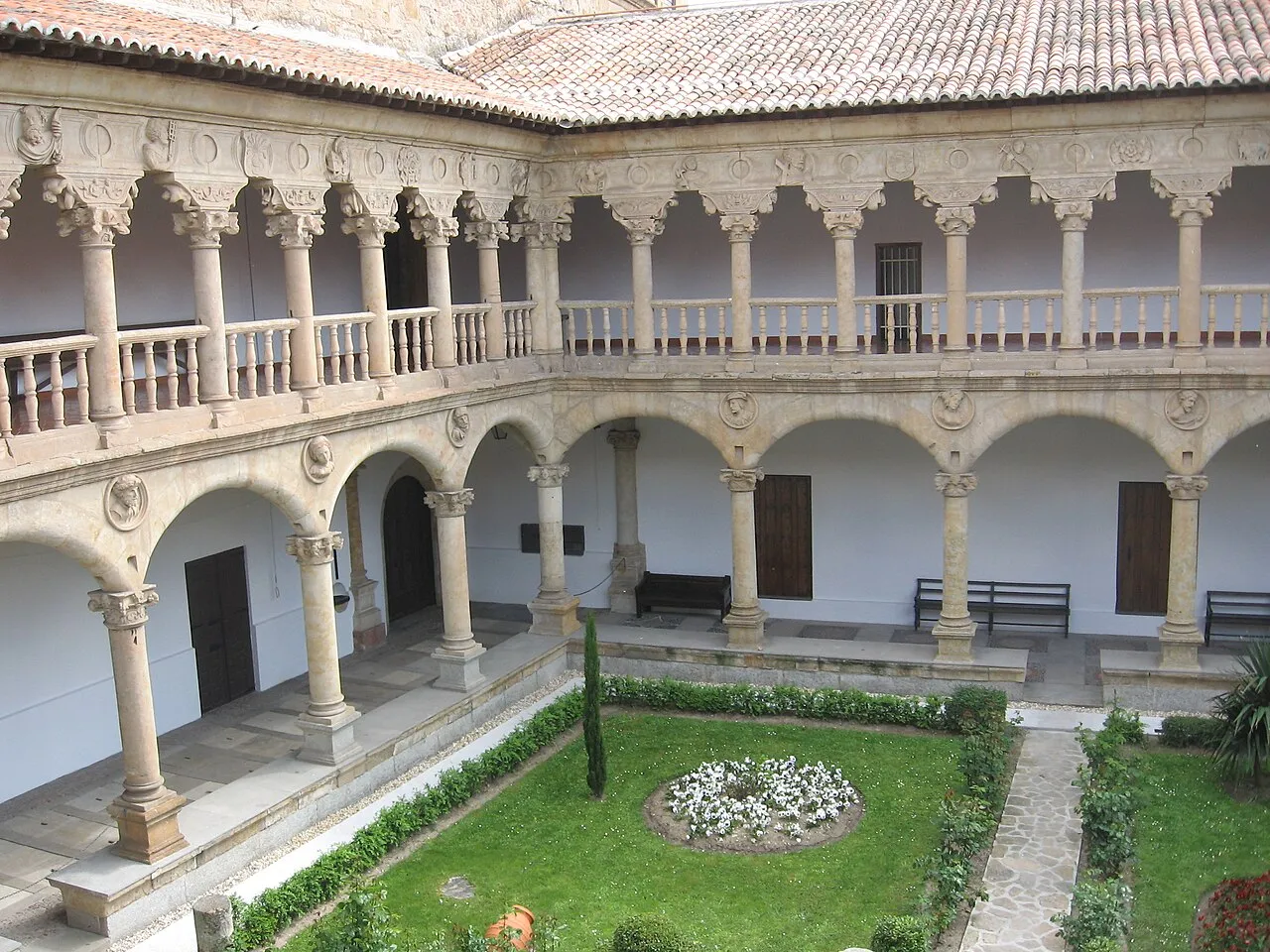
It stands opposite, across the square, and is far smaller. Its cloister has an irregular plan, practically pentagonal, with no two sides the same and no right angles, because the convent moved into an existing palace and had to be fitted onto an impossible plot.
That irregularity, which was a problem, works in its favour today: since no two stretches are the same, the perspective changes constantly as you walk round and the courtyard seems bigger than it is. It is an accident turned into a virtue.
What you have to look at are the capitals of the upper gallery, carved one by one and all different, with a repertoire that mixes Renaissance plant motifs with human figures, fantastical animals, monsters, skulls and mermaids. Some are openly unsettling.
People have wanted to read the influence of Bosch into them, although the connection is not proven. What is certain is that they are startling in an enclosed convent, that they are small, that they are set high up and that you have to walk the gallery slowly to see them. In photographs they do not come across.
Santa Clara: the ceiling that was covered up
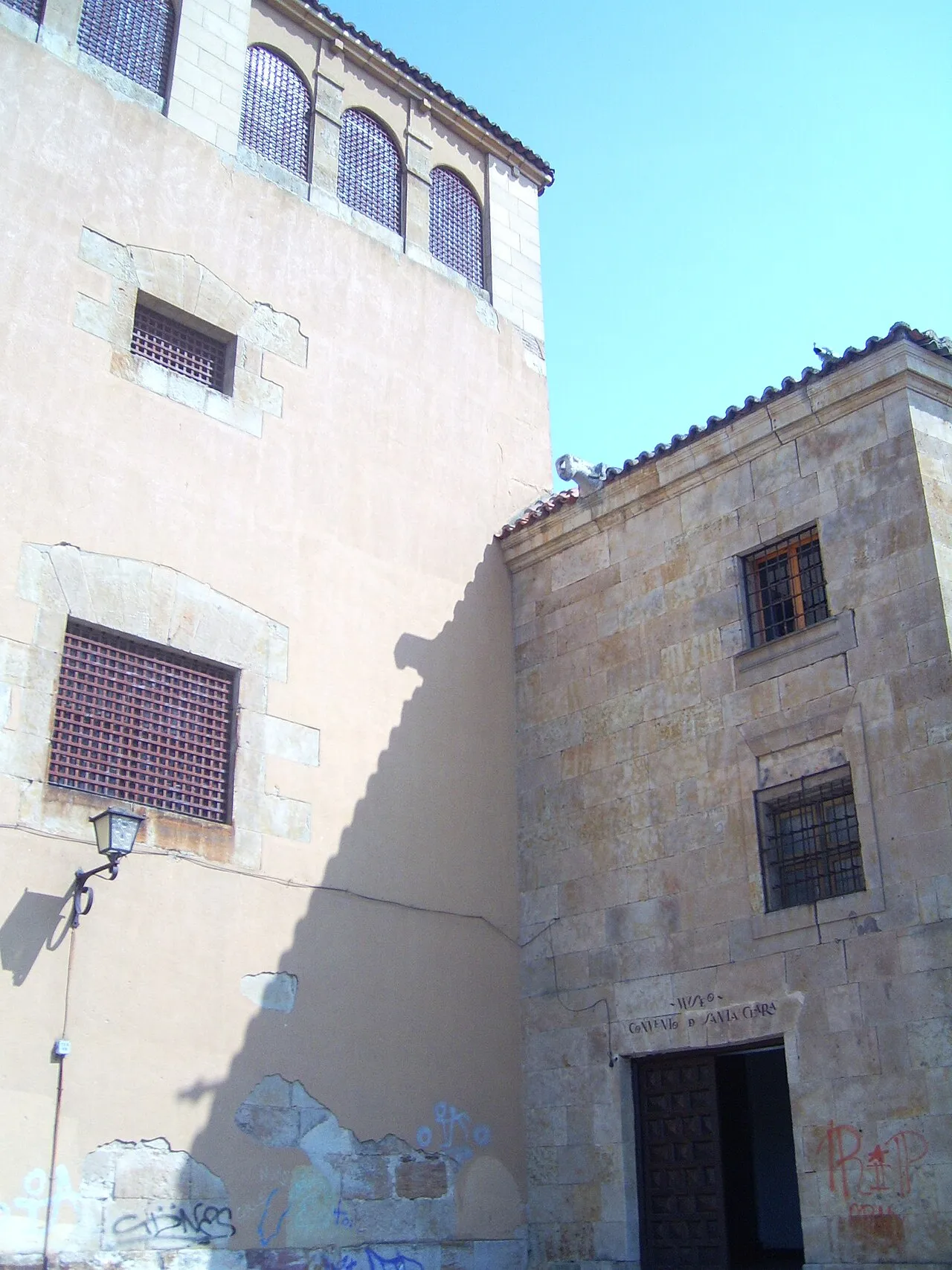
The third is five minutes away and is the one fewest people know. From outside it does not draw attention and inside it looked like an ordinary Baroque convent, with its plain white ceiling over the church. Until, in the twentieth century, somebody looked at what was above it.
What appeared was a fifteenth-century Mudéjar coffered ceiling, polychrome and complete, hidden under a false ceiling put in during the seventeenth century because taste had changed and Mudéjar work was considered old-fashioned. It was not destroyed: it was simply covered over.
That gesture of aesthetic contempt turned out to be the best possible conservation system. The ceiling was protected from candle smoke, from damp and from later alterations for three hundred years, and when it was uncovered it was in a condition no exposed ceiling would have reached.
Today you walk along a gangway installed at its level, so that you pass right beneath the carved wood and see the interlacing and the paintwork close up. During the same works, Gothic wall paintings also appeared that had spent centuries under layers of whitewash.
An enclosed Dominican community still active, so only the cloister and a few rooms can be visited, with reduced hours and a closure at midday. They sell sweets they make themselves through a revolving hatch, and that can be done without going into the cloister.
The building works as a stratigraphic section: twelfth-century Romanesque remains, a fifteenth-century Mudéjar coffered ceiling, Gothic paintings, a seventeenth-century Baroque layer and later additions. Enclosed Poor Clares live in it and the visit is guided, with slots at fixed times.
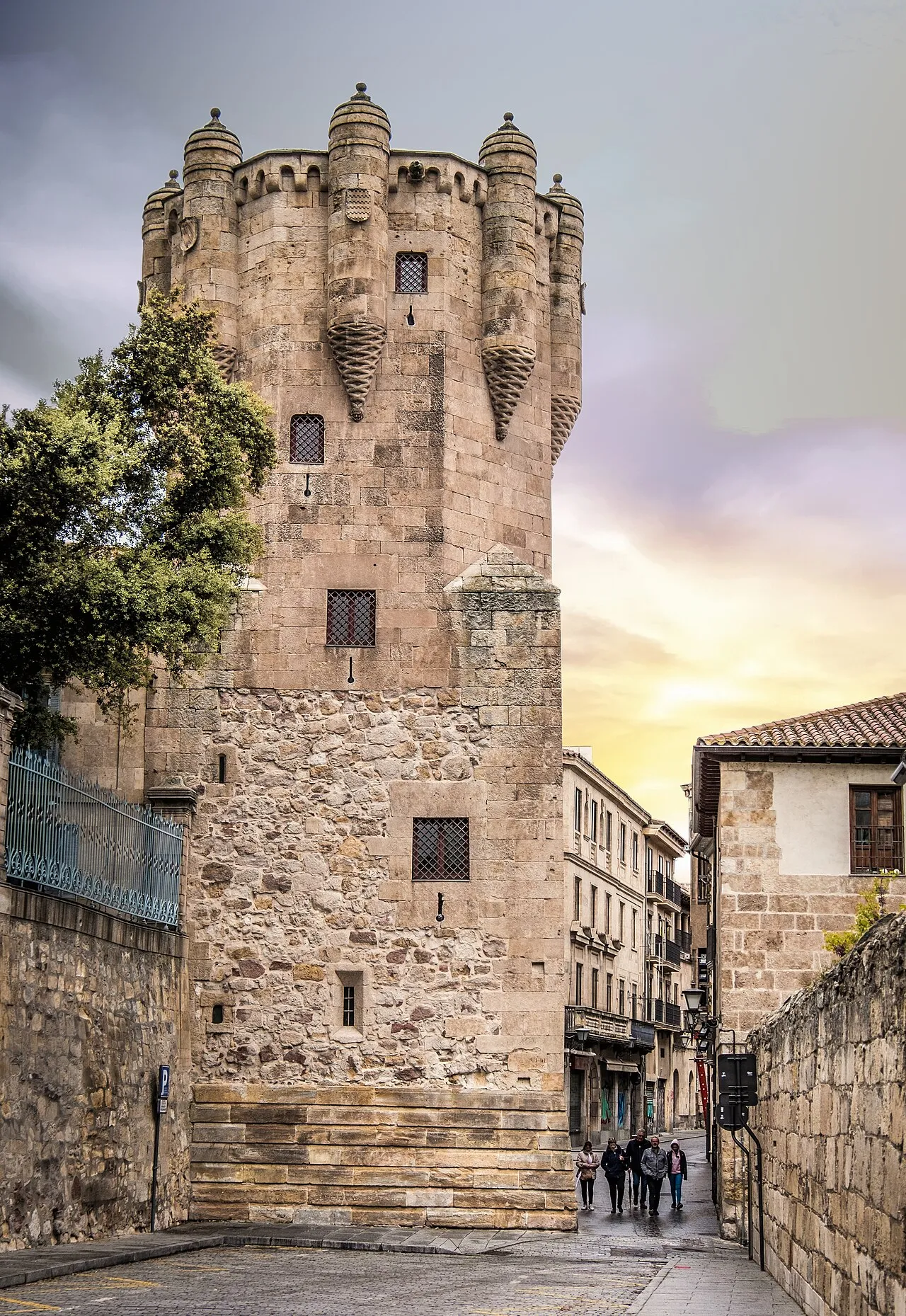
On the way to the convent quarter from the Plaza Mayor, an octagonal tower crowned by eight projecting turrets, the only remnant of a vanished fifteenth-century palace. It was built by the clavero, the key-keeper of the Order of Alcántara. The inside cannot be visited, but it is seen from the street.
Yes. When the committee of experts convened in Salamanca rejected his project, he found in this Dominican convent the support of Fray Diego de Deza, who put him up and pressed his case at court until the voyage was funded. The experts, incidentally, were right: Columbus had miscalculated the circumference of the Earth.
What is special about the capitals at Las Dueñas?
They are carved one by one in the upper gallery of the cloister and not one is repeated. They mix Renaissance plant motifs with monsters, mermaids, skulls and deformed faces, some openly unsettling for an enclosed convent. They are small, they are set high up and you have to walk the gallery slowly to see them.
Why is the cloister at Las Dueñas irregular?
Because the convent moved into an existing palace and the cloister had to be fitted onto a plot of impossible shape: no two sides are the same length and no angle is a right angle. That irregularity works in its favour, because the perspective changes as you walk and the courtyard seems bigger than it really is.
What is the hidden ceiling at Santa Clara?
A fifteenth-century Mudéjar coffered ceiling, polychrome and complete, which in the seventeenth century was covered over by a false Baroque ceiling because taste had changed. It was not destroyed, only hidden, and that aesthetic contempt kept it intact for three hundred years. It was uncovered in the twentieth century and today you walk along a gangway at its level.
Can you see all three in one morning?
Yes, they are less than ten minutes' walk from one another and no visit goes beyond forty minutes. The real constraint is the timetable: all three close at midday and Santa Clara can only be entered on a guided visit with slots at fixed times, so it is worth checking that timetable before organising the rest.
Is it true that the nuns sell sweets?
Yes, at Las Dueñas, which is an enclosed Dominican community still active. The sweets are bought through a revolving hatch, with nobody seeing anybody's face, and it can be done without going into the cloister, within whatever hours they have set. They are mostly biscuits made by the community itself.
Practical information
WhereEast of the old town, 10 minutes from the Plaza Mayor along calle San Pablo.
DurationA long morning for the three convents.
TicketsSan Esteban around 4 €, Las Dueñas 2 €, Santa Clara 3 € with a compulsory guided visit.
Opening hoursAll three close at midday. Santa Clara runs on slots at fixed times: check them first.
On the wayThe Torre del Clavero, which is seen from the street and needs no ticket.
ExtraLas Dueñas sell sweets through the revolving hatch, with no need to go into the cloister.
On the map
🎧 With Viavoy
Walk Salamanca and listen at your own pace
Download Viavoy and walk Salamanca offline, whenever you like.
from 2,99 €· one-off payment
City Pass · 9,99 €3 days, all the tours in Salamanca