1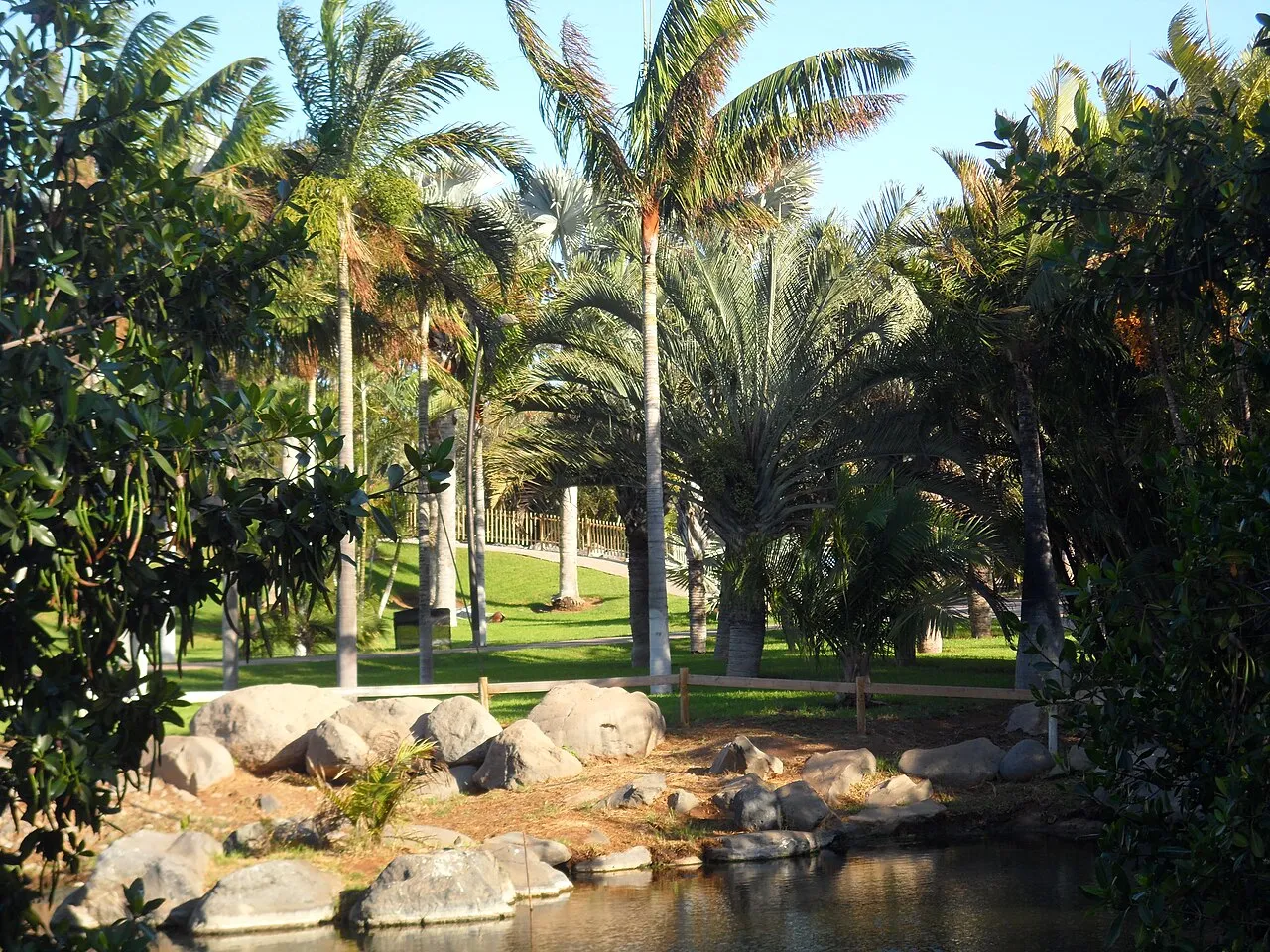
Palmetum of Santa Cruz
📍 End of the seafront
Twelve hectares with more than 400 species of palm arranged by continent, on the old municipal rubbish tip. Opened in 2014. An hour and a half for the visit.
Twelve hectares of tropical palms on the old municipal tip, sixty-seven thousand square metres of dragon trees and sculptures, and salt-water pools signed by César Manrique.
🎧 On the walk The Auditorium, the Palmetum and the seafrontThe climate of Tenerife allows something that in continental Europe would demand heated greenhouses: growing tropical plants from half the world in the open air. Santa Cruz has made the most of it, and has three green spaces that are each worth a journey on their own, including the most improbable of them all.
For decades this hill was the municipal tip: the mountain of waste where everything Santa Cruz threw away ended up. When it closed, instead of covering it over and forgetting it, someone proposed sealing it and turning it into a botanical garden.
The operation demanded years of technical work — sealing, drainage, gas management, bringing in soil — before anything could be planted. The Palmetum opened to the public in 2014, with some hundred and twenty thousand square metres, twelve hectares.
It brings together more than four hundred species of palm from the tropical zones of the whole planet, arranged by region: you walk from Madagascar to the Caribbean and from New Guinea to Central America, changing continent on every terrace. It is one of the most important collections in Europe.
Among those species there are extremely rare palms, or ones almost extinct in the wild, which find refuge here. It works as a kind of plant ark, keeping specimens of which barely any remain outside.
And there is a reward at the end of the climb: from the viewpoint you take in the whole seafront with the Auditorio and the Santa Cruz Towers in the same frame, and the Atlantic behind.
Twelve hectares with more than 400 species of palm arranged by continent, on the old municipal rubbish tip. Opened in 2014. An hour and a half for the visit.
Download the app and discover Santa Cruz de Tenerife offline, whenever you like. Take the walking tour The Auditorium, the Palmetum and the seafront with a local guide in your ear.
Find out more about Viavoy →The García Sanabria Park covers more than sixty-seven thousand square metres and is the largest urban garden in the whole archipelago. It opened in 1926, driven by the mayor who gives it his name and who was determined to give shade to a city that had almost none.
It is not an ornamental garden in the usual sense: it works as half a botanical garden. Dragon trees, Canary palms, bougainvillea and coral trees grow here in the open air thanks to a climate that allows species to be grown outdoors that in continental Europe would demand a greenhouse.
It is protected as a Bien de Interés Cultural, a listed heritage asset, and the nuance matters: not for any building, but for its value as a living landscape. It is the garden itself that is considered heritage.
Scattered among the trees there are works of contemporary open-air sculpture, the legacy of an international exhibition held in 1973 that left the pieces permanently installed and turned Santa Cruz into one of the first open-air sculpture museums in Spain.
A scar worth knowing about: in November 2005 tropical storm Delta crossed Tenerife and brought down hundreds of the park's trees, many of them centuries old. It took years to recover, so what gives shade today is also the fruit of a great deal of patience.
The third space is not exactly a garden, but it belongs to the same family of ideas: the César Manrique Maritime Park, a maze of salt-water pools, waterfalls and black volcanic rock dotted with palms, across twenty-two thousand square metres reclaimed from the sea.
It was designed by the Lanzarote artist who argued that architecture in the Canary Islands should be born of the volcanic landscape instead of being imposed on it. Here the water, the stone and the planting work together, with no jarring straight lines.
Manrique died in a car accident in 1992 and the park opened in 1995, by then without him. It has an older brother in the north of the island, the Lago Martiánez in Puerto de la Cruz, signed years earlier and on a bigger scale.
The formula answers a real problem: along many stretches of the Canarian coast the shore is cliff or cutting rock, with no usable beach. Salt-water pools solved urban bathing where nature did not offer it.
The three spaces are on the same axis: the Parque Marítimo and the Palmetum on the seafront, one behind the other, and the García Sanabria in the upper part of the centre. A full day is enough for all three at a calm pace.
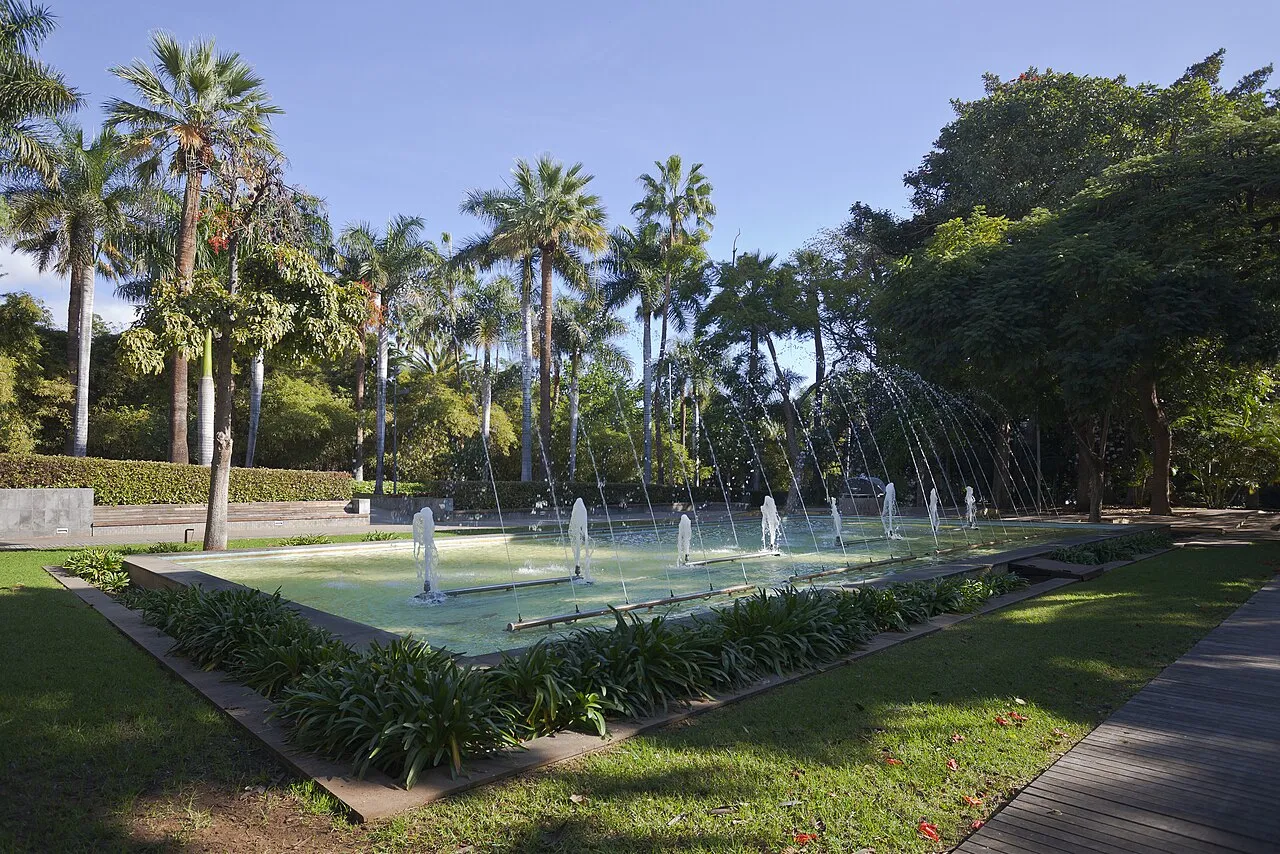
More than 67,000 m² opened in 1926: dragon trees, palms and tropical species in the open air, with contemporary sculptures from 1973 among the trees.
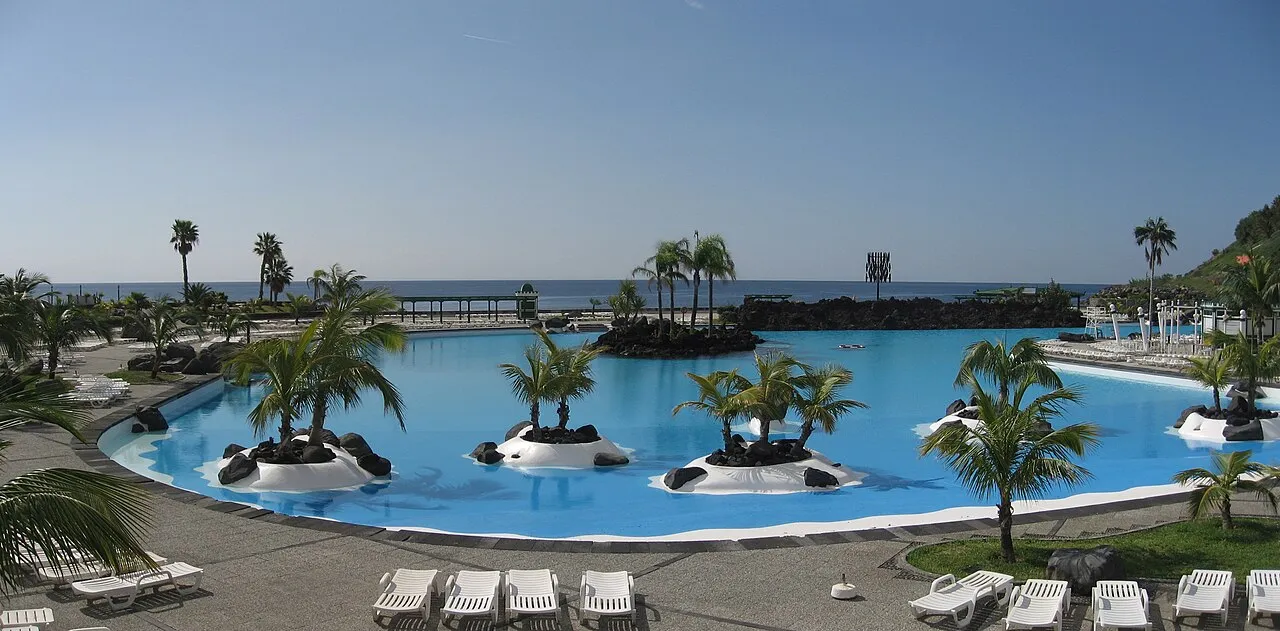
Salt-water pools, waterfalls and volcanic rock across 22,000 m² reclaimed from the sea. Manrique died in 1992 and never saw it: it opened in 1995.
Yes. That hill was for decades the municipal tip of Santa Cruz, the mountain of waste where everything the city threw away ended up. When it closed, it was sealed with years of technical work — drainage, gas management, bringing in soil — and replanted as a botanical garden. It opened to the public in 2014.
More than four hundred species of palm from the tropical zones of the whole planet, arranged by region of the world, across twelve hectares of terraces. It is one of the most important palm collections in Europe, and it includes extremely rare species, or ones almost extinct in the wild, which find refuge here.
The Parque García Sanabria, in the upper part of the centre of Santa Cruz: more than sixty-seven thousand square metres opened in 1926. It is protected as a Bien de Interés Cultural, and the nuance matters: not for any building, but for its value as a living landscape.
Because of the climate: the island has a practically perpetual spring, with mild temperatures all year, which allows species to be grown outdoors that in continental Europe would demand a heated greenhouse and permanent expense. It is the same condition that made the Canary Islands a compulsory botanical stop on the scientific expeditions of the eighteenth and nineteenth centuries.
Works of contemporary open-air sculpture, the legacy of an international exhibition held in Santa Cruz in 1973 that left the pieces permanently installed in streets and gardens. That initiative turned the city into one of the first open-air sculpture museums in Spain.
Yes, that is its purpose: they are pools of salt water pumped from the Atlantic, with waterfalls and volcanic rock, and the city uses them all year. There is paid entry at a moderate price and every service. If you have no swimming costume with you, walking round it and looking at it from outside for fifteen minutes is also worth it.
A full day is enough for all three at a calm pace. The Parque Marítimo and the Palmetum are on the same seafront axis, one behind the other, and the García Sanabria is in the upper part of the centre, fifteen minutes uphill from the Plaza de España.
Download Viavoy and walk Santa Cruz de Tenerife offline, whenever you like.

Keep reading