The Mérida Festival: classical theatre in a Roman theatre
What's on · Mérida

The Mérida Festival: classical theatre in a Roman theatre

Since 1933, Greek tragedy and Latin comedy in the original tiers and with the acoustics they were designed for. How it works, what to expect and how it fits with a visit to the city.

7 min read · Updated for the season
🎧 On the walk Roman Mérida: a walk through Emerita Augusta

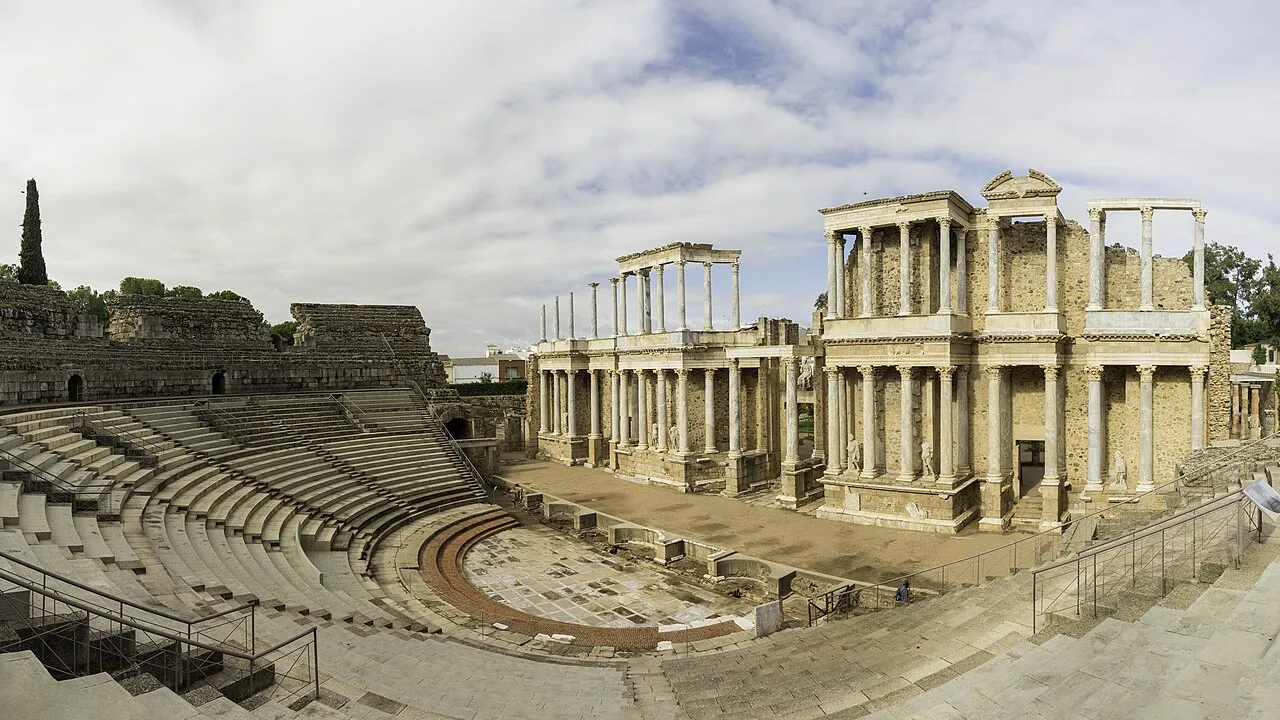
There are monuments that are preserved and monuments that are used. The Roman Theatre of Mérida belongs to the second group: every summer since 1933, apart from the interruptions of the war, Greek tragedies and Latin comedies are performed here in front of six thousand people seated in the very tiers they were written for. It is not a re-enactment: it is continuity.

What is performed is what was written for this kind of space. Sophocles, Euripides, Plautus and Seneca in a Roman theatre is not a set-design idea: it is the place where they work.

Almost a century of history

The theatre was excavated from 1910 onwards and in 1933 Seneca's Medea was premiered here, in a version by Miguel de Unamuno and with Margarita Xirgu in the leading role. That performance was the origin of what is today the oldest classical theatre festival in Spain and one of the most long-standing in Europe.

The approach has held: Greek and Latin repertoire — Greek tragedy, Latin comedy, classical mythology — with large-scale in-house productions and casts drawn from the front rank of Spanish theatre and cinema. It is not a festival of archaeological reconstruction, but of contemporary theatre on ancient texts.

The season runs from the end of June to the end of August, with performances almost every night and several shows on the bill over the course of the summer. It is performed at night, when the temperature drops, and the natural stage set is the lit stage façade itself.

1Roman Theatre

Roman Theatre

📍 Archaeological site

The setting for the festival and the most famous monument in the city. The two-storey façade with marble columns is a remodelling from the time of Trajan. It was buried until 1910: all that showed were a few walls that people called Las Siete Sillas, the Seven Chairs.

🎧 With Viavoy

Explore Merida at your own pace

Download the app and discover Merida offline, whenever you like. Take the walking tour Roman Mérida: a walk through Emerita Augusta with a local guide in your ear.

Find out more about Viavoy →

What it is like to attend a performance

The first thing that surprises you is the acoustics. A Roman theatre is designed with a very precise geometry — semicircular tiers, orchestra, reflecting stage wall — that lets you hear from the top without amplification, and although sound reinforcement is used today, the underlying design still does its work.

The second is the seating. Six thousand people sit in the same arrangement as twenty centuries ago, with the lower rows closer to the action and the upper ones with a complete view of the whole. Some people prefer the high ones precisely because from up there you see the stage entire, with the stage façade behind it.

And the third is the place. Performances begin as night falls, with the stone still warm from the day and the façade lit up. That context adds to any production a dimension no modern theatre can reproduce.

It is worth bringing something to sit on, because the tiers are stone — although seats are usually installed — and a light jacket: even if the day has gone past forty degrees, from midnight on the temperature drops quite a bit.

2Roman Amphitheatre

Roman Amphitheatre

📍 Next to the theatre

The theatre's neighbour, and also a setting for activities in summer. Seeing the two buildings one after the other, by day, and coming back at night for a performance in the theatre is the best way to spend twenty-four hours in Mérida.

Frequently asked questions

When is the Mérida Festival held?

From the end of June to the end of August, with performances almost every night and several shows on the bill over the course of the summer. It is performed at night, when the temperature drops, on the stage of the Roman Theatre and with the lit stage façade as a natural backdrop.

Can you visit the theatre during the festival?

Normally yes, in the morning, but access is restricted during the hours of set-up and performance, and that changes according to each day's programme. It is worth checking the timetable before organising the visit, because it is the only monument in the group whose access is affected.

What kind of works are performed?

Greek and Latin repertoire: Greek tragedy, Latin comedy and texts on classical mythological themes, in large-scale contemporary productions with casts from the front rank of Spanish theatre and cinema. It is not archaeological reconstruction, but present-day theatre on ancient texts.

How do you buy tickets?

Online and in advance. The most sought-after performances, above all at weekends, sell out. If your trip coincides with the festival, the sensible thing is to buy the ticket before booking your accommodation, and not the other way round.

Can you hear well from the top?

Yes. A Roman theatre is designed with a precise geometry — semicircular tiers, orchestra and reflecting stage wall — that lets you hear from the upper rows without amplification. Sound reinforcement is used today, but the acoustic basis still works. Some people prefer the high tiers because from up there you see the whole stage.

What should you take to the performance?

A light jacket, because even if the day has gone beyond forty degrees, from midnight on the temperature drops quite a bit on the Extremaduran plateau. And water. The tiers are stone, although seats are normally installed on them.

How to fit it into the trip

The festival conditions the tourist visit to the theatre. During the season, access is restricted during the hours of set-up and performance, although you can normally visit in the morning. It is worth checking the timetable before organising the day, because it changes according to the programme.

The ideal combination is to give the day to the Roman circuit — amphitheatre, museum, Temple of Diana, bridge, aqueduct — and save the night for the performance. Everything is a short walk away and the centre is full of terraces where you can have dinner before or afterwards.

Tickets are sold online in advance and the most sought-after performances sell out, above all at weekends. If your trip coincides with the festival, buying before booking your accommodation is a good order of priorities.

And a warning: July and August in Extremadura are brutal. The festival makes up for the heat, but organise the outdoor visits for first thing in the morning and leave the middle hours for the museum, which is the only air-conditioned part of the circuit.

Practical information

Since1933, with Seneca's Medea in Unamuno's version and Margarita Xirgu. The oldest in Spain.
WhenFrom the end of June to the end of August, with performances almost every night.
RepertoireGreek tragedy, Latin comedy and classical mythology, in contemporary productions.
CapacitySome six thousand seats in the original tiers of the Roman Theatre.
TicketsOnline and in advance. At weekends they sell out.
What to bringA light jacket: in the small hours it cools down even if the day has gone past 40°.

On the map

🎧 With Viavoy

Walk Merida and listen at your own pace

Download Viavoy and walk Merida offline, whenever you like.

from 3,99 €· one-off payment
City Pass · 9,99 €3 days, all the tours in Merida
Find out more about Viavoy →
Viavoy app

Keep reading

More articles

Itineraries

Mérida in one day: an itinerary through Emerita Augusta

History

Emerita Augusta: why Mérida has so much Roman in it

Themed routes

Mérida beyond the theatre: the circus, the Mitreo and the alcazaba

Food & drink

Eating in Mérida: the dehesa, the Guadiana market gardens and Ribera del Guadiana