Mérida in one day: an itinerary through Emerita Augusta
The largest Roman complex in Spain spread across a living city. How to order the day to see it all without frying, and in what order it makes sense to do it.
Mérida is not an archaeological site with a city beside it: it is a city with the site inside it. The Roman monuments are spread among streets, squares and inhabited neighbourhoods, and that forces you to plan a little. The good news is that it is all done on foot and that a single day, well ordered, covers the essentials.
The order matters because of the heat, not because of the history. In summer, outdoor sites first thing and last thing, and the museum — the only air-conditioned place — in the middle hours.
Morning: theatre, amphitheatre and museum
Three and a half hours.
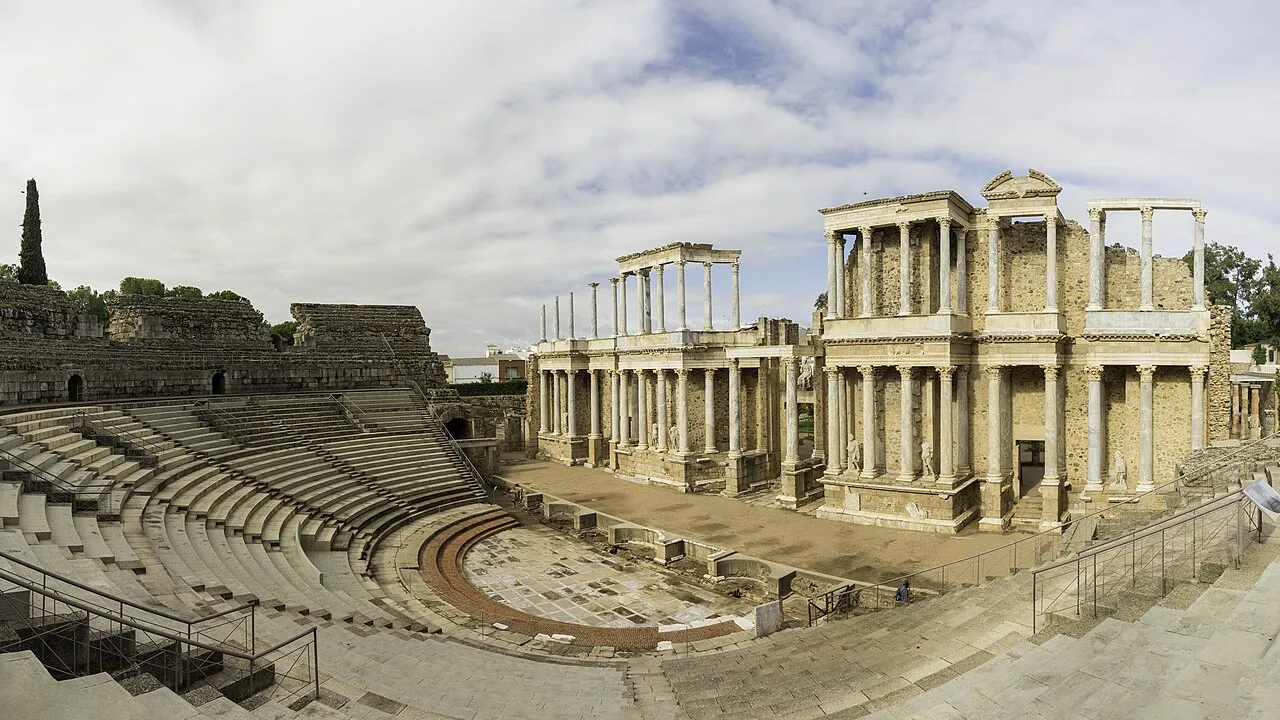
Start with the theatre-amphitheatre complex as soon as it opens. They are two buildings side by side with a joint ticket, and seeing them one after the other is what makes this place special: in twenty metres you go from the stage façade with marble columns to the oval where people were killed in the afternoon.
The theatre opened around 16 or 15 BC, barely a decade after the city was founded, and it lay buried until 1910: all that showed were a few walls that in Mérida were called Las Siete Sillas, the Seven Chairs. The amphitheatre arrived seven years later, with room for fifteen thousand people, more than twice as many.
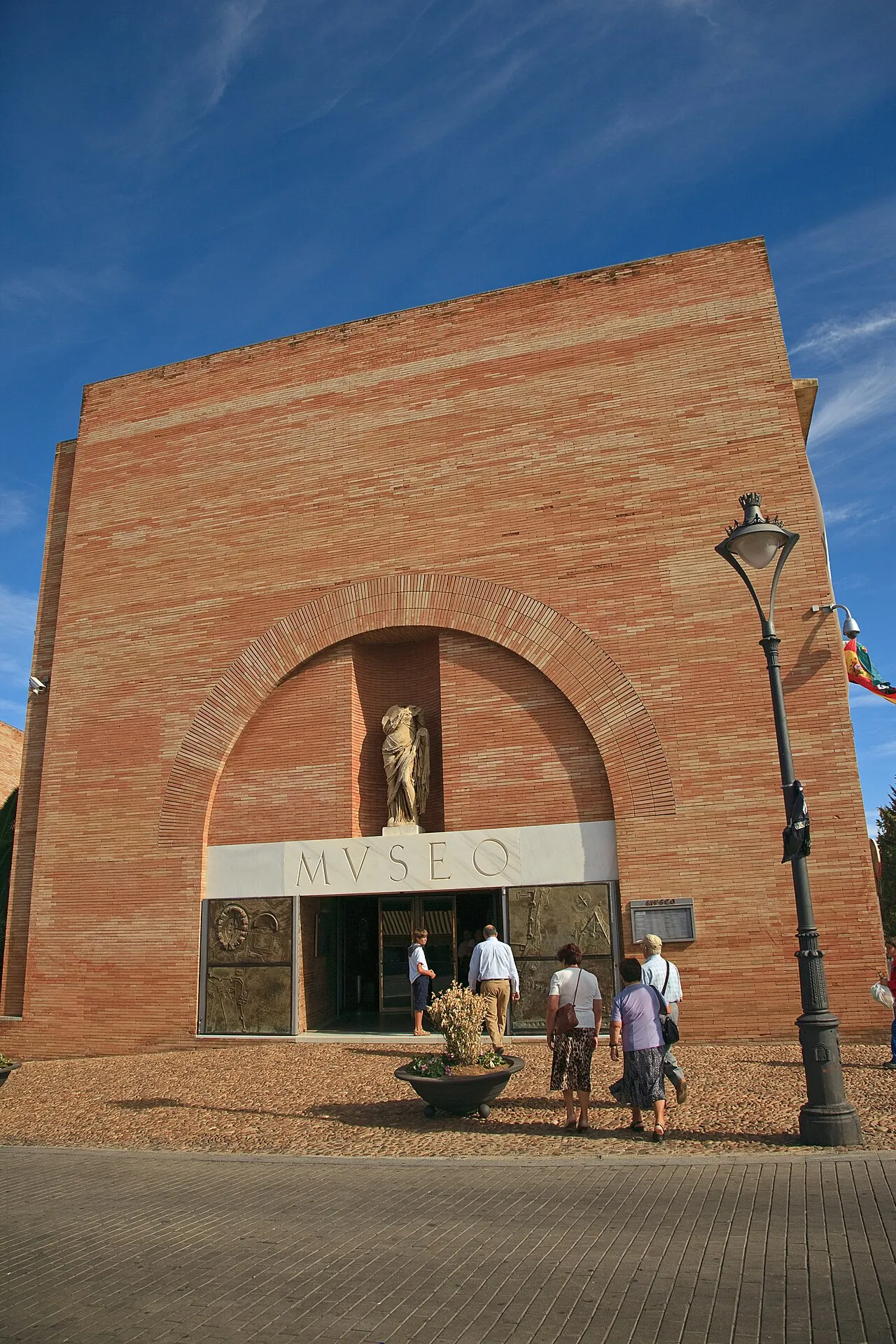
Then cross the street to the National Museum of Roman Art. The order matters: first the empty buildings, then the pieces that came out of them. And do not skip the crypt, with a Roman road and several tombs preserved under the building.
Allow an hour and a half for the archaeological complex and a good hour and a half more for the museum. That takes you to lunchtime, which in summer is exactly when you want to be under a roof.
The two-storey stage façade is a remodelling from the time of Trajan over the theatre of Marcus Agrippa. Six thousand people fitted, seated by social class. And since 1933 it fills up again every summer with the oldest classical theatre festival in Spain.
Very tall brick halls with giant arches and overhead light, the work of Rafael Moneo. The mosaics are hung like paintings because on the floor you cannot take them in at a glance. Underneath, the crypt with a road and some tombs that turned up while it was being built.
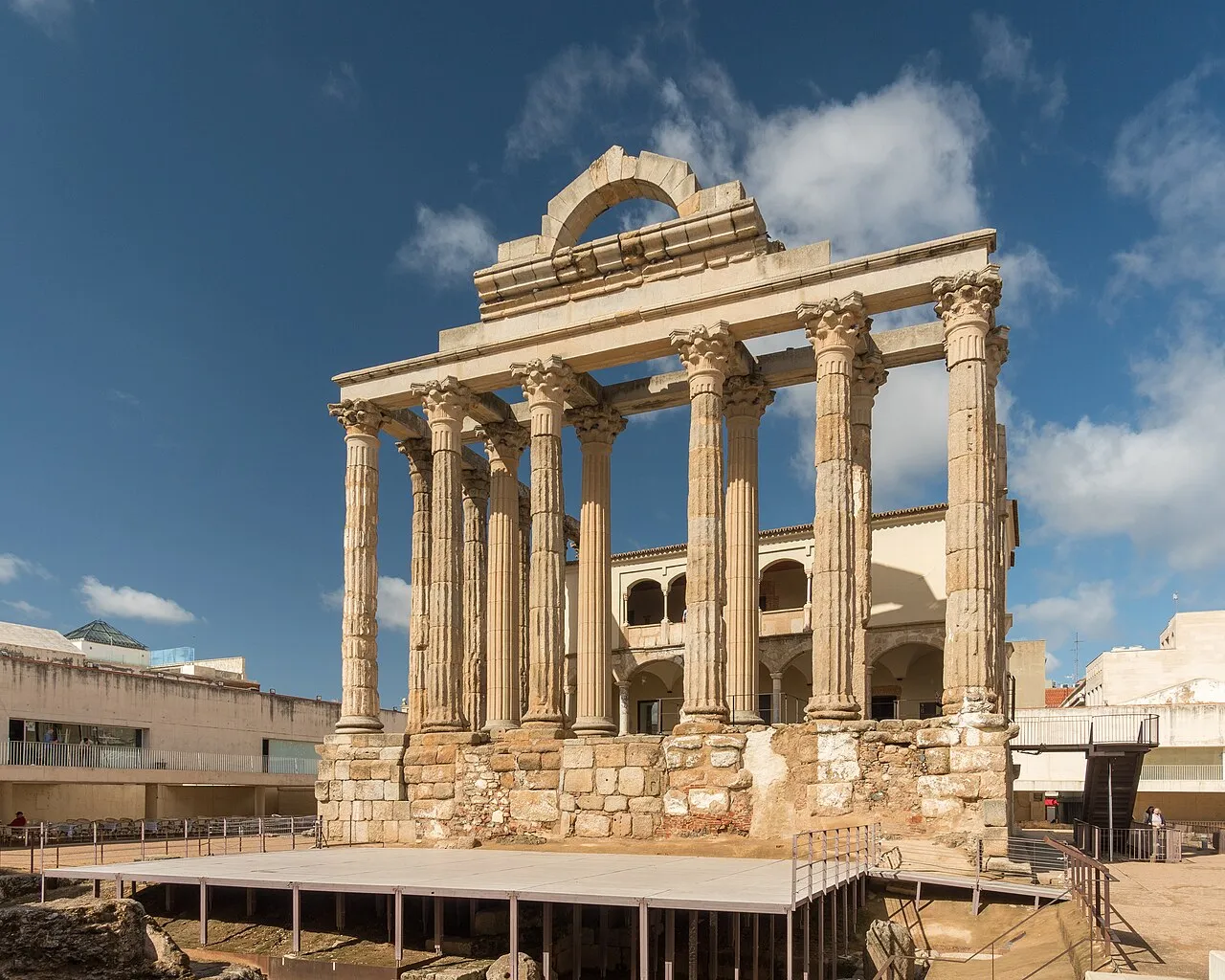
Go down to the centre and start with the Temple of Diana, which was neither Diana's nor ever an ordinary temple: it was dedicated to the imperial cult and presided over the city's forum. It survived because in the sixteenth century a nobleman embedded its columns in the palace he built on top of it.
Two streets away is the Arch of Trajan, which is not what its name suggests either: it was not a triumphal arch, but the monumental gateway into a sacred precinct. In Mérida the popular names get it wrong quite often, and that is part of the fun.
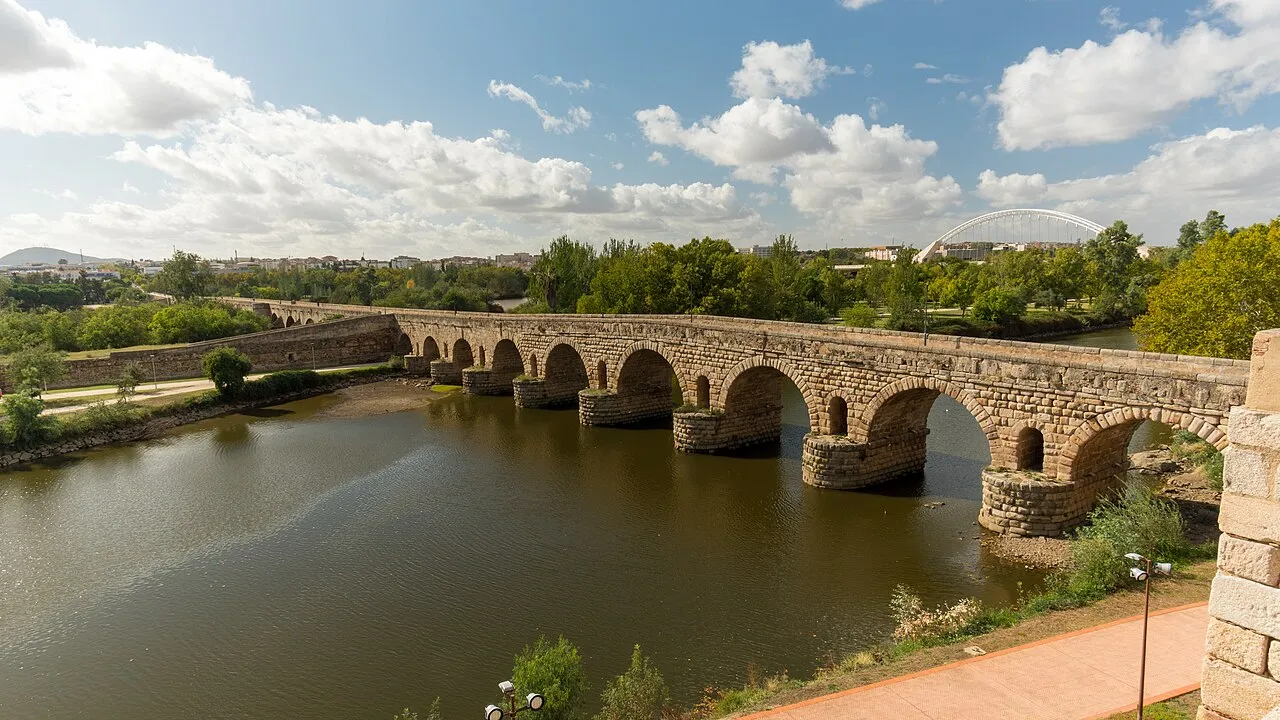
Carry on down to the plaza de España, the centre of the living city, and from there to the river. There stand the ninth-century Arab Alcazaba, built to control the head of the bridge, and the Roman Bridge, almost eight hundred metres and some sixty arches, one of the longest Rome ever raised.
Cross the whole of it, which takes ten minutes, because the best view of the ensemble is from the far bank. And if you have energy left, the Morería archaeological area, next to the river, shows the city's town planning stratified from Roman times to the medieval period.
The only Roman temple left standing in the city, dedicated in fact to the imperial cult. Walk right round it: it changes a great deal with the angle, and in front you can see the long pool that served as a water mirror. It is lit at night and access is free.
The official entrance to Emerita, where the Vía de la Plata arrived. It rests on an island in the river bed and its triangular cutwaters break the floods. A flood in the seventeenth century carried off several arches: if you look carefully, the stones are not all the same.
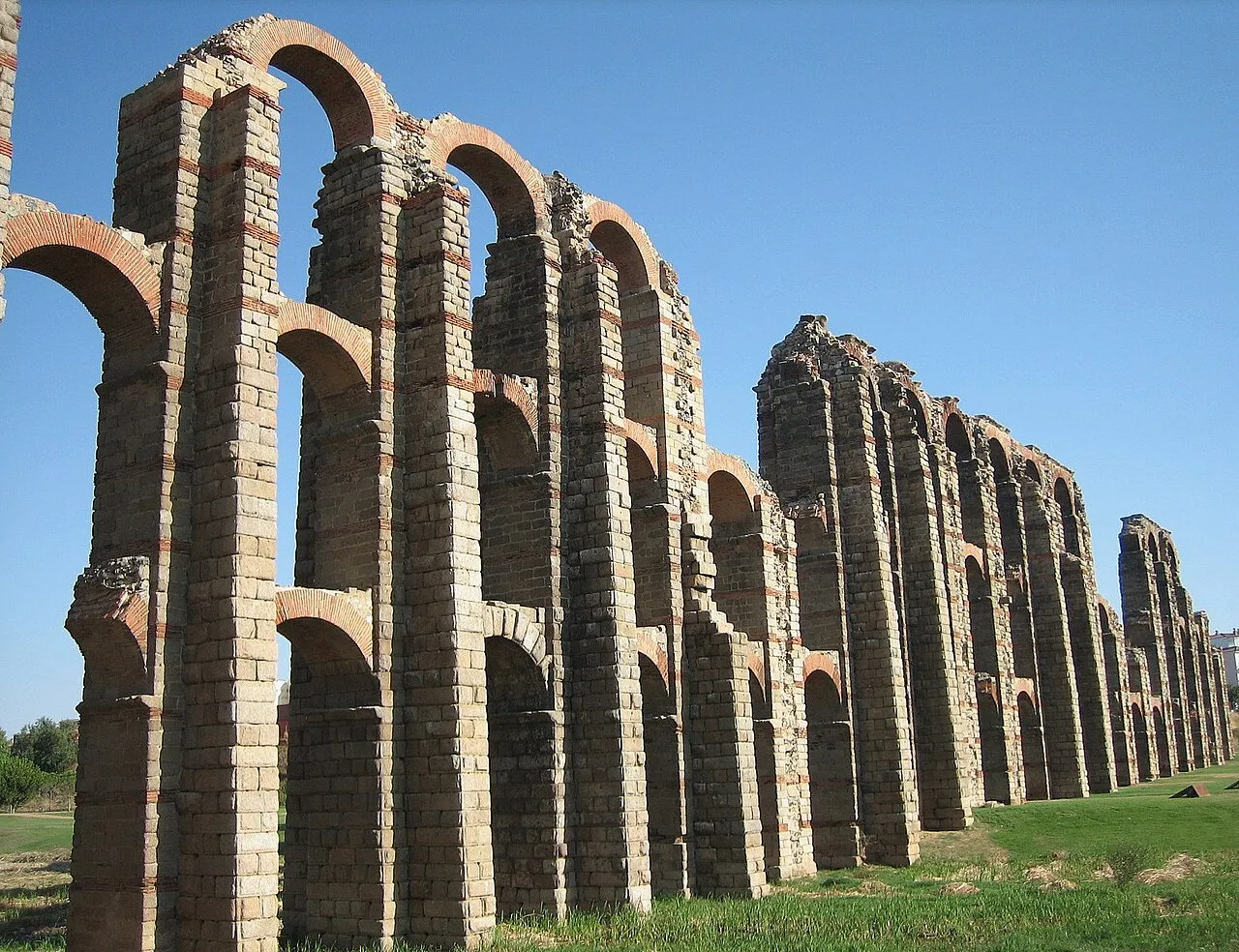
Save the Aqueduct of Los Milagros for the end of the day, because the low light of the last hour sets the granite alight and brings out the contrast with the bands of brick. It is about twenty minutes' walk from the centre, to the north, in an open park with free access.
It is the most impressive image in the city and yet the one most people skip because it lies off to one side. Its arches reach twenty-five metres at the deepest point of the Albarregas valley, and they brought the water from the Roman reservoir of Proserpina.
Walk among the piers, which is how you take in the scale. And look at the storks: they nest generation after generation on top of the arches, and for many people they are as much part of the image of the monument as the stripes.
If you have time to spare, nearby is the San Lázaro aqueduct, another surviving stretch of a different water supply, and from there you go back to the centre past the basilica of Santa Eulalia, where early Christian remains can be seen beneath the present church.
Red and white stripes of opus mixtum: granite to take the load, brick to level and lighten. Up to twenty-five metres high. The name comes from pure popular admiration: for centuries it seemed impossible that the thing was still standing.
If you have half an hour to spare at the end, go back. The amphitheatre in afternoon light and without groups is another place: you can see the central machinery pit better and make out the gates and the sectors separated by social class in the tiers.
Yes, the essentials fit into one well-ordered day: theatre, amphitheatre, museum, Temple of Diana, Roman Bridge and the Aqueduct of Los Milagros. With a second day you can add the Roman circus, the Arab alcazaba, the Casa del Mitreo with its mosaics, the columbaria and the basilica of Santa Eulalia, all at a calmer pace.
Is there a joint ticket for the monuments?
Yes. The pass for the monumental complex includes theatre and amphitheatre, Casa del Mitreo, columbaria, alcazaba, Roman circus and the basilica of Santa Eulalia. The National Museum of Roman Art has its own separate ticket, because it is state-owned, so you have to count on two tickets.
In what order should you make the visit?
First the buildings and then the museum, because the museum holds the pieces that came out of them, including the original sculptures from the theatre façade. And in summer, outdoor sites first thing in the morning and last thing in the afternoon, with the museum in the middle hours, which is the only air-conditioned part of the circuit.
Is it worth going out to the aqueduct?
Very much so, even though it is twenty minutes from the centre. It is the most impressive image in Mérida and the one most people skip precisely because it is off to one side. It is in an open park with free access, you walk among the piers and the light of the last hour of the afternoon suits it best.
Can you combine it with Cáceres?
Yes, they are about seventy kilometres and an hour's drive apart, and they are two completely different cities: Mérida is Roman and Cáceres is medieval and Renaissance. A weekend with a day in each works very well, and both are World Heritage Sites.
When is the best time to visit Mérida?
Spring and autumn. The Extremaduran summer goes comfortably past forty degrees and practically the whole circuit is in the open air and without shade. If you go in July or August, it coincides with the classical theatre festival, which makes up for the heat, but organise the day very carefully.
Practical information
DurationA full day. With two you can fit in the circus, the Mitreo, the columbaria and Santa Eulalia.
TicketsJoint pass for the monumental complex. The museum goes separately, with its own ticket.
The orderOutdoor sites first thing and last thing; the museum in the middle hours of the day.
Getting aroundAll on foot and flat. The aqueduct is 20 minutes north of the centre.
SummerMore than 40°. Hat, water and planning: almost the whole circuit is in the open air.
EatingPlaza de España and around it. Ibérico products, torta del Casar and Ribera del Guadiana.
On the map
🎧 With Viavoy
Walk Merida and listen at your own pace
Download Viavoy and walk Merida offline, whenever you like.