Barcelona's Gothic Quarter: what to see and what is really medieval
Neighbourhoods · Barcelona

Barcelona's Gothic Quarter: what to see and what is really medieval

A Roman wall, a cathedral with geese, a silent Jewish quarter and a famous bridge built in 1928. A guide to walking it knowing what you are looking at.

10 min read · Updated for 2026
🎧 On the walk The Gothic Quarter and the Cathedral

The Barri Gòtic is the heart of Barcelona and also its greatest misunderstanding. A good part of what gets photographed as medieval is not: it was rebuilt, moved or simply constructed in the first third of the twentieth century, when the city decided to give itself an old town worthy of its history. That does not make it less interesting, it makes it more so: here there are two thousand real years of city with a layer of reinvention on top. Knowing how to tell them apart completely changes the walk.

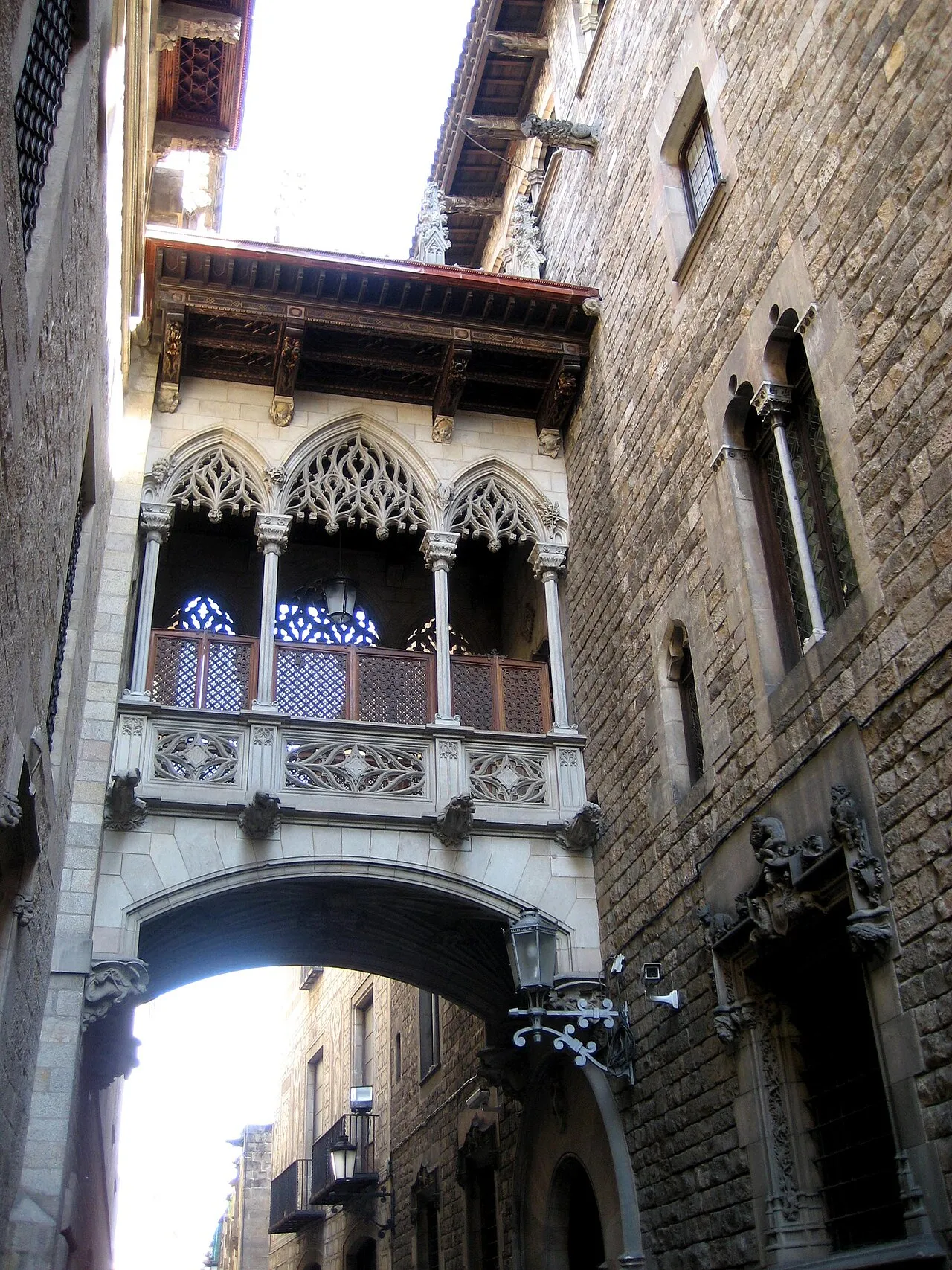
The neo-Gothic bridge on the Carrer del Bisbe, the most photographed in Barcelona, dates from 1928. It is not medieval, and the skull pierced by a dagger on its underside has a legend of its own.

What really is old

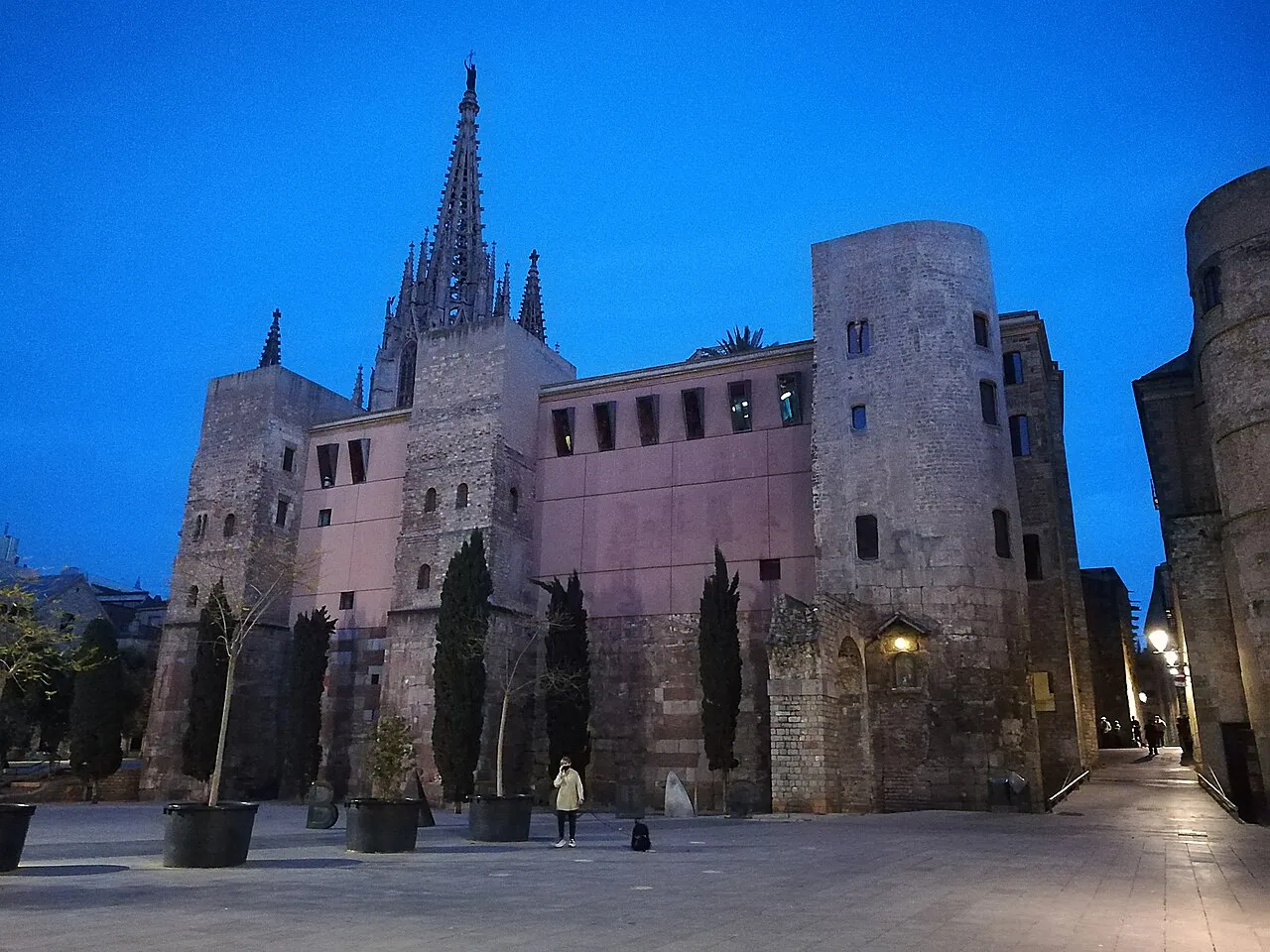
The Roman wall. It is the oldest thing you can touch: the towers in the Plaça Nova are from the fourth century and formed part of an enclosure of one thousand three hundred metres and seventy-eight towers. It was raised in a hurry, out of fear of raids, reusing gravestones and blocks from earlier monuments as filler.

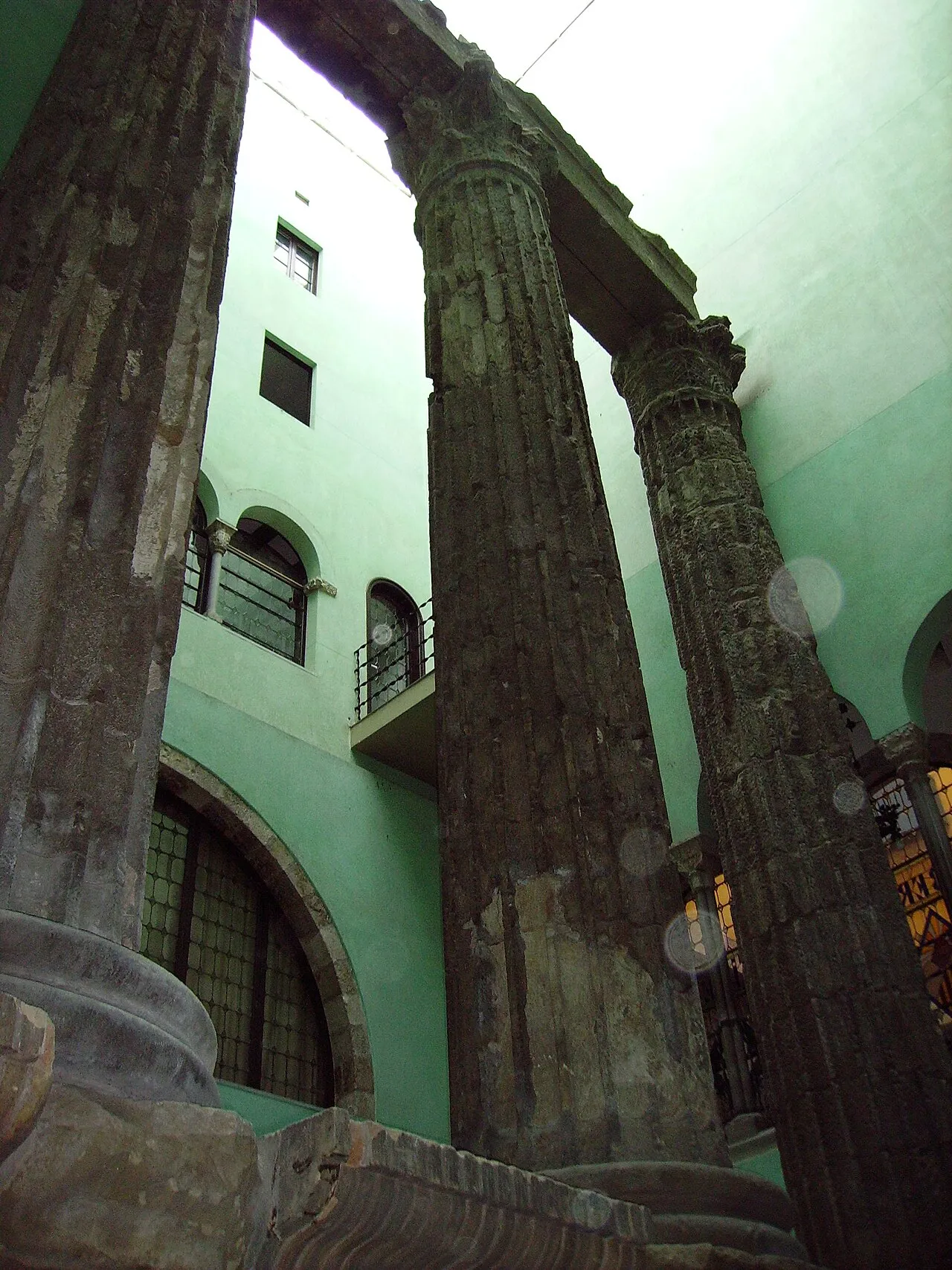
The Temple d'August, hidden in a courtyard on the Carrer Paradís: four Corinthian columns eleven metres high, standing since the first century, inside a building of the Centre Excursionista de Catalunya. Entry is free and almost nobody finds it, although it is signposted.

The underground. Beneath the Plaça del Rei, the MUHBA preserves four thousand square metres of excavated Barcino: streets, a dye works, a laundry and a garum factory, the fermented fish sauce that was the great Roman export. It is the most impressive visit in the neighbourhood and one of the least crowded.

And the Plaça del Rei with the Saló del Tinell, the great fourteenth-century Gothic hall where the Catholic Monarchs received Columbus in 1493, with diaphragm arches spanning eighteen metres.

1Plaça Nova and the Roman wall

Plaça Nova and the Roman wall

📍 Entrance to the Gothic Quarter

Two fourth-century towers that marked the main gate of Barcino. At their base there are funerary slabs reused as filler: the city sealed the names of its dead inside its own defences. Opposite, the white-line frieze of the Col·legi d'Arquitectes was drawn by Picasso from France without ever returning to Spain.

2The Cathedral and the cloister of the geese

The Cathedral and the cloister of the geese

📍 Pla de la Seu

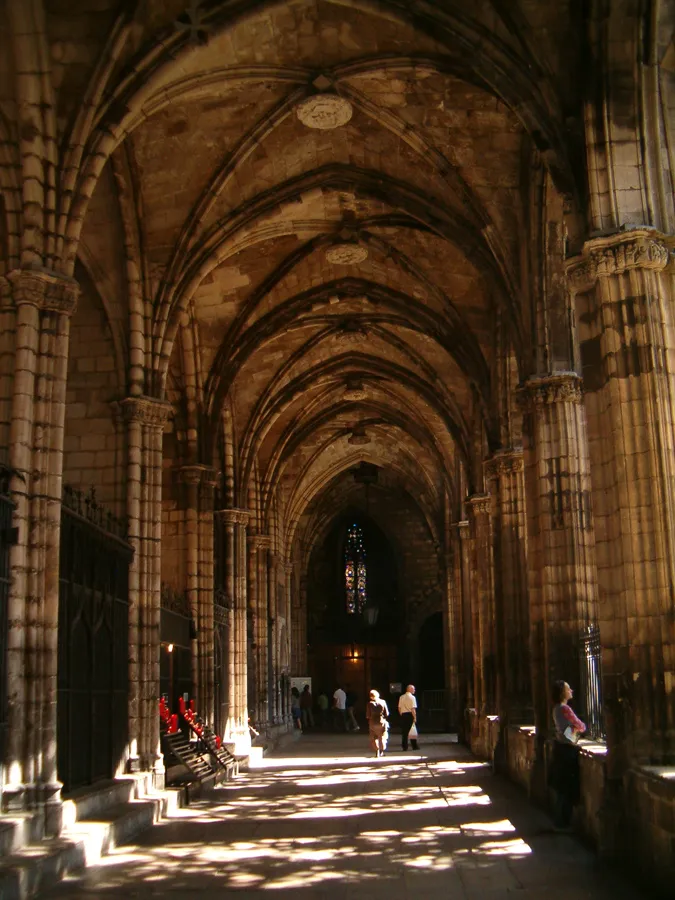
The church is from the thirteenth to fifteenth centuries; the façade, from 1913. The memorable part is in the cloister: palm trees, a fountain and thirteen live white geese, thirteen for the thirteen years of Santa Eulàlia, martyred according to tradition with thirteen torments and buried in the crypt. There is a lift to the roof terrace and up there is almost never anyone.

3The Temple d'August

The Temple d'August

📍 Carrer Paradís, 10

Four first-century Corinthian columns eleven metres high, standing at the highest point of Barcino, wedged inside the courtyard of a modern building. Entry is free, it is signposted, and even so most people walk straight past along the street without knowing there is a Roman temple ten metres away.

🎧 With Viavoy

Explore Barcelona at your own pace

Download the app and discover Barcelona offline, whenever you like. Take the walking tour The Gothic Quarter and the Cathedral with a local guide in your ear.

Find out more about Viavoy →

What the twentieth century invented

And why it was done.

Between 1908 and the sixties, Barcelona remade its old town. The opening of the Via Laietana in 1908 destroyed hundreds of medieval houses, and several of the buildings in the way were dismantled stone by stone and reassembled somewhere else: the Casa dels Canonges, the Casa de la Pia Almoina and other Gothic elements travelled within the neighbourhood itself.

The bridge on the Carrer del Bisbe, the most reproduced image of Barcelona, was built by Joan Rubió i Bellver in 1928 to connect two buildings. It is neo-Gothic, not Gothic, and answers to the same logic as the International Exhibition of 1929: to give the city a recognisable historic image for the visitor.

On its underside there is a skull pierced by a dagger. Legend says that if it is removed, the city collapses; the likely explanation is that it is an iconographic motif of death, common in the neo-Gothic repertoire. As with almost everything in this neighbourhood, the pretty version has won.

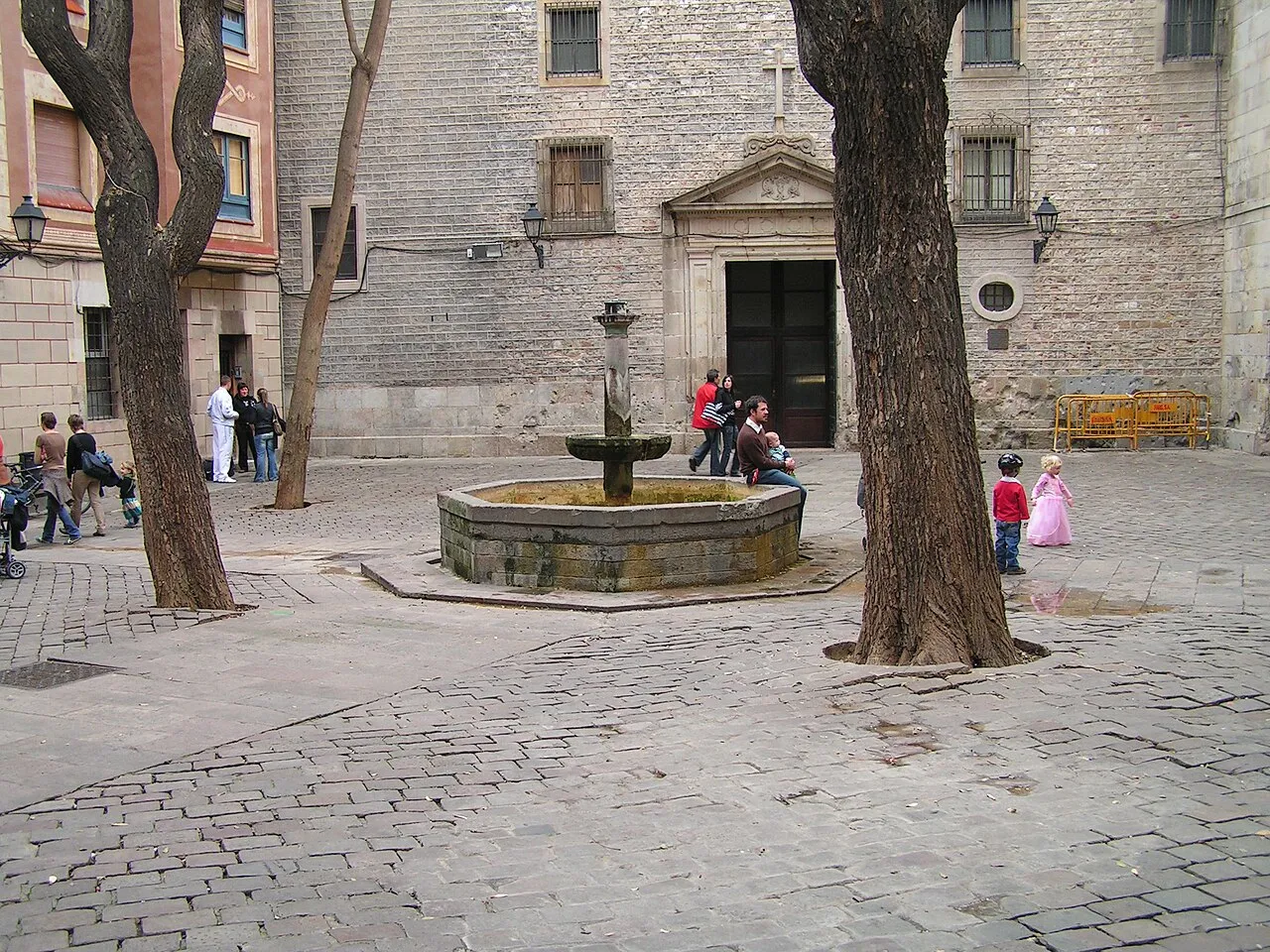
And the Plaça de Sant Felip Neri itself, which so many people describe as the oldest corner of the neighbourhood, was opened up by demolishing buildings in the twentieth century. Its walls do hold something terribly real: the shrapnel marks from the bombing by Italian aircraft in January 1938, in which forty-two people died, most of them children sheltering in the church.

4Pont del Bisbe

Pont del Bisbe

📍 Carrer del Bisbe

The most photographed bridge in Barcelona was built in 1928, not in the Middle Ages. It was signed by Joan Rubió i Bellver, a disciple of Gaudí, to join two institutional buildings ahead of the 1929 Exhibition. On its underside there is a skull pierced by a dagger, with its corresponding legend: if it is removed, the city falls.

5Plaça de Sant Felip Neri

Plaça de Sant Felip Neri

📍 Heart of the Gòtic

The most secluded square in the neighbourhood and also the hardest. On the church façade you can still see the shrapnel marks from the bombing of 30 January 1938, in which forty-two people died, most of them refugee children. For decades they were attributed to executions by firing squad; a plaque now sets out what really happened.

6El Call, the medieval Jewish Quarter

El Call, the medieval Jewish Quarter

📍 Between Sant Jaume and the Cathedral

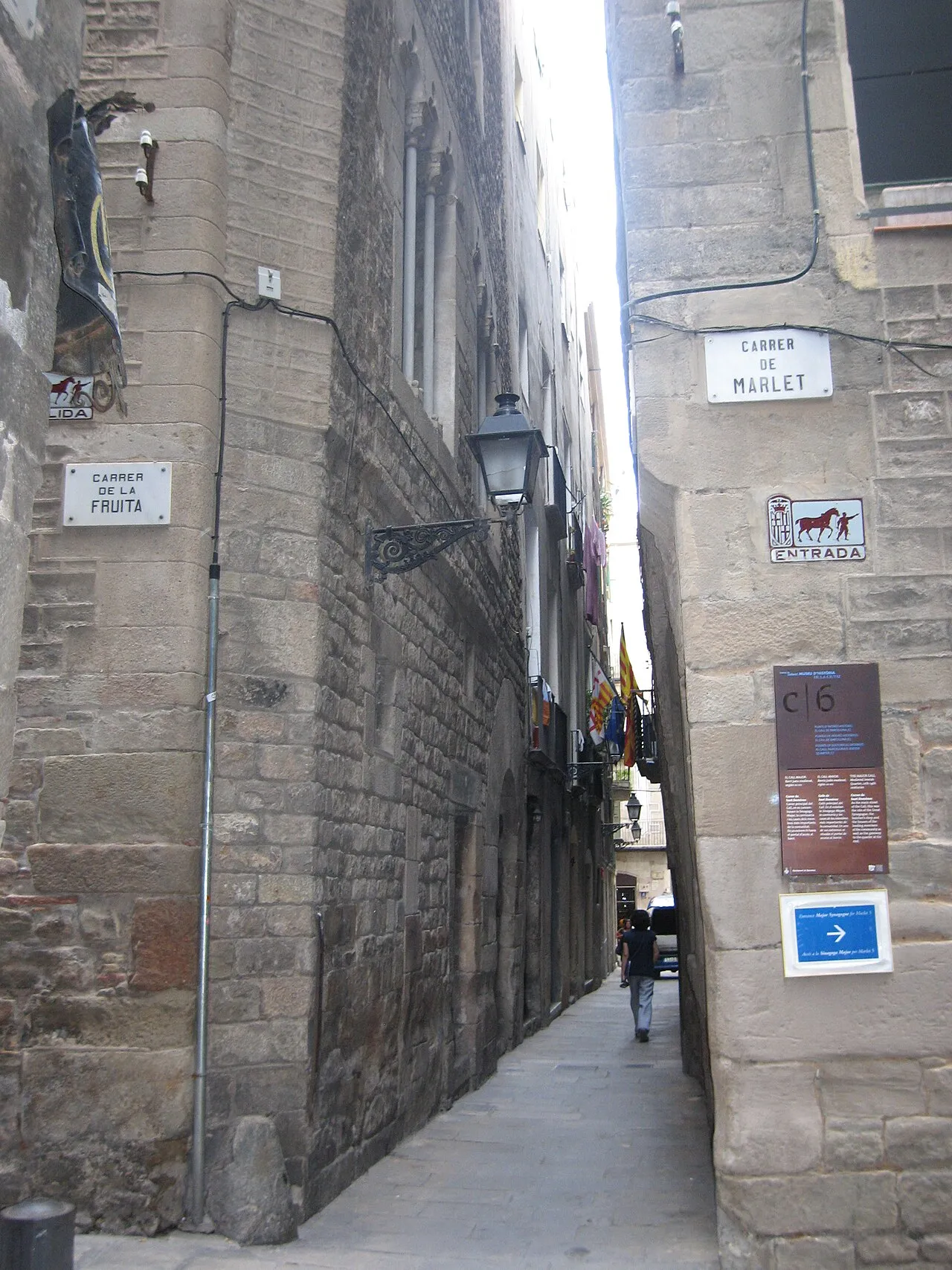
Barcelona's Jewish quarter was one of the most important on the peninsula until the assault of 1391, which destroyed it. Today it is the quietest area of the neighbourhood: extremely narrow alleys, the main synagogue — one of the oldest in Europe, now open to visitors — and a Hebrew gravestone reused in the wall of a house on the Carrer de Marlet, in plain sight of anyone.

Frequently asked questions

Is Barcelona's Gothic Quarter really medieval?

Partly yes and partly no, and that is its charm. There are genuinely old elements: the fourth-century Roman wall, the first-century Temple d'August, the cathedral from the thirteenth to fifteenth centuries and the underground remains of Barcino. But a good part of the neighbourhood's “medieval” image was built or recomposed between 1908 and the sixties, when the city remade its old town by moving buildings stone by stone and adding neo-Gothic elements such as the famous bridge on the Carrer del Bisbe, from 1928.

What to see in the Gothic Quarter in a morning?

The Plaça Nova with the Roman towers, the Cathedral with its cloister of the thirteen geese and the roof terrace, the Carrer del Bisbe with its bridge, the Plaça de Sant Felip Neri, the Temple d'August hidden on the Carrer Paradís, the Plaça de Sant Jaume with the City Hall and the Generalitat, the Jewish Call and the Plaça del Rei. If you have an hour to spare, the Roman underground of the MUHBA is the best thing in the neighbourhood.

Why are there bullet holes in the Plaça de Sant Felip Neri?

They are not from bullets but from shrapnel, and they come from the bombing by Italian aircraft on 30 January 1938, during the Civil War. Forty-two people died, most of them children who had taken shelter in the basement of the church. For decades the version circulated that they were marks from executions by firing squad, and there are still people who repeat it; today a plaque in the square explains what really happened.

Can you visit the synagogue in the Call?

Yes. The Sinagoga Major de Barcelona, on the Carrer de Marlet, is considered one of the oldest in Europe and can be visited with a very cheap ticket and a brief guided explanation. The space is tiny and preserves Roman and medieval remains below street level. On the same street there is a Hebrew gravestone reused in the wall of a house, visible from outside, which almost nobody identifies.

Where does the Gothic Quarter begin and end?

It is bounded by La Rambla to the west, the Via Laietana to the east, the Plaça de Catalunya to the north and the Passeig de Colom to the south. The Via Laietana separates it from the Born, and La Rambla from the Raval: the three make up what is called Ciutat Vella, the old city. You cross from one to another in five minutes on foot, so in practice they are walked together.

What is the best time to visit the Gothic Quarter?

Before ten in the morning or after eight in the evening. In the middle of the day, the axis running from the Cathedral to La Rambla becomes a continuous funnel of groups, and the streets of the Gòtic are too narrow to absorb it. First thing you can hear the echo of your own footsteps against the Roman wall, which is the way this neighbourhood is meant to be enjoyed.

How to walk it

The neighbourhood is small — it fits into barely a square kilometre — and can be done in full in a morning. The route that works starts in the Plaça Nova, continues through the Cathedral and its cloister, loses itself along the Carrer del Bisbe towards the Plaça de Sant Jaume, drops down to the Call and comes back via the Plaça del Rei.

The important thing is not to follow the straight line. The Gòtic is made of dead ends, kinks and squares that appear all of a sudden, and getting lost in it is the only way to see it. The practical rule: if you pass more than twenty people in a row, you are on the group route, and one street further in there is nobody.

For eating, avoid the Plaça Reial and the streets that open onto La Rambla. The best bars are towards the east, near the Plaça de Sant Just, and on the boundary with the Born. The Cafè de l'Acadèmia has been the neighbourhood's reference for decades and you need to book.

And the hours: before ten in the morning or after eight in the evening the neighbourhood is another thing altogether. In the middle of the day, the stretches between the Cathedral and La Rambla are a continuous funnel of groups.

Practical information

Getting thereMetro L4 Jaume I or L3 Liceu. From Plaça de Catalunya, 8 minutes on foot along the Portal de l'Àngel.
DurationA whole morning at a calm pace, or two hours if you go straight for the essentials.
What costs moneyThe Cathedral (tourist visit with cloister and terrace) and the MUHBA. The wall, the Temple d'August and the Call are free or almost.
Best momentBefore ten or after eight. In the middle of the day, the Cathedral-Rambla axis is a funnel.
Where to eatTowards the Plaça de Sant Just and the boundary with the Born. Avoid the Plaça Reial and the side streets off La Rambla.
Don't missThe Roman underground of the MUHBA beneath the Plaça del Rei. It is the best thing in the neighbourhood and the least visited.
On the map

🎧 With Viavoy

Walk Barcelona and listen at your own pace

Download Viavoy and walk Barcelona offline, whenever you like.

from 2,99 €· one-off payment
City Pass · 9,99 €3 days, all the tours in Barcelona
Find out more about Viavoy →
Viavoy app

Keep reading

More articles

Itineraries

Barcelona in 2 days: the itinerary that actually works

Neighbourhoods

El Born: the Barcelona of the merchants and of 1714

What to see

Las Ramblas and the Boqueria: how to see them without being taken for a ride

Neighbourhoods

El Raval: Barcelona's most mixed neighbourhood, without the clichés