The Puente Nuevo of Ronda: how it was built and where to see it
The previous bridge collapsed and killed fifty people, and it took thirty-four years for the lesson to be applied. The four viewpoints that work and the legends worth taking apart.
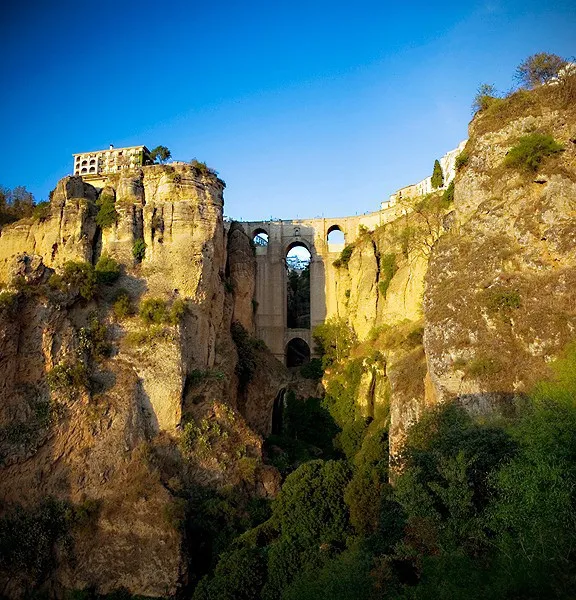
Almost a hundred metres of air beneath your feet, vertical rock on both sides and the green thread of the Guadalevín at the bottom. It is the image of Ronda around the world and one of the boldest pieces of engineering of the eighteenth century. But what gets told least is what came before: another bridge, thrown up in haste in 1735, which came down six years later.
The bridge is almost never seen whole from where people look at it. From on top you only see the parapet; to really see it you have to go down into the canyon or find one of the side viewpoints.
A collapse and a lesson thirty-four years in the learning
Why it has three arches and not one.
In 1735 a bridge was raised here with a single enormous arch spanning the gap in one go. It was quick, it was spectacular and it was reckless: in 1741 it collapsed and dragged some fifty people to their deaths. Ronda understood that this canyon allowed no shortcuts.
The present bridge was begun in 1759 and not finished until 1793, under the direction of the Aragonese engineer José Martín de Aldehuela. The difference lies in the approach: instead of a single arch, three arches resting on the very floor of El Tajo, the gorge, with two piers going all the way down to the rock of the riverbed.
Building that way is slower, dearer and vastly harder, because it means working at the bottom of a hundred-metre ravine with eighteenth-century means. But it is what has stood without moving for two hundred and thirty years, and for decades it was among the highest bridges in the world.
All the stone came out of the abyss itself: the ashlars were quarried from the floor of the Tajo gorge, at the foot of the works. Hoisting each block up to this height was almost as hard as setting it in place, and it goes a long way to explaining the thirty-four years it took.
Crossing is free and possible at any hour. Above the central arch there is a chamber hanging over the void that was the keeper's room, a lock-up and a prison during the Civil War, and that today houses an interpretation centre with its own cheap ticket.
The balcony that juts out thirty seconds from the centre, from which you see the side arch and the full drop of the gorge. It is free and it is the best view of the bridge without going down into the canyon. It carries the name of the engineer who built it.
The first concerns the chamber above the central arch, that stone room hanging literally over the void, reached from the parapet. It was the keeper's room, later a lock-up and, during the Civil War, a prison. That is where the stories of prisoners thrown into the abyss from it come from.
There was considerable violence in Ronda during the war, as there was all over Spain, but the specific version of executions thrown from the bridge comes largely from literature — Hemingway set a similar scene in “For Whom the Bell Tolls” — and not from the historical record. It is worth telling with that distance.
The second is that the architect himself died falling from the bridge while trying to carve the completion date into the stone. It is simply false: Aldehuela died peacefully in Málaga years later, where he went on working, among other projects, on the San Telmo aqueduct.
What is interesting is that both legends say something true about the place: it is a spot that produces vertigo, and vertigo generates stories. The chamber exists, the abyss exists and the bridge goes on impressing without needing either tale.
The four places to look at it from
The first, and the worst, is from on top: you only see the parapet and the drop, not the bridge. Almost everyone stays here, takes the photograph of the ravine and leaves convinced they have seen it.
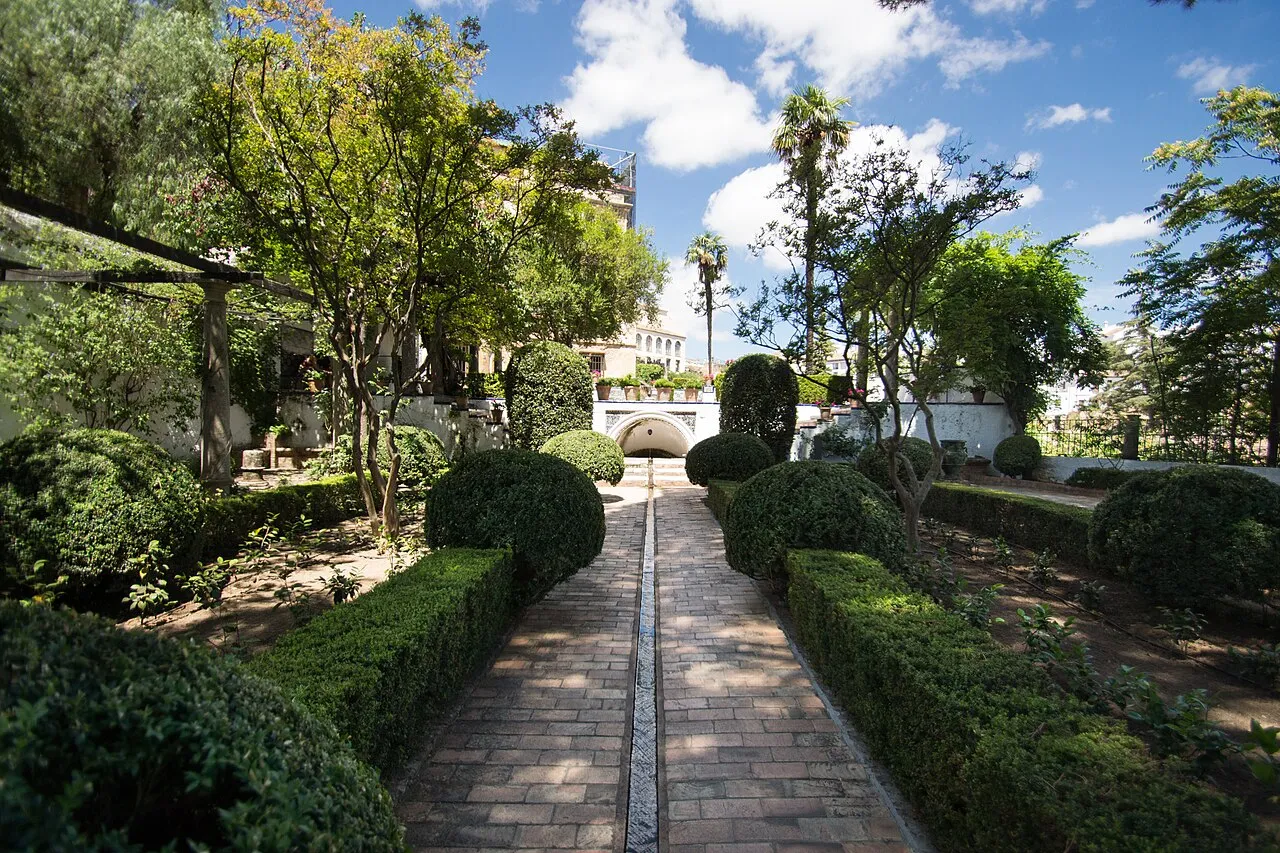
The second is the Mirador de Aldehuela, thirty seconds away, which gives you the side arch and the full drop. It is free and it settles the visit for anyone who does not want to go down. The third is the gardens of the Casa del Rey Moro, hanging over the ravine, with a very different side perspective.
And the fourth, the one that really pays off, is the floor of the Tajo gorge. A path drops from the bridge in about twenty minutes, with steps and uneven stretches, down to the riverbed. From there the bridge appears whole, with a hundred metres of stone above and the central arch cut out against the sky.
Bear in mind that the way back is all uphill and that the path calls for proper footwear. In exchange, it is the only image that explains what people mean when they say Ronda is built over an abyss.
Its terraced gardens, designed by Forestier in 1912, hang over the ravine and give a side perspective of the bridge that no other spot achieves. It also holds the mine, the stairway of two hundred steps cut into the rock down to the river.
The point where the bridge comes out on the Mercadillo side, with the parador hotel installed in the old town hall. The descent to the viewpoint and the access to the chamber in the central arch both start here.
Around ninety-eight metres from the bed of the Guadalevín up to the roadway. It was built between 1759 and 1793 with three arches resting on the floor of the canyon, and for decades it was among the highest bridges in the world.
Is it true that a bridge fell down before?
Yes. In 1735 a bridge was raised here with a single enormous arch, built in haste, which collapsed in 1741 and dragged some fifty people to their deaths. That disaster explains why the present one has three arches resting on the floor of the canyon and why it took thirty-four years to build.
What is inside the chamber in the central arch?
An interpretation centre on the construction of the bridge, with its own cheap ticket. That space was the keeper's room, later a lock-up and, during the Civil War, a prison. That is where the legends about prisoners thrown into the abyss come from, and they derive largely from literature rather than from the record.
Did the architect die falling from the bridge?
No, it is a much repeated and false legend. The story goes that Martín de Aldehuela fell into the void while trying to carve the completion date into the stone, but he died peacefully in Málaga years after finishing the work, where he went on working, among other projects, on the San Telmo aqueduct.
How do you get down to the floor of the Tajo gorge?
By a path that sets off beside the bridge and drops in about twenty minutes, with steps and uneven stretches of earth and rock. It calls for footwear with grip and is not lit, so it is not a good idea at dusk. The way back is all uphill and costs considerably more effort than the way down.
Is it worth going down?
It is what separates an ordinary visit from a good one. From above you only see the parapet and the ravine; from the bottom the whole bridge appears, with a hundred metres of stone above and the central arch cut out against the sky. It is the only image that really explains what Ronda is.
Practical information
WherePlaza de España, the exact centre of Ronda, between the Mercadillo and the old town.
PriceCrossing is free. The interpretation centre in the chamber has its own cheap ticket.
Best viewThe floor of the Tajo gorge, 20 minutes down the path. The way back is all uphill.
FreeThe Mirador de Aldehuela, thirty seconds from the bridge, gives you the side arch.
Best timeSunset, when the light comes in along the canyon and the stone catches fire.
Watch outThe path to the bottom calls for footwear with grip and is not lit.
On the map
🎧 With Viavoy
Walk Ronda and listen at your own pace
Download Viavoy and walk Ronda offline, whenever you like.