The Gaudí route in Barcelona: what to see, in what order and what to book
Seven works spread across the city, three of them on the same promenade. Which ones deserve the ticket, which one can be seen for free and why the first house he built is the one the fewest people visit.
Antoni Gaudí left Barcelona seven buildings declared World Heritage Sites, and the city has built around them a tourist industry that sometimes hides the essential: that he was, above all, an extraordinary builder. His curves are not decoration, they are the consequence of calculating structures in a way nobody else used. This route orders his works by geography and by real interest, and tells you which one you can skip if you are short of time or money.
All the Gaudí works that can be visited work by time slots and they sell out. The Sagrada Família, weeks in advance; the rest, days. Buying them at the door means losing the morning.
How Gaudí thought
The key to everything lies in a basement: the funicular model. Gaudí hung strings with small bags of lead shot that reproduced the loads of the building, let gravity give them their shape, photographed the result and turned it upside down. What gravity draws when hanging is exactly the shape that works best in compression when set the right way up.
Out of that come the catenary arches, the leaning columns and the branching vaults. They are not an organic whim: they are ruled geometry applied with brutal precision, done without computers and checked by hand. That is why his buildings stand up with far less material than an equivalent Gothic building would need.
The second idea that explains him is that he did not separate structure from ornament. The chimney is sculpture, the railing is a dwarf-palm leaf, the column is a tree. And the third, almost always forgotten: he was a site foreman of extreme exactingness, who redid whatever did not convince him and worked with the traditional Catalan crafts — brick, ceramics, wrought iron — pushed to their technical limit.
🎧 With Viavoy
Explore Barcelona at your own pace
Download the app and discover Barcelona offline, whenever you like. Take the walking tour Gaudí and the Modernista Eixample with a local guide in your ear.
They can be done in a morning, if you have booked.
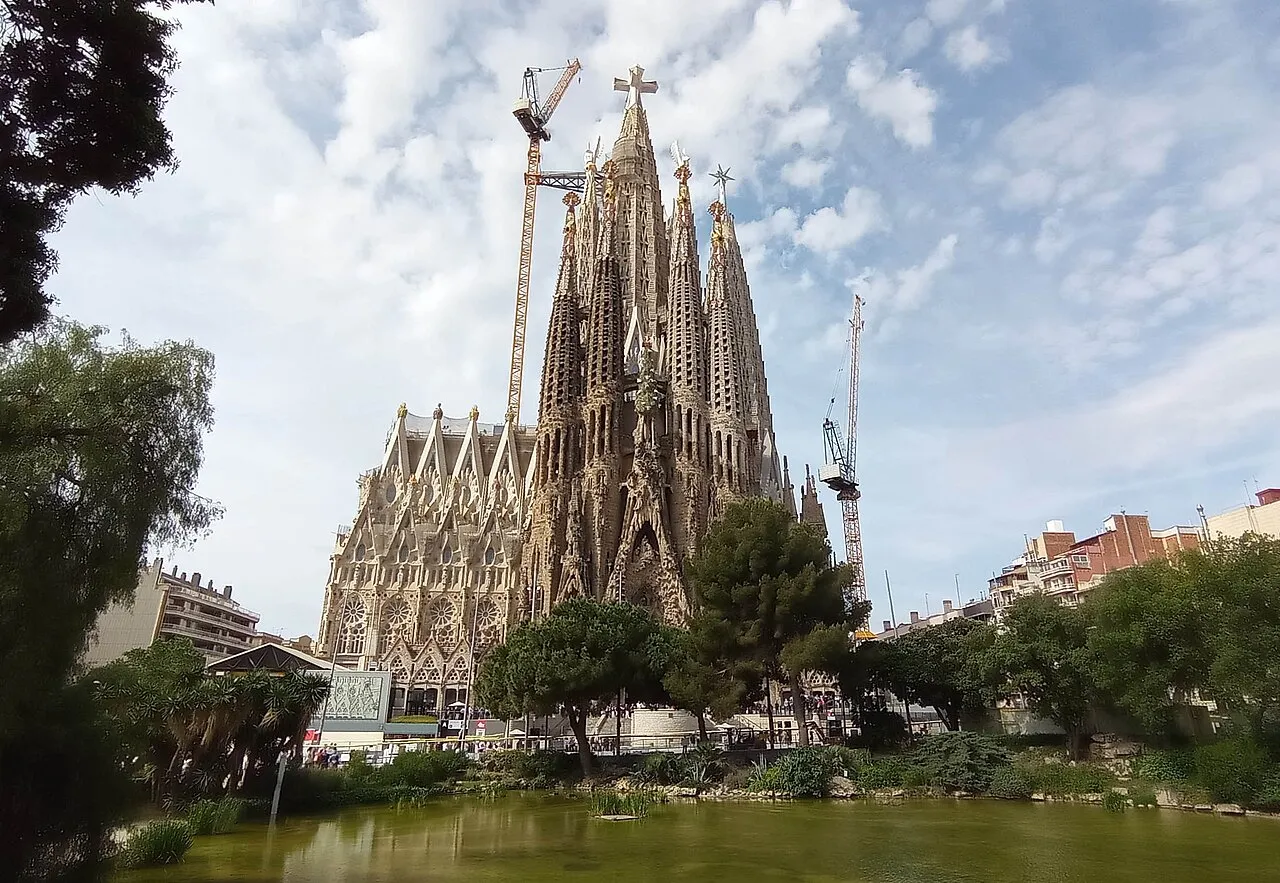
The Sagrada Família is the starting point and also the one that dictates the rest of the day, because its time slot rules. Give fifteen minutes to the Nativity façade before going in: it is the only one Gaudí left almost finished, and it is sculpted with figures moulded from real residents and animals of the neighbourhood.
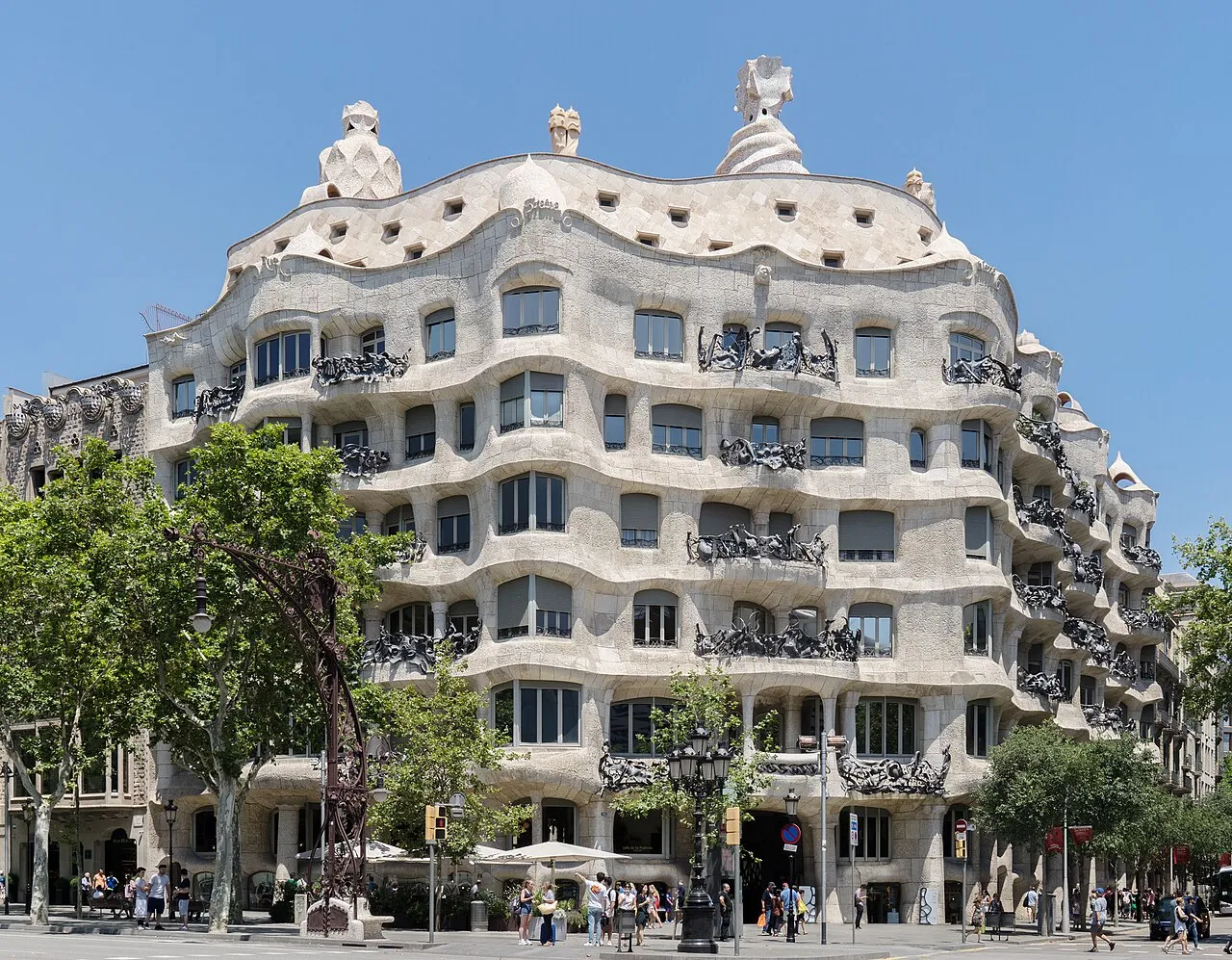
La Pedrera is two metro stops away, or twenty minutes on foot through the Eixample. It is the work that best explains Gaudí the engineer: no load-bearing walls, with the façade hanging from a structure of pillars, and an attic of two hundred and seventy brick arches beneath the rooftop. If you can only pay for one Modernista house, this is the one that shows how things work.
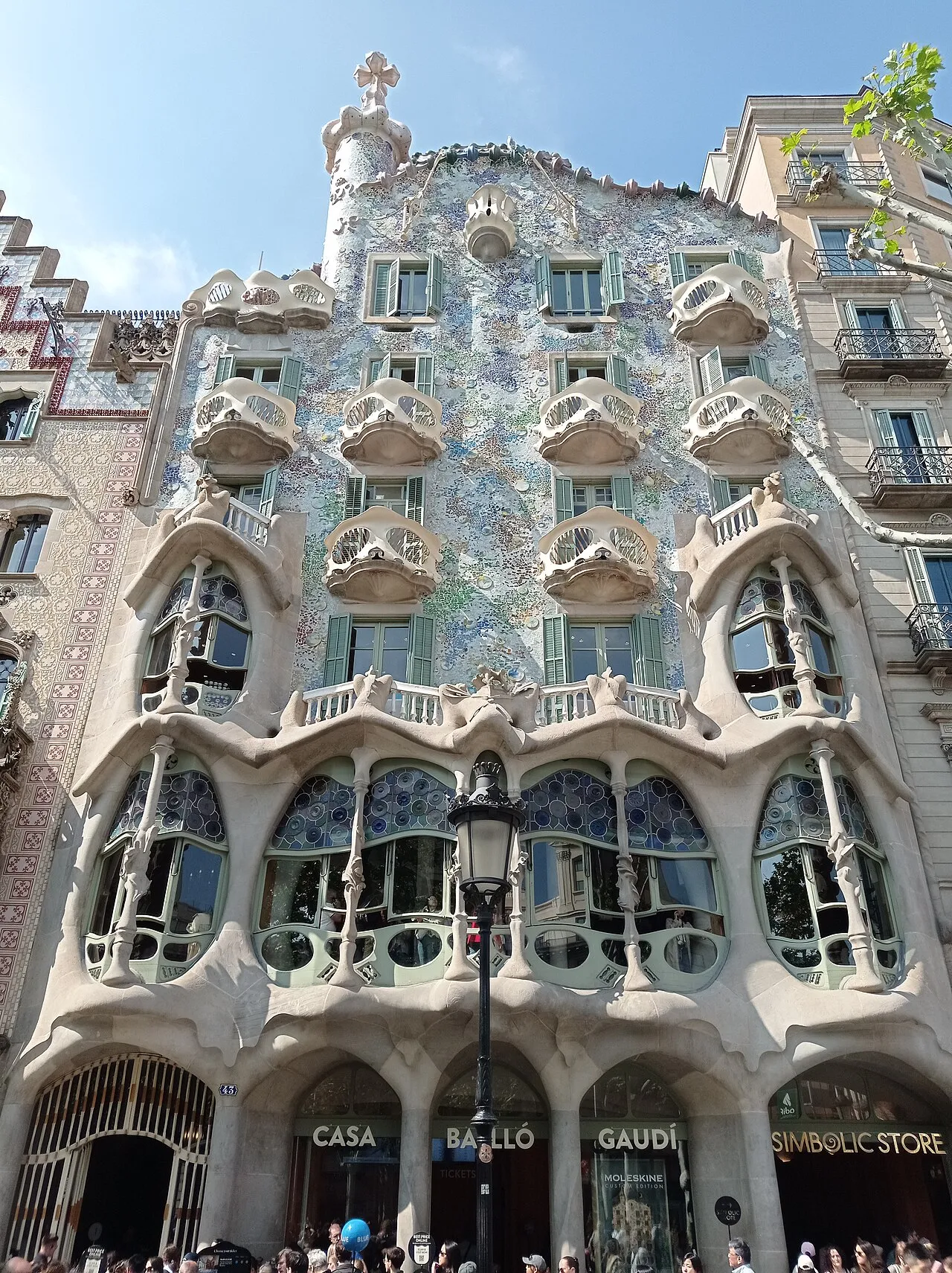
The Casa Batlló, five minutes further down, is the one that shows what colour looks like. A façade of trencadís, chimneys covered in ceramics, the light well with tiles that go from white to intense blue according to the height so as to spread the light equally to every floor. It is the most spectacular inside and also the most expensive.
And if you have to choose between the two: La Pedrera if you are interested in construction, the Batlló if you are interested in the effect. Doing both on the same day is possible and it is a lot of Modernista house in a row.
The original project of 1882 was a conventional neo-Gothic church by another architect. Gaudí inherited it at thirty-one and redid it entirely: columns that branch like trees, a structure calculated with models of strings and weights, and eighteen towers planned. The stained-glass windows are ordered by colour temperature, cool to the east and warm to the west, so the interior changes completely according to the hour.
Gaudí's last civil work and the most radical from a technical point of view: not a single load-bearing wall, the façade hung from the structure and the interior walls movable. An open plan in 1906, half a century before the Modern Movement formulated it. The rooftop of warrior chimneys and the attic of 270 arches justify the ticket on their own.
The house of the dragon: a façade of trencadís with reflections that change with the light, balconies that look like masks and a scaled roof. Inside, the light well is tiled with ceramics that grow lighter towards the bottom so that every floor receives the same amount of light. It is Gaudí's most spectacular work inside and the most expensive to visit.
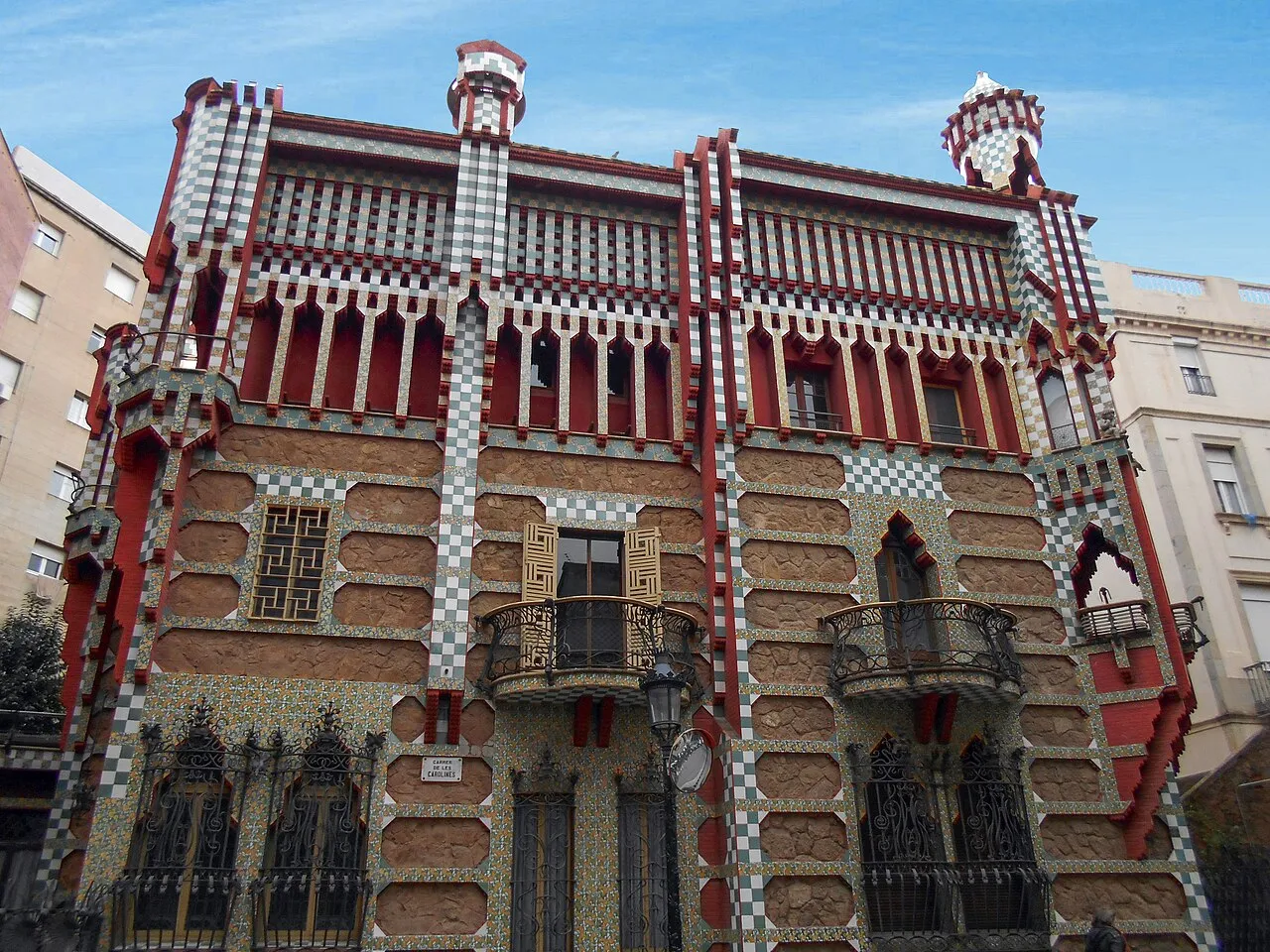
The Casa Vicens, in Gràcia, is Gaudí's first major work, from 1883, and it was a private home until 2017. That explains why it is the one with the shortest queue, the cheapest and, for many people, the most revealing: here there are no impossible curves, there is an orientalist Gaudí, with glazed ceramics and a muqarnas vault in the smoking room that recalls the Alhambra. It is the starting point of everything else.
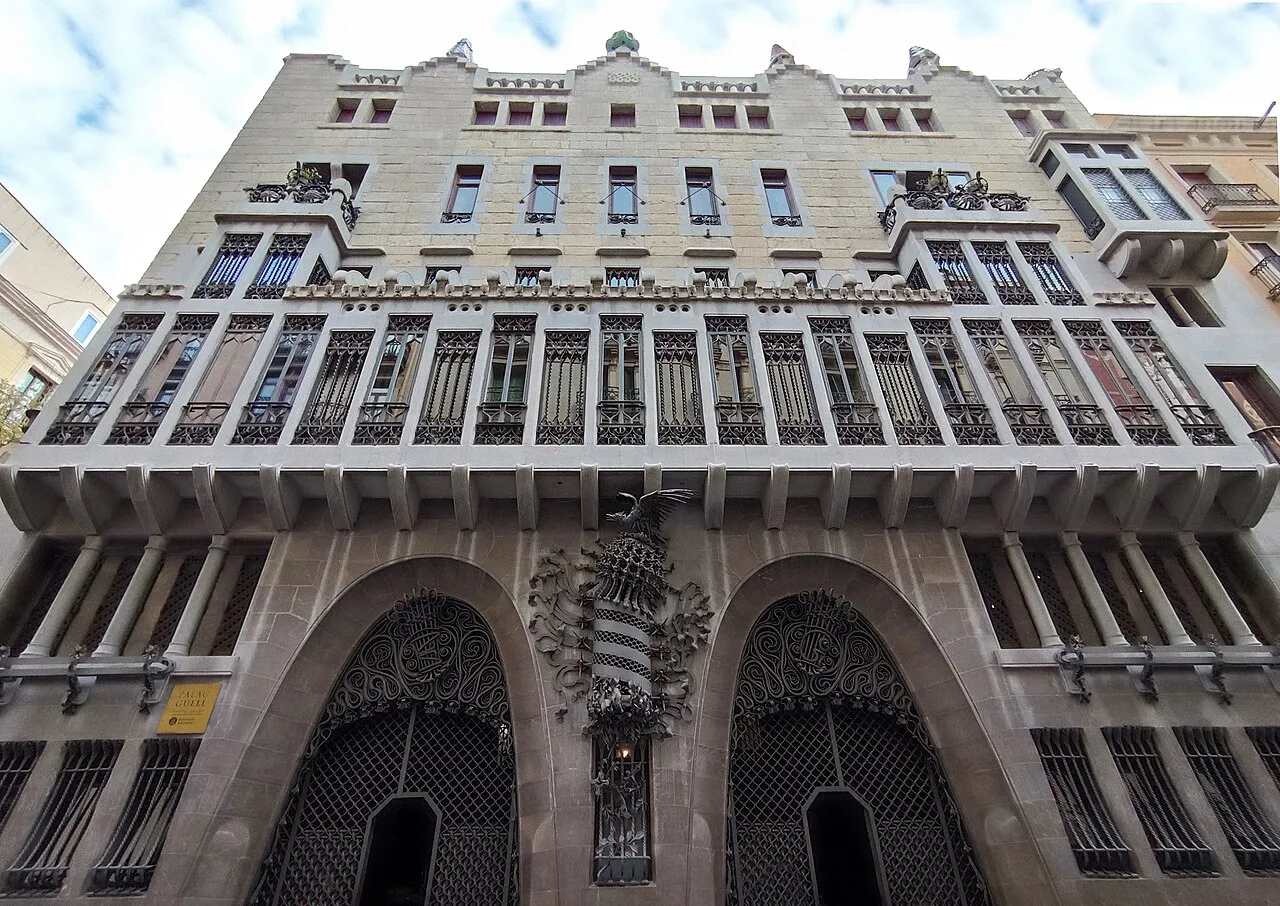
The Palau Güell, in the heart of the Raval and a step from La Rambla, is the commission that changed his career: Eusebi Güell, his patron, gave him freedom and budget. The rooftop of trencadís chimneys is the first of the series that would culminate at La Pedrera, and the central hall beneath a perforated dome, which simulates a starry sky, is among the best things he did.
Park Güell began as a luxury housing estate that failed commercially: two plots out of sixty were sold. What is visited today is the failure turned into a public park. The monumental zone — the dragon staircase, the hypostyle hall, the undulating bench on the square — charges admission and works by time slots; the rest of the park is free.
And the Colònia Güell, in Santa Coloma de Cervelló, half an hour away by train: the crypt where Gaudí rehearsed everything he would later apply at the Sagrada Família, including the funicular model. It is the least known visit and the most impressive for anyone who understands architecture.
Gaudí's first major work, from 1883, closed to the public until 2017. Green, white and yellow glazed ceramics, with tiles that copy the French marigold that grew on this very plot and a railing that imitates the leaves of the wild dwarf palm. The smoking room has a muqarnas vault of polychrome plaster. It is the one with the shortest queue and the cheapest.
The commission that changed his career: Eusebi Güell gave him freedom and budget, and Gaudí built an urban palace with a central hall beneath a perforated dome that simulates a starry sky. The rooftop of trencadís chimneys is the first rehearsal of what would later be La Pedrera. It is in the Raval, a step from La Rambla, and has far fewer people.
Seven are declared World Heritage Sites by UNESCO: the Sagrada Família (Nativity façade and crypt), Park Güell, the Palau Güell, the Casa Milà or La Pedrera, the Casa Vicens, the Casa Batlló and the crypt of the Colònia Güell, the last in Santa Coloma de Cervelló. There are also other works by him and by his workshop spread across the city, such as the Güell Pavilions in Pedralbes or the lampposts in the Plaça Reial, which he made when he was very young.
Which is the best Gaudí work to visit if I can only see one?
The Sagrada Família, no argument, because it is the only one in which you see his complete idea: structure, light, sculpture and symbol working at the same time. If for price or queue you had to choose another, La Pedrera is the one that best explains how he thought as a builder, with its attic of arches and its rooftop. And if you are after the spectacular inside, the Casa Batlló.
Can you enter Park Güell for free?
The park has a very wide free zone, with paths, viaducts and viewpoints, which you enter without paying anything. What costs a ticket is the so-called monumental zone: the dragon staircase, the hypostyle hall and the square with the undulating bench. Residents registered in Barcelona enter everything for free. For everyone else, you need to book a time slot and capacity is limited.
Why is the Sagrada Família taking so long to finish?
For two specific reasons. The first is financial: it is an expiatory temple, which means it is funded exclusively by donations and by what visitors pay, with no public money. The second is that in 1936 the workshop was set on fire and the original plans and models were destroyed, which forced the project to be reconstructed from fragments. The central tower of Jesus was completed in 2026, the centenary year of Gaudí's death.
How did Gaudí die?
Run over by a tram on the Gran Via on 7 June 1926, as he was walking from the building site to mass. He was so poorly dressed and looked so shabby that nobody recognised him or wanted to help him: they took him for a beggar and he ended up in the paupers' hospital. He died three days later, on 10 June, and only then did the city learn whom it had lost. He is buried in the crypt of the Sagrada Família.
Is the Casa Vicens worth it?
Very much, and for a reason that is not the obvious one: it is Gaudí's first major work and shows a language — orientalist, ceramic, without structural curves — that he later abandoned completely. Seeing it helps you understand where everything else came from. Besides, having been closed to the public until 2017, it is still the one the fewest people visit, the cheapest and the one where you can book almost the same day.
How to put the route together according to the time you have
Half a day: Sagrada Família and La Pedrera. It is the minimum combination that gives a complete idea, because one shows the total work and the other the building technique. They are two metro stops apart.
A whole day: add the Casa Batlló and go up to Gràcia to see the Casa Vicens, or go down to the Raval for the Palau Güell. The route stays geographically chained and does not force you to cross the city more than once.
Two days: fit in Park Güell early in the morning, when the monumental zone can still breathe, and leave the afternoon for the rest. Watch out for the slopes: the park is on high ground and the climb from the metro is serious; there are public escalators on the Lesseps side.
And if you are one of those who enjoy understanding how things stand up, the Colònia Güell is worth more than any of the others except the Sagrada Família. Half an hour by train from Plaça d'Espanya and practically nobody.
Practical information
BookingAll of them work by time slots. Sagrada Família weeks ahead; the rest, days in advance.
Guide pricesSagrada Família ~26 €, Casa Batlló ~35 €, La Pedrera ~28 €, Casa Vicens ~18 €, Park Güell ~10 €.
Recommended orderSagrada Família → La Pedrera → Casa Batlló, all on the same axis. Casa Vicens and Palau Güell separately.
The cheapestCasa Vicens, and it is also the one with the shortest queue. The free zone of Park Güell costs nothing.
Outside the cityColònia Güell, in Santa Coloma de Cervelló: half an hour on the FGC from Plaça d'Espanya.
Best timeFirst slot of the morning at all of them. At the Sagrada Família, the last of the afternoon for the warm stained glass.
On the map
🎧 With Viavoy
Walk Barcelona and listen at your own pace
Download Viavoy and walk Barcelona offline, whenever you like.
from 2,99 €· one-off payment
City Pass · 9,99 €3 days, all the tours in Barcelona