The Alcazaba and Gibralfaro: the hill that explains Málaga
How to link the two fortresses without repeating a single climb, what to look at in each one and the free lift almost nobody uses. With the combined ticket and the free slot on Sundays.
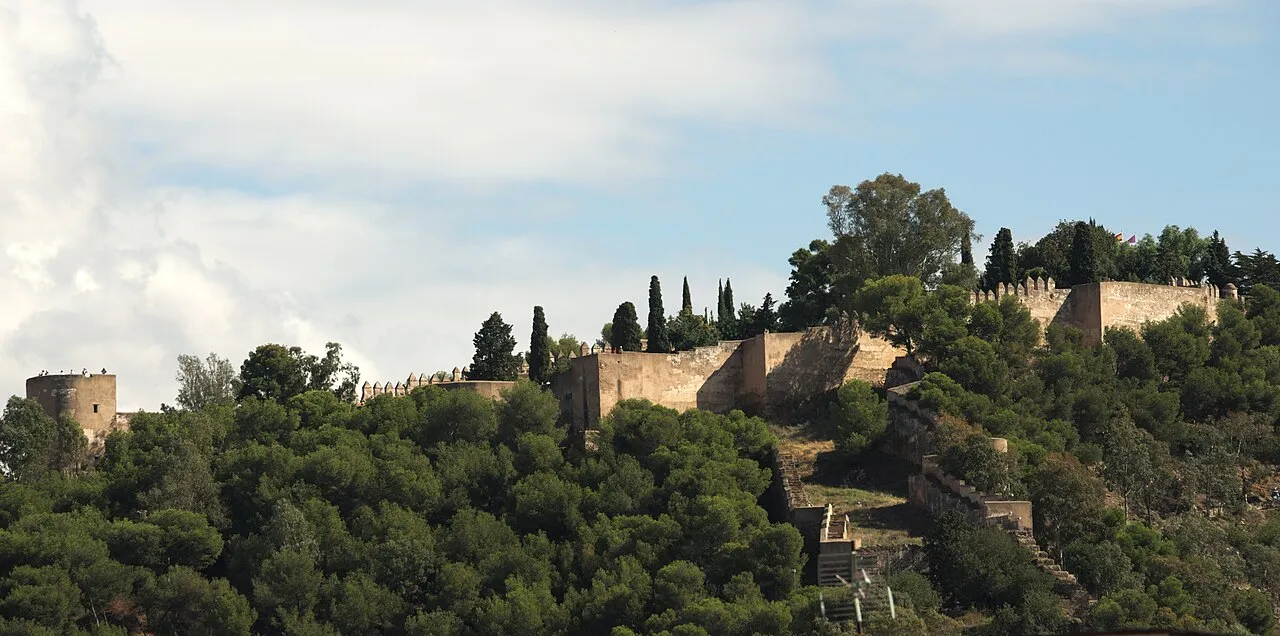
Málaga is where it is because of this hill. It commands the bay, shelters the city from the north and lets you see any ship coming hours in advance, and that is why Phoenicians, Romans, Arabs and Castilians all chose the same spot. What survives today are two fortresses, one above the other and joined together: the Alcazaba halfway up the slope, from the eleventh century, and the castle of Gibralfaro on the summit, from the fourteenth. They are visited together, and there is an order that saves you a whole climb.
The combined ticket for the two costs considerably less than the two separately and does not oblige you to use them on the same day. The Alcazaba, moreover, usually has free access in the last slot of the afternoon on Sundays.
The Alcazaba: a city inside a wall
The interesting part is not a room, it is the route.
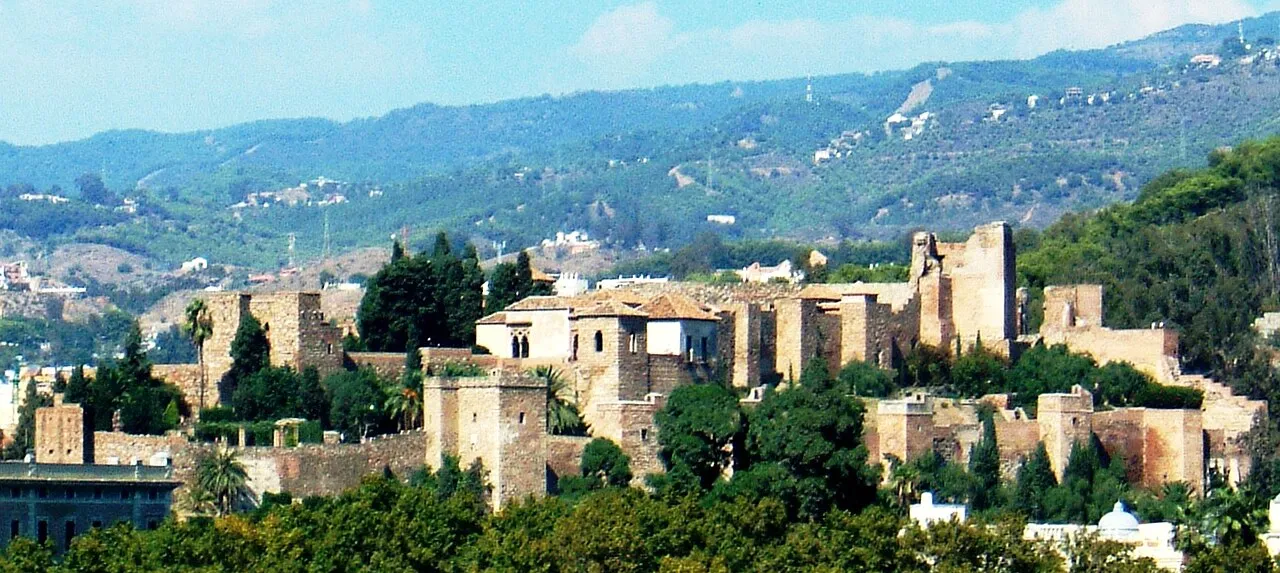
It is considered the best preserved alcazaba in Spain, and as soon as you cross the first gate you understand why the word does not mean castle: this is a small fortified town, with two concentric enclosures, one military and one palatial, and a whole service quarter in between.
The first thing that strikes you is that you do not go up in a straight line. The entrance forces you to turn constantly between bent gateways, towers and narrow corridors, and it is not a whim of the terrain: every turn broke the momentum of an attacker, took away the room to use a battering ram and left him exposed on the flank from above. It is the Andalusi fortification manual put into practice.
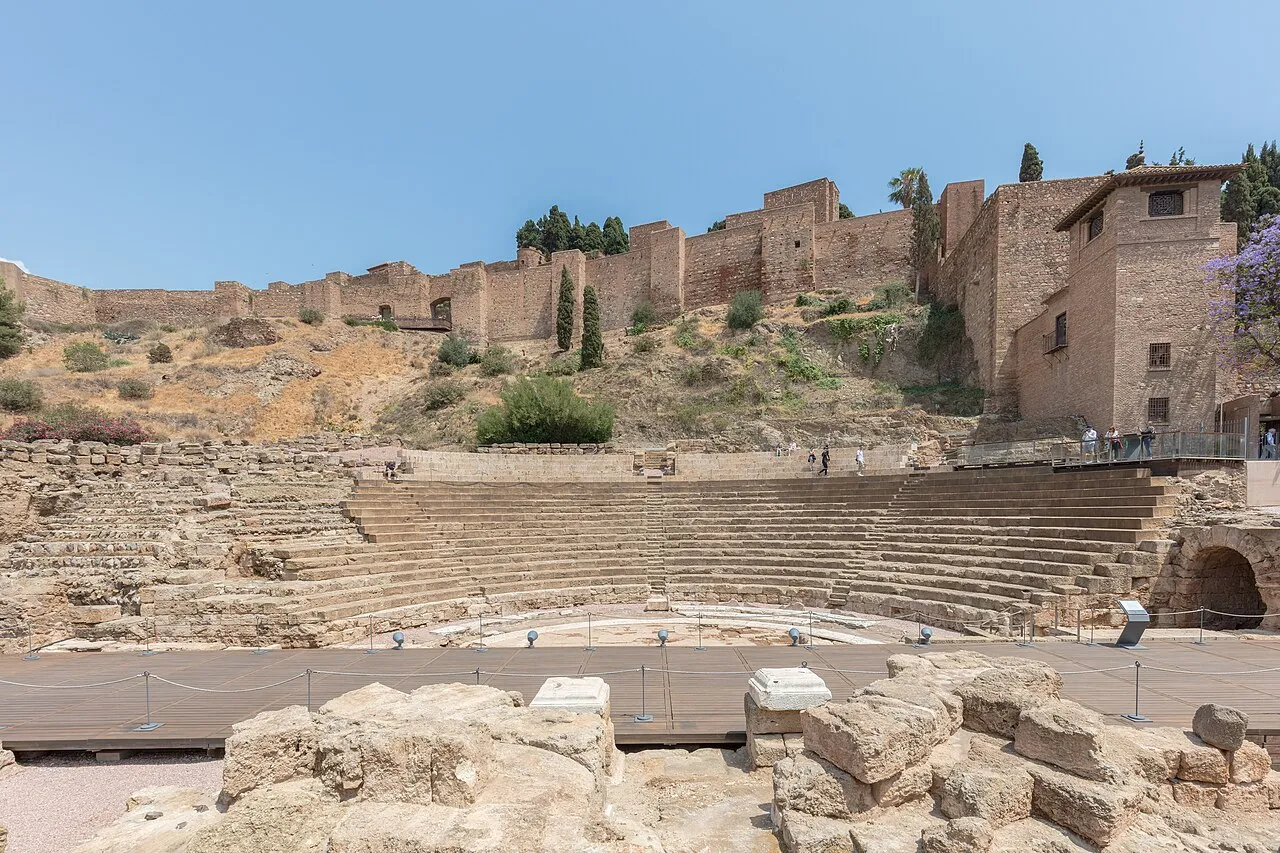
At the Puerta de las Columnas is the detail most people photograph without knowing what they are looking at: Roman column shafts and capitals set into the Arab wall with no attempt to hide them. They came from the theatre just below, and that shameless reuse was the norm, not the exception.
Up above, in the palace area, the protagonist is water: acequias, irrigation channels, running along the edges of the paths, fountains, rectangular pools reflecting the arches. Bringing water to the top of a dry hill demanded considerable engineering, and that effort was precisely the political message.
Raised from the eleventh century onwards, in the taifa period, and enlarged by every power that came afterwards. Two enclosures, bent gateways and palaces with water gardens. A good part of what looks so well kept comes from the great restoration that began in the nineteen-thirties: it is honest, but it is restoration.
From the first century, buried and forgotten for centuries until it turned up in 1951 during works on the Casa de la Cultura. You can see the whole of it from the street without paying. Its best reading is to have it right below the wall that was built with its stones: a thousand years of history in a single frame.
Gibralfaro: the castle that protected the other castle
The name comes from a mixture of two languages: yabal, mountain in Arabic, and faro, from the Greek, for the beacon that was lit up here to guide ships as far back as Phoenician times. Literally, the mountain of the lighthouse. It has been serving as a watchtower for almost three thousand years.
The present castle was ordered built by the Nasrid king Yusuf I in the fourteenth century, and its function was very specific: the Alcazaba was vulnerable from this summit, so whoever took the mountain could pound it at will. The summit was armoured and the two were joined by a walled corridor, the Coracha, which you can still walk.
Inside there are no halls and no plasterwork, because this was barracks and powder magazine. What there is instead is a well cut into the living rock some forty metres deep: without water of its own no castle holds out under siege, and here it was planned to hold out for a long time. In 1487 it was the last position to fall during the conquest of the city, after months of siege and hunger.
The real visit is the adarve, the wall-walk that crowns the rampart and goes all the way round the enclosure. In twenty minutes you see Málaga from all four points of the compass, and from the southern side the whole bullring appears among the rooftops, read as a perfect circle with the beach behind it.
A fourteenth-century military enclosure with a complete adarve, a keep and the well cut into the rock. There is a small interpretation centre in the old powder magazine, but the real content of the visit is the horizon. Next to the entrance there is a public viewpoint with a terrace that you reach without paying.
The walled corridor that connects the two fortresses climbing the slope. It lets you link the two visits without going down and up again, and it is a fine stretch in itself, with the wall on both sides and the city opening up below at every bend.
Which do you visit first, the Alcazaba or Gibralfaro?
In winter or in decent temperatures, the Alcazaba first and the castle afterwards, going up the Coracha: you do the climb only once and finish at the top with the views. In summer it is better the other way round: bus 35 up to Gibralfaro and walk down, which is all downhill and comes out in the historic centre.
Is there a combined ticket?
Yes, and it works out considerably cheaper than the two separately. It does not oblige you to use both on the same day, so you can split them over two days if your trip is long. The Alcazaba also has a free access slot in the last hour of the afternoon on Sundays.
Can you get to the Alcazaba without climbing the hill?
Yes. There is a free lift with access from calle Guerrero that goes straight up to the upper part of the enclosure. It is poorly signposted and very few people use it, but it works and it solves the visit for anyone who does not want to, or cannot, tackle the ramp.
Is the castle worth it if you have already seen the Alcazaba?
They are different things. The Alcazaba is palace, gardens and architecture; the castle is military, with hardly any interior, and what it offers is the wall-walk and the views. If there is only time for one and what you want is Andalusi architecture, the Alcazaba. If what you want is to understand the city at a glance, the castle.
How much time should you set aside for both?
A good hour for the Alcazaba, three quarters of an hour for Gibralfaro and about twenty minutes for the stretch of the Coracha between them. With the journeys, allow a full half-day, better the morning one.
Can you see anything without paying?
Quite a lot. The Roman theatre can be seen whole from calle Alcazabilla, the foot of the wall and the Puerta de las Columnas are visible from outside, and next to the castle there is a public viewpoint with a terrace that gives the classic panorama over the port without having to enter the enclosure.
How to do it without suffering
There is a free lift on calle Guerrero that goes straight up to the upper part of the Alcazaba and skips the whole approach ramp. It is poorly signposted and very few people use it, and in the heat or with mobility problems it changes the morning completely.
For the castle there are three options: the path on foot from the Alcazaba, with pine shade and about twenty-five minutes of serious climb; city bus 35, which leaves from the centre and drops you at the gate; or a taxi. At thirty degrees, the bus is not giving up.
The combination that works best in summer is to go up on the 35 to Gibralfaro, do the adarve, come down the Coracha to the Alcazaba and leave at the bottom, straight out onto the Roman theatre and the centre. All downhill and with no stretch repeated.
Allow a good hour for the Alcazaba and three quarters of an hour for the castle. And go early: from mid-morning onwards there is not a scrap of shade on that slope.
Practical information
WhereAlcazaba at calle Alcazabilla, 2. Castle at camino de Gibralfaro, 11.
TicketsAround 4 € each, with a cheaper combined ticket. Free slot at the Alcazaba on Sunday afternoons.
DurationA good hour for the Alcazaba, three quarters for the castle.
Getting upFree lift on calle Guerrero for the Alcazaba. Bus 35 for the castle.
WhenBefore ten in the morning in summer. The slope has no shade.
FreeThe Roman theatre can be seen whole from the street, and the viewpoint next to the castle charges nothing.
On the map
🎧 With Viavoy
Walk Málaga and listen at your own pace
Download Viavoy and walk Málaga offline, whenever you like.