The stained glass of León Cathedral: how to look at it
Eighteen hundred square metres of medieval glass, eight centuries of history and a cathedral that almost fell down from holding it up. A guide to understanding what you are seeing.
Almost everybody goes into León Cathedral, looks up, says “how beautiful” and leaves after twenty minutes. That is a shame, because this glass is not decoration: it is a complete programme, ordered by theme and by height, with a logic you can read if you know where to look. And there is a good deal more than you take in on a quick pass.
No sun, no stained glass. If the day is overcast, change the order of your itinerary and go in when it clears: it is the only monument in León that depends on the weather.
Why there is so much glass
Gothic makes it possible to unload the weight of the building onto specific points — piers, flying buttresses, buttresses — instead of onto continuous walls. That frees the panels between supports, which stop being structural and can be opened up. Stained glass is the technical consequence of that discovery.
The architects of León took the principle to the extreme. They cut the stone back to the bare minimum and turned the walls into a skeleton, with the highest proportion of glazed surface of any Spanish cathedral and comparable to the best French ones.
And there is the problem: the building was left at the limit of what the technique could hold, with a poor-quality local stone and badly resolved thrusts. In the nineteenth century there was a real risk of collapse, and the restoration that saved it lasted decades and dismantled entire sections.
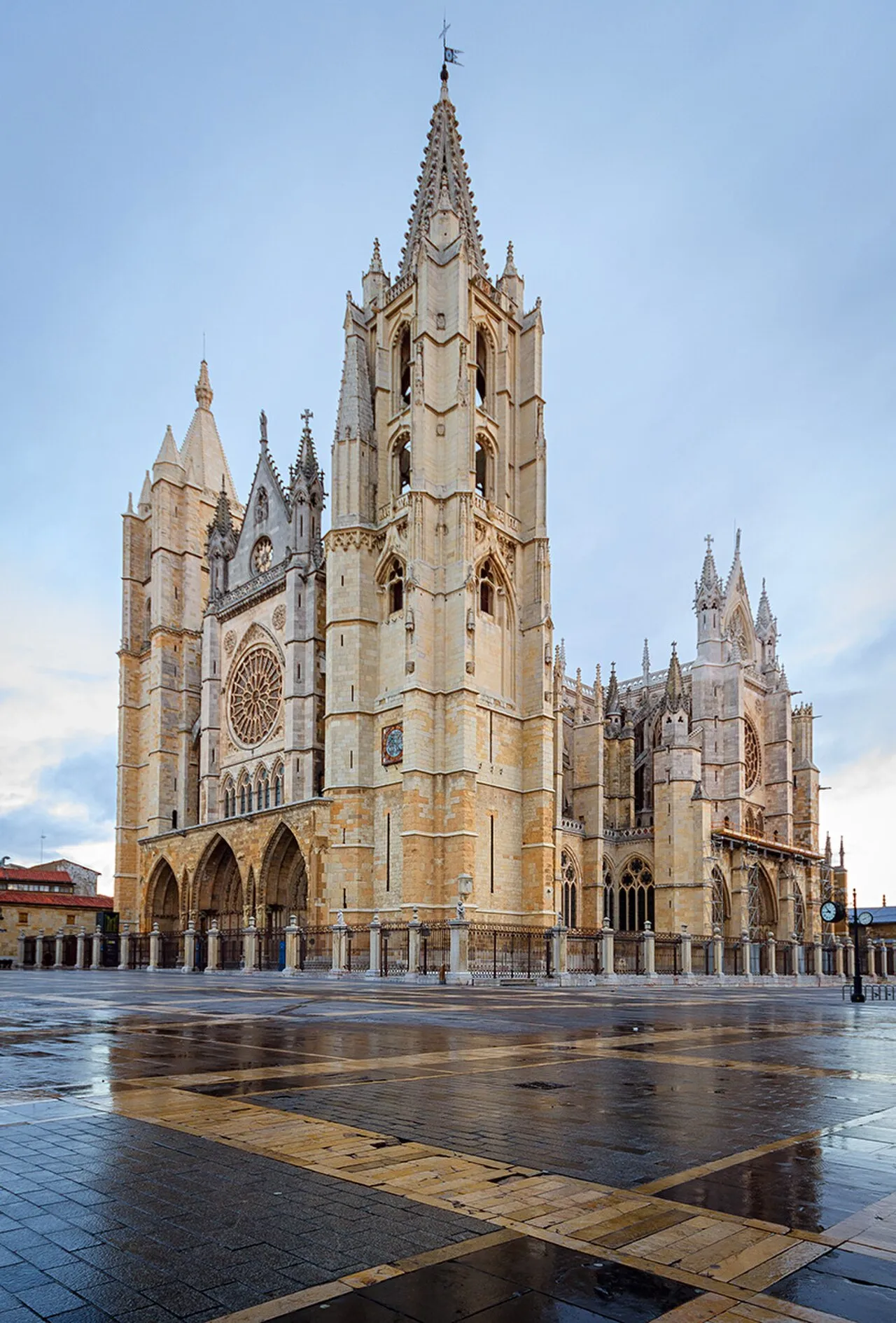
The Pulchra Leonina. Outside, three doorways packed with sculpture, with the Portada del Juicio, the Last Judgement doorway, as the greatest piece, and two towers of different heights and styles because they were finished at separate moments. Step back into the square to take it all in.
The programme is ordered by height. Below, at the level of the chapels and the side aisles, come the subjects closest to the worshipper: local saints, scenes of trades, plant life. At the middle level, the triforium. And above, in the high windows, the great cycles: prophets, apostles, the genealogy of Christ.
That hierarchy has a practical reason as well as a symbolic one: what is closer to the eye can carry fine detail and narrative; what is twenty metres up needs large figures and flat colours to be read at all. The composition changes with the distance it is going to be looked at from.
You should also watch the dominant colour of each area, because it is not accidental. The deep blues of the thirteenth century are not the same as those of later replacements, and in a set that has been repaired for eight centuries, glass from very different periods lives side by side.
And among so many saints, there are surprises. The cathedral holds a window devoted to a hunting scene, with riders and dogs: profane life slipped in among the sacred, something extremely rare for the period and one of the pieces specialists have studied most.
The great rose window of the west gable is the best moment of the day if you go in with the low afternoon sun: the light comes straight in and casts colour across the nave. It is worth working out the hour so as to catch it.
The hour matters more than at any other monument. With high midday light the whole set is seen complete and balanced; with the low afternoon sun, the great west rose window comes straight in and casts colour across the nave, which is the photographic moment. On a cloudy day, much of the effect is lost.
As well as the stained glass, inside there are the choir stalls, among the best of Spanish Gothic, with carvings of a remarkable freedom of subject, and the altarpiece of the main chapel. The Renaissance retrochoir was dismantled and repositioned during the restoration so as not to block the view down the nave, a decision disputed at the time and appreciated today.
The ticket usually includes the cloister and the cathedral museum, with pieces of sculpture, goldsmith's work and codices. And there are specific visits to the windows and to the roofs at certain times of year, which are the best way to see them close up.
Afterwards, five minutes' walk to San Isidoro. The contrast between the Gothic box of light and the half-light of the Romanesque Royal Pantheon is exactly what you should experience on the same day.
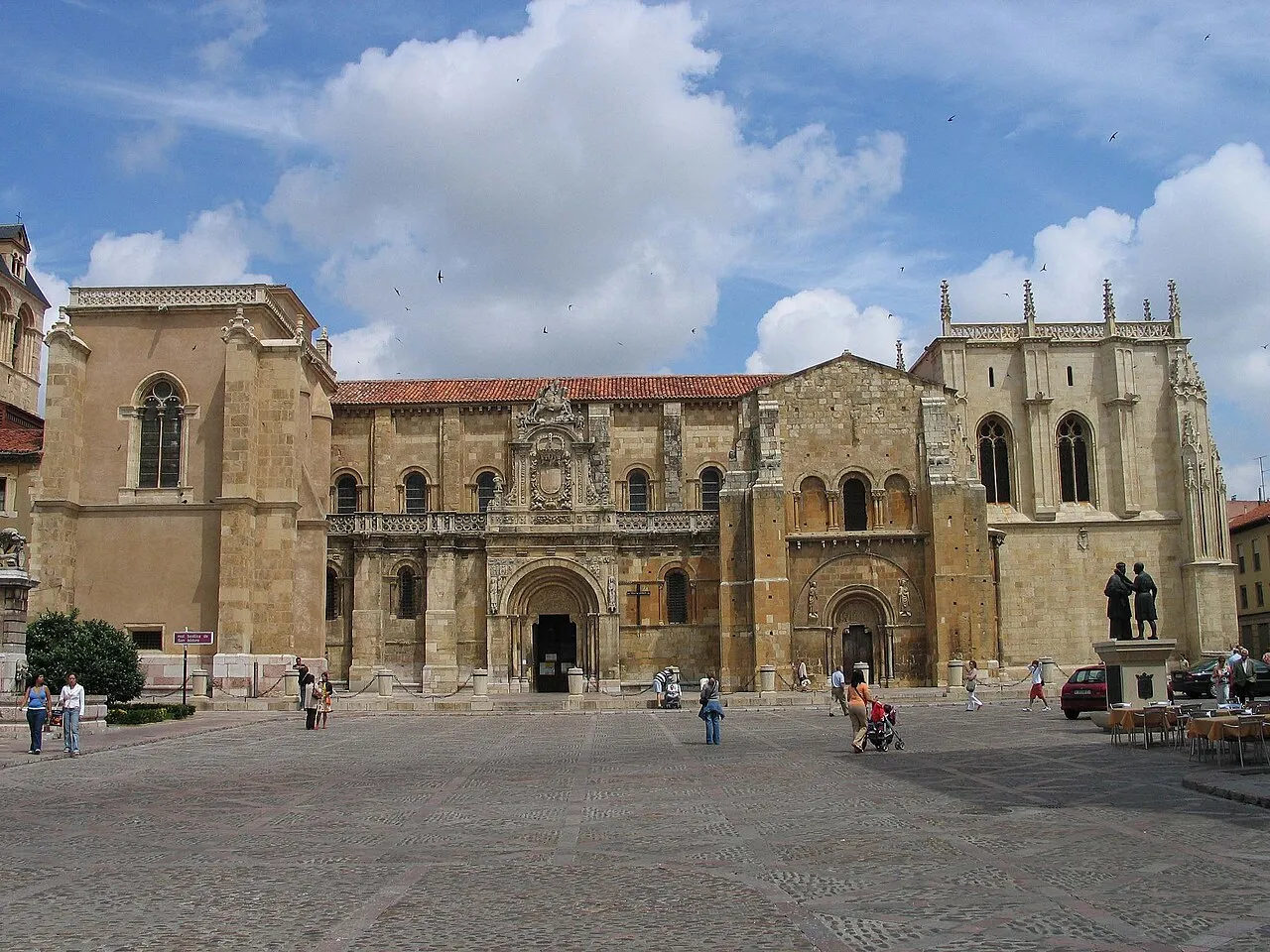
The perfect counterpoint: eleventh-century Romanesque, massive, low and dark, with the Royal Pantheon covered in intact frescoes. Where the cathedral dissolves the wall into glass, San Isidoro keeps it and paints it. Two opposite ways of solving the same thing.
Close to eighteen hundred square metres of glazed surface, with glass ranging from the thirteenth century to much later replacements. It is one of the largest collections of medieval stained glass in the world and the proportion of glass to wall is the highest of any Spanish cathedral.
Why did the cathedral almost collapse?
Because its architects took the Gothic system to the limit: they cut the stone back to the minimum in order to maximise the glass, with a poor-quality local stone and badly resolved thrusts. Serious cracks and deformations appeared as early as the modern period, and in the nineteenth century there was a real risk of collapse.
What time is best to visit?
With high midday light you see the whole set complete and balanced. With the low afternoon sun, the great west rose window comes straight in and casts colour across the nave, which is the best photographic moment. On a cloudy day much of the effect is lost, so it is worth reorganising the itinerary if the weather changes.
How do you read the windows?
By height. Below, in the chapels and side aisles, the subjects closest to the worshipper: local saints, trades, plant life. Above, in the high windows, the great cycles: prophets, apostles, the genealogy of Christ. The composition changes with distance: fine detail below, large figures and flat colour above.
Is it true that there is a hunting window?
Yes, and it is one of the most studied pieces in the set: a hunting scene with riders and dogs, profane life slipped in among the sacred. It was very unusual for the period to find such a subject in a cathedral programme, and that is why specialists have given it so much attention.
What else is there to see inside?
The choir stalls, among the best of Spanish Gothic and with carvings of a remarkable freedom of subject; the altarpiece of the main chapel; and the cloister with the cathedral museum, which is usually included in the ticket and holds sculpture, goldsmith's work and codices.
Practical information
How much glassClose to 1,800 m² of medieval stained glass, one of the largest collections in the world.
Best timeHigh midday light for the whole set; low afternoon sun for the west rose window.
If it is cloudyChange the order of your itinerary. Without sun, much of the effect is lost.
AlsoThe choir stalls, the altarpiece of the main chapel, the cloister and the cathedral museum.
Special visitsThere are specific routes to the windows and the roofs at certain times of year.
AfterwardsSan Isidoro, five minutes away: the Romanesque-Gothic contrast on the same day.
On the map
🎧 With Viavoy
Walk Leon and listen at your own pace
Download Viavoy and walk Leon offline, whenever you like.