The palaces of Cáceres: how to read a city of lineages
Cut towers, forbidden coats of arms, blind walls and storks on the battlements. A guide to understanding what each façade in the walled quarter is telling you.
Inside the walls of Cáceres there are more than twenty noble houses, and at first glance they all look alike: granite ashlar, few windows, a massive air. But every detail of those façades — the height of the tower, the presence or absence of a coat of arms, the type of window — is a statement about a family's standing. Learning to read them turns the walk into something else.
Basic rule: if a tower is sliced off horizontally with no crowning, it is not unfinished. It was cut down by royal order.
The tower: who gave the orders and who obeyed
In the fourteenth and fifteenth centuries the noble families of Cáceres lived in open war with one another. The tower on a house was not decorative: it gave visual reach over the streets, it allowed you to shoot from above and it worked as a permanent signal of power. The taller it was, the clearer the message.
The Catholic Monarchs put an end to that by the direct method. They ordered the city's noble towers to be lopped — that is, cut down — and that is why so many of them today end abruptly, sliced off horizontally with no crowning. That truncated profile, which looks like an oversight, is in fact the mark of state policy.
The exceptions are easy to spot and they tell the other half of the story. The Torre de las Cigüeñas kept its battlements by royal concession to Diego de Ovando, loyal to the Crown, and that privilege made it the tallest tower in the complex, which is exactly what everyone was meant to notice.
The Torre de Sande, the Torre de los Púlpitos and the Torre del Horno complete the catalogue, and you can pick them all out from the street without going into a single building. It is the best way to walk the complex: looking up.
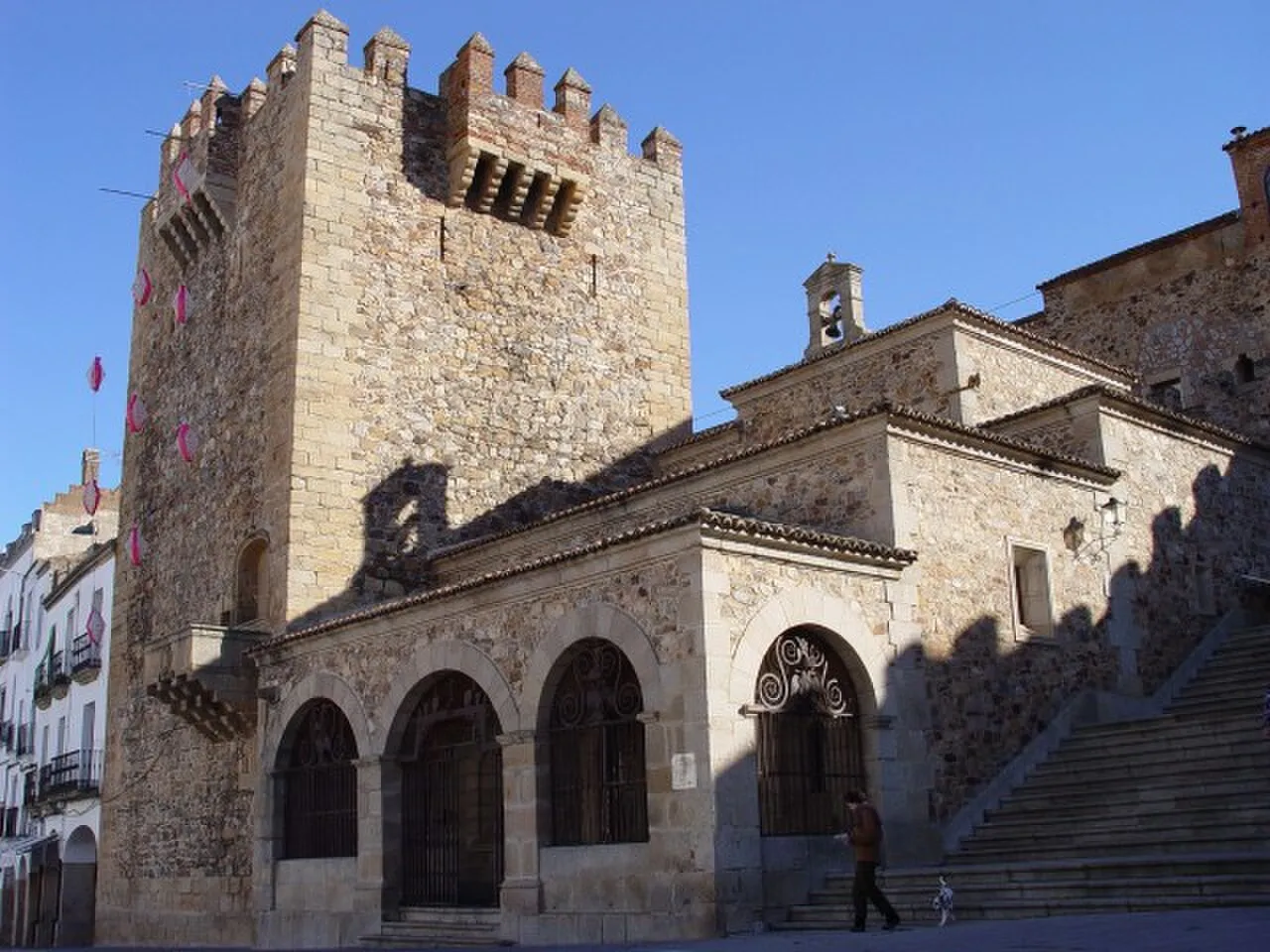
Not a noble tower but a defensive one, Almohad and twelfth century, which is why it keeps its full height. It serves as a benchmark for comparison: earthy rammed earth against the granite ashlar of the palaces. You can climb it, and from the terrace you see the whole forest of towers at once.
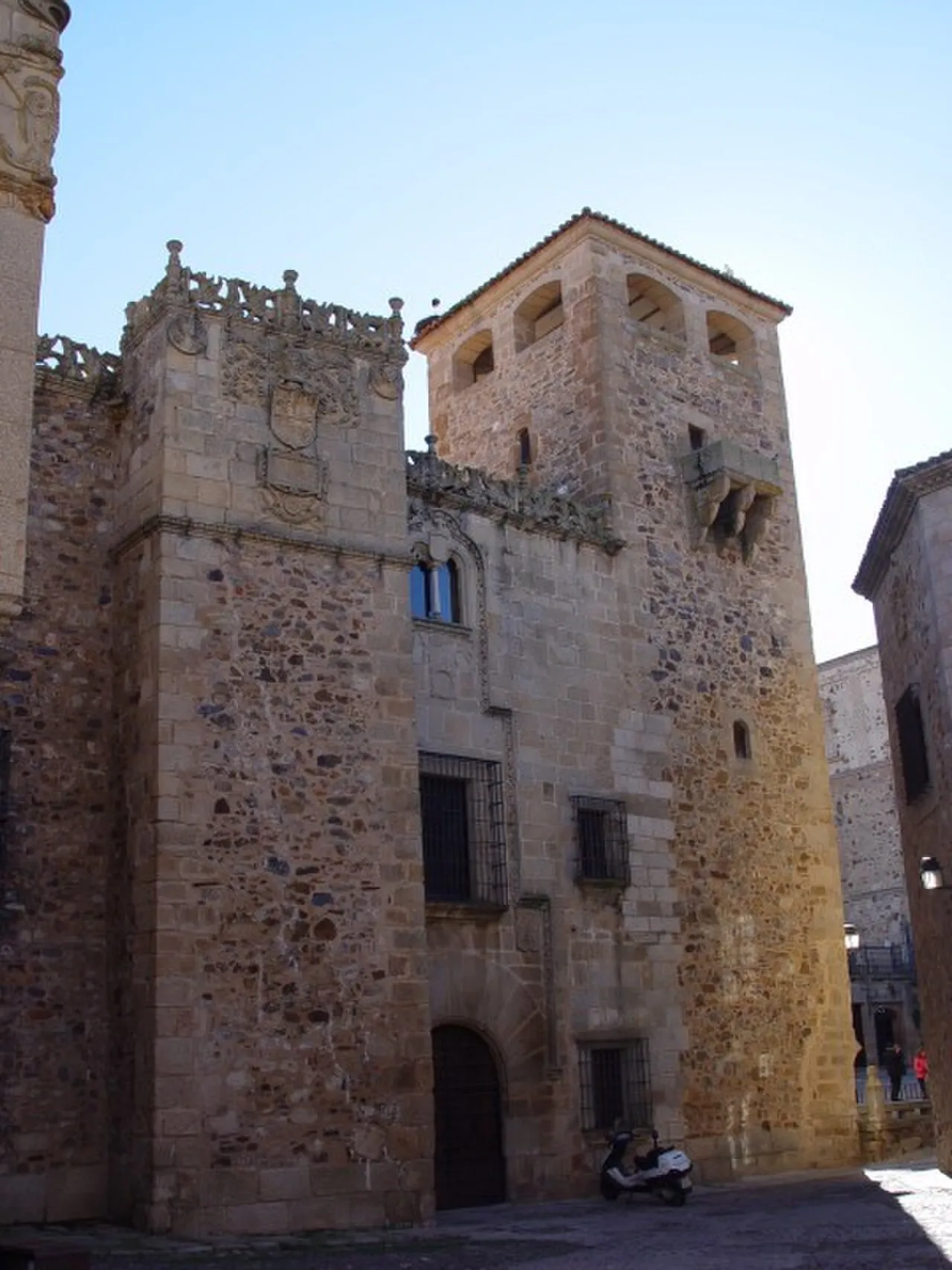
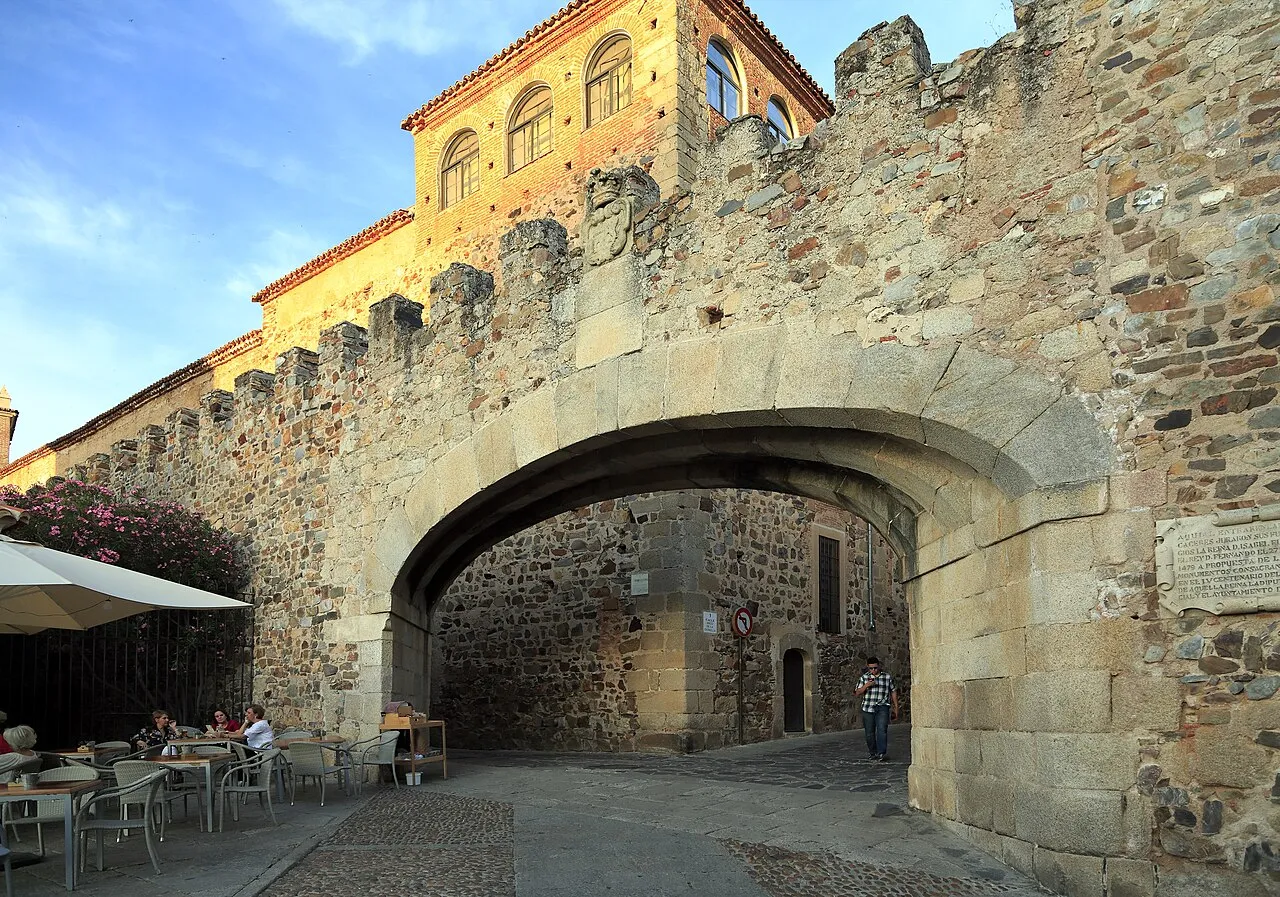
The only one allowed a coat of arms on its façade, by privilege of the Catholic Monarchs. The base is a fifteenth-century fortified house, with tower and machicolations; the crown is an openwork Plateresque cresting full of fantastical animals. Two centuries and two mindsets in the same wall.
Look at the ground floors: they have almost no openings, and the few there are sit small and high up. It is not an aesthetic convention, it is defence. A house that can be stormed by the family across the street does not put windows at street level.
The door is usually a round arch with large voussoirs, sometimes with a coat of arms above it where that was allowed, and the ashlar is rusticated granite in the older buildings. The whole produces that ravine-like street feeling that makes the quarter so recognisable.
From the sixteenth century everything changes. Money from the Americas reaches Extremadura and the same families begin to open wide windows, corner balconies, arcaded galleries along the upper floor and Plateresque decoration. There is no longer any need to defend yourself from the neighbours: now you have to impress them.
The Palacio de Toledo-Moctezuma is the most eloquent case of that stage: it was built by Juan Cano de Saavedra, a conquistador who married Isabel Moctezuma, daughter of the Aztec emperor. A Cáceres house with a Mexican story inside it, and a Renaissance dome visible from half the city.
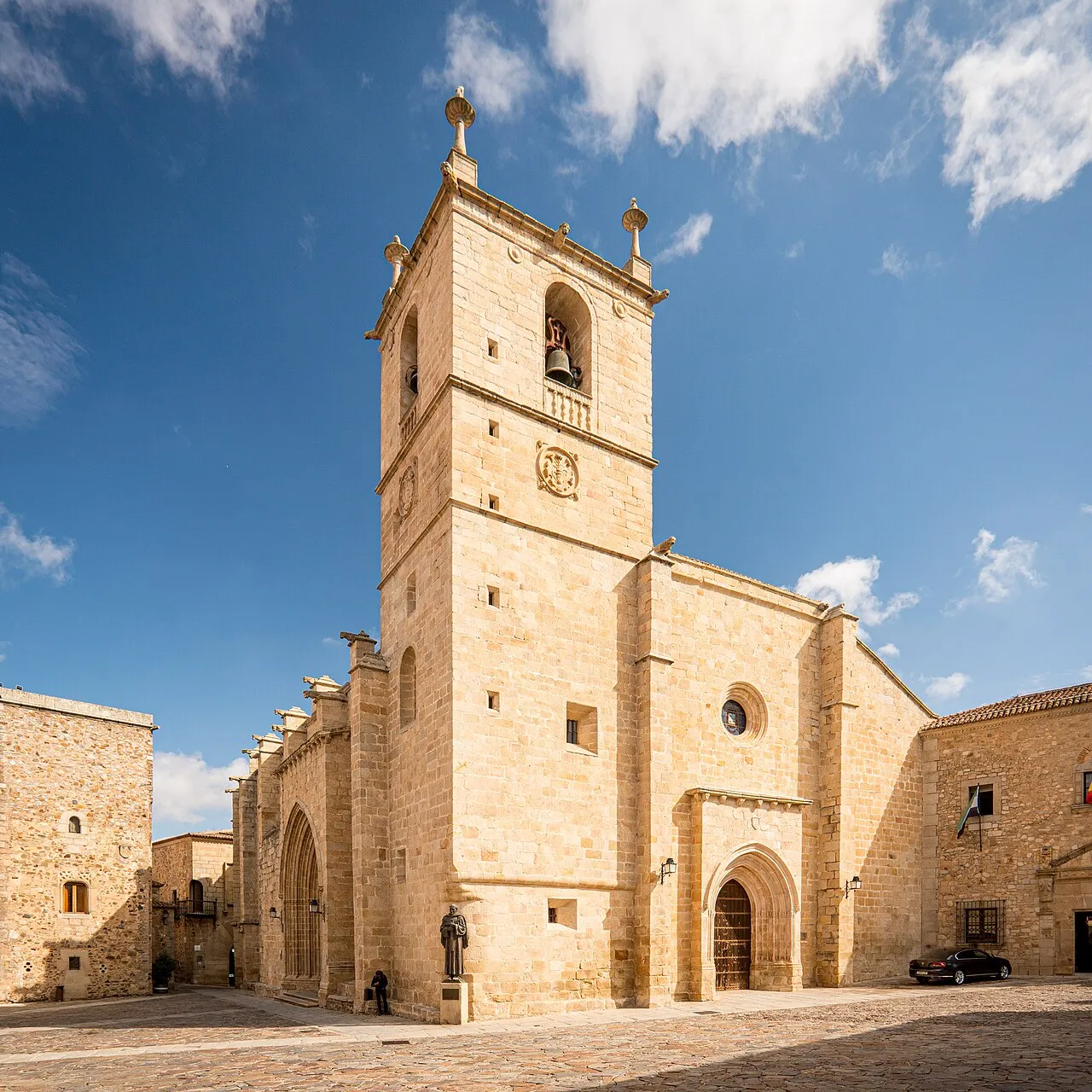
The church shares the same aesthetic as the palaces: granite ashlar, scarce openings, massive volume, more fortress than temple. Climb its tower, because from up there you see the sea of rooftops with the noble towers rising out of it and you grasp the scale of the whole.
Here is the limitation of Cáceres: the vast majority of the palaces cannot be visited. They are still private homes, foundations, institutional headquarters or government offices, and from the street you see only the façade. It is a city to look at from outside.
There are three important exceptions. The Palacio de los Golfines de Abajo, with a full visit: courtyard, noble staircase, the Salón de los Linajes, the tapestry room, the state dining room and the tower. It is the one to do if you only go into one.
The Casa de las Veletas houses the Museo de Cáceres and preserves, in its basement, an Almohad cistern with five aisles on horseshoe arches, one of the best preserved in Spain and probably the most surprising space in the quarter. And the Palacio de Carvajal, an institutional headquarters, opens its courtyards and its round tower free of charge.
With those three and an attentive turn around the façades you cover the essentials. And if you have time left, look for the storks: they nest on the towers and bell towers of the quarter, and their constant presence above the stone is part of the image the city has always given of itself.
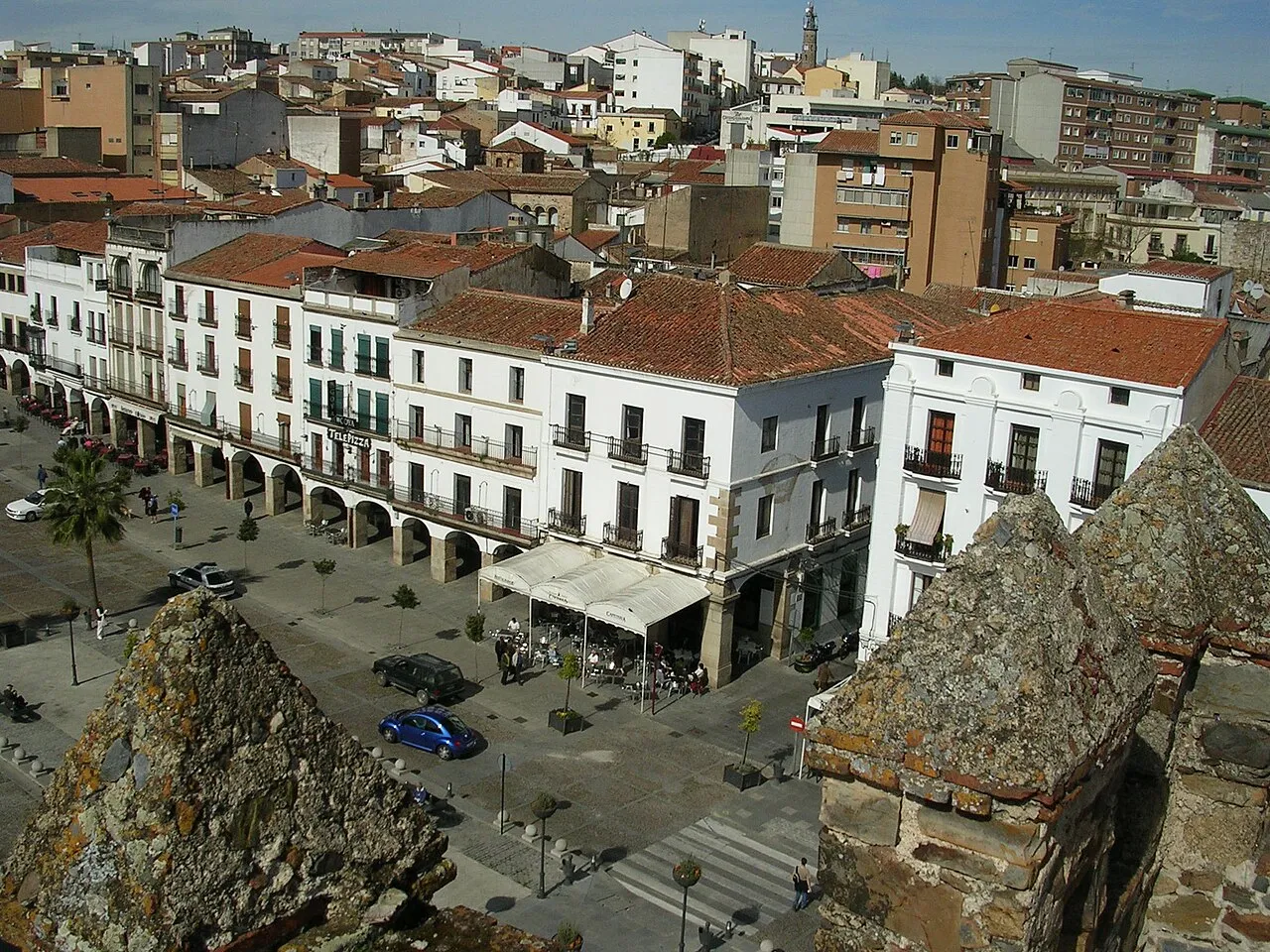
The perfect counterpoint. There are no palaces here but arcades, and that difference explains everything: the nobility lived inside and trade lived outside. Come back at the end of the walk and look at the stretch of wall with the towers rising behind it.
More than twenty noble houses inside the walled quarter, counting both palaces proper and fortified houses with a tower. Most are fifteenth and sixteenth century, and they belonged to the lineages that dominated the city after the Christian conquest: Golfines, Ovando, Ulloa, Carvajal, Saavedra and others.
Why are the towers cut off?
Because the Catholic Monarchs ordered them lopped. The noble towers were not decorative: they gave visual reach over the streets, they were used to shoot from above and they were a permanent signal of power in a city where the lineages lived at each other's throats. Cutting them down was the way to disarm that competition.
Which palaces can be visited inside?
Few. The Golfines de Abajo with a full visit — courtyard, noble staircase, the Salón de los Linajes and the tower — the Casa de las Veletas, which is the Museo de Cáceres and preserves an extraordinary Almohad cistern, and the Palacio de Carvajal, an institutional headquarters that opens its courtyards and round tower free of charge.
Why do the ground floors have almost no windows?
For defence. A house that can be stormed by a rival lineage does not open holes at street level, so the few openings are small and set high. From the sixteenth century, with money from the Americas and peace between the families, wide windows, corner balconies and arcaded galleries begin to appear.
What is the Palacio de Toledo-Moctezuma?
The house built by Juan Cano de Saavedra, a conquistador from Cáceres married to Isabel Moctezuma, daughter of the Aztec emperor. It is the most eloquent example of the city's Renaissance turn, with a dome visible from half the city, and a Mexican story grafted into the heart of a medieval Extremaduran quarter.
Why are there so many storks?
Because the towers and bell towers of the quarter are ideal nesting platforms: high, stable and undisturbed, in an area of dehesa pastureland with plenty of food. Their presence is so constant that it forms part of the image of the city, and one of the towers in the quarter is called precisely the Torre de las Cigüeñas.
Practical information
How to look at themUpwards. The tower, its height and whether it has been cut is what tells you most.
Lopped towersCut down by order of the Catholic Monarchs to disarm the feuding lineages.
The exceptionThe Torre de las Cigüeñas, which kept its battlements by royal concession to Diego de Ovando.
Coats of armsOnly the Golfines de Abajo had permission to display one on the façade.
Open to visitorsGolfines de Abajo (full visit), Casa de las Veletas (museum and cistern) and Palacio de Carvajal (free).
The restPrivate homes, foundations or private headquarters. Seen only from outside.
On the map
🎧 With Viavoy
Walk Caceres and listen at your own pace
Download Viavoy and walk Caceres offline, whenever you like.
from 3,99 €· one-off payment
City Pass · 9,99 €3 days, all the tours in Caceres